
Abstract:
The global energy landscape is undergoing a change that many analysts had not expected. Solar power has expanded rapidly over the past decade and will slightly surpass nuclear power in global annual electricity production for the first time in 2025. Entering 2026, this gap will further widen. According to data analysis by energy think tank Ember, global solar power generation has been approximately 13% higher than nuclear power in the past 12 months to September 2026. Once seen as a supplement to traditional energy sources, solar energy is now becoming one of the fastest growing forces in the global electricity supply.
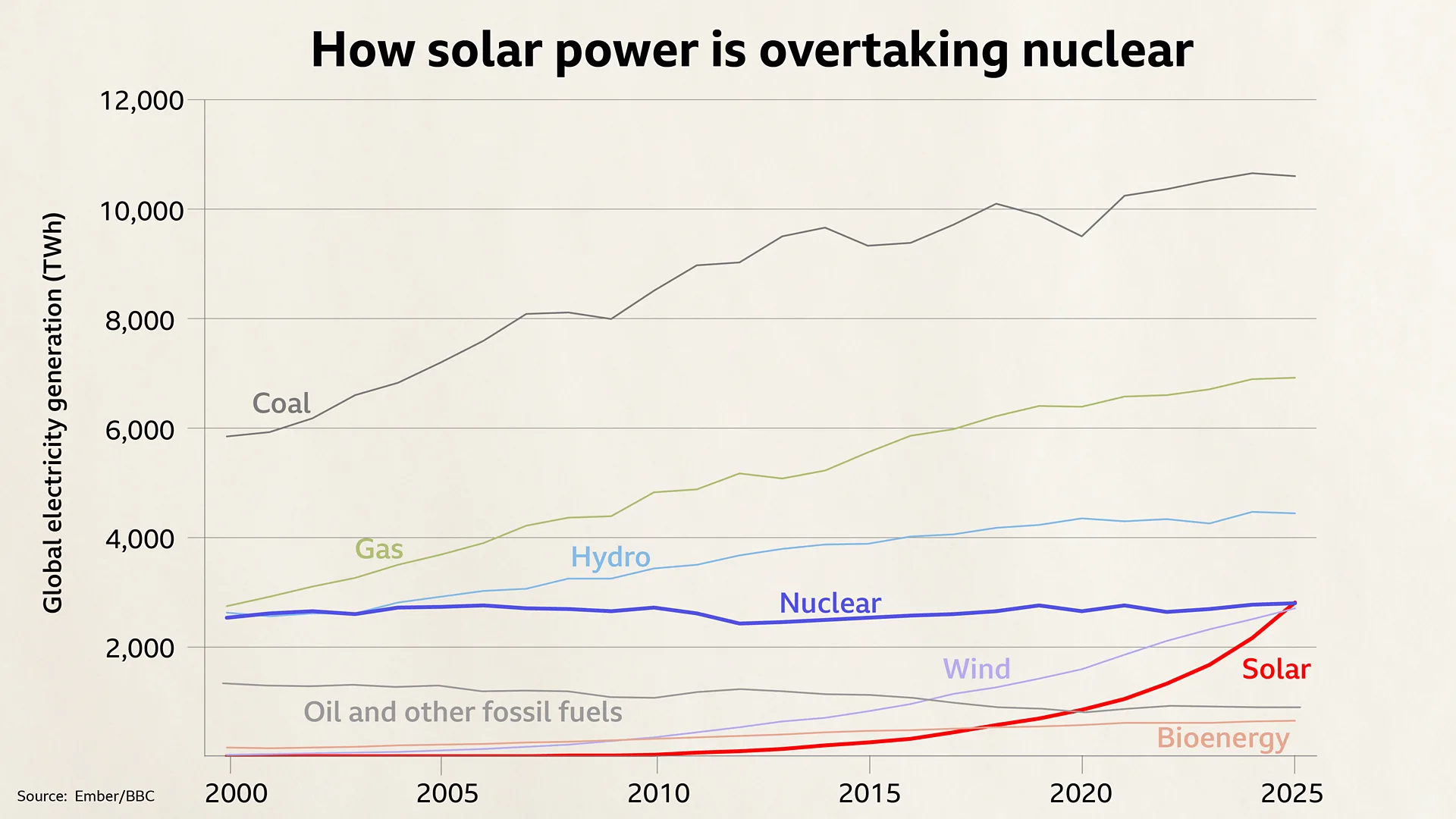
Ten years ago, solar energy accounted for only about 1% of global electricity supply. At the time, nuclear power produced about ten times more electricity than solar power, and wind power was clearly ahead of solar power. However, as the price of photovoltaic modules continues to fall, the scale of manufacturing continues to expand, and energy storage technology gradually matures, the growth rate of solar energy far exceeds the previous forecasts of many institutions.
According to Ember data, global solar power generation will reach approximately 2,778 terawatt hours in 2025, a year-on-year increase of 30%. Not only did solar energy become the world's fastest-growing major source of electricity, it also met approximately three-quarters of the world's new electricity demand that year. Meanwhile, overall nuclear power generation has changed relatively little since 2000, while solar power has grown thousands of times over the past two decades.
Jan Rosenau, an expert on energy and climate policy at Oxford University, believes that solar energy has become a core driving force in the global energy transition. In the past, some mainstream energy forecasts often assumed that solar energy would grow at a relatively linear rate and module prices would only decline slowly. However, the reality is that technological progress and manufacturing scale effects are superimposed on each other, making the development speed of solar energy continue to exceed expectations.
The most direct reason for the rapid expansion of solar energy is that the cost has dropped significantly. As photovoltaic technology matures, the conversion efficiency of solar cells continues to increase, and the amount of materials such as silicon and silver required to manufacture each module is also reduced. At the same time, China's huge photovoltaic manufacturing industry chain has promoted the continuous expansion of production scale, and market competition and overcapacity have further depressed module prices.
Ember co-founder David Jones pointed out that between 2023 and 2024, the price of photovoltaic modules has dropped significantly, bringing solar energy into a new stage of extremely low cost. Today, an ordinary photovoltaic module costs less than $100 and can continue to generate electricity for 30 to 40 years under appropriate conditions, with little additional fuel input during operation.
This is in sharp contrast to traditional coal-fired and gas-fired power generation. Traditional power plants need to continue to purchase fuel and bear the costs of transportation, storage, and price fluctuations; solar power plants mainly invest funds in the early stages of construction, and subsequent power generation costs largely depend on factors such as equipment maintenance, land, financing, and grid connection. The economic appeal of solar energy is particularly evident in areas with high electricity prices and unreliable fuel supplies.
China plays a key role in this process. China is not only the world's largest solar market, but also a major manufacturer of photovoltaic modules, cells and related equipment. Huge production capacity has lowered global photovoltaic product prices, allowing more and more countries to build solar power plants at lower costs.
Although the growth rate of new domestic solar installations in China may be starting to slow down, low-priced modules made in China are still flowing to overseas markets in large quantities. For many developing countries, imported photovoltaic equipment is easier to start up than building large traditional power plants and is more conducive to rapidly expanding electricity supply.
The United States remains the second largest solar market in the world. Despite tariffs and other restrictions imposed by the U.S. government, solar installations continue to grow. Relevant researchers at the University of Maryland pointed out that trade barriers and policy restrictions may increase the cost of photovoltaics and slow down the installation speed, but the economic advantages of solar energy itself are still strong. In many areas, new solar installations remain one of the cheapest options for increasing electricity supply.
India is also accelerating the development of solar energy. Solar energy has met about 60% of India's new electricity demand over the past two years. In Australia, more than 4 million households have installed rooftop solar systems, accounting for more than one-third of the country's total households. Solar energy is no longer limited to centralized power stations built by large power companies, but has gradually become an energy facility that households and businesses can deploy on their own.
In countries such as Pakistan, Lebanon and Nigeria, the popularity of solar energy is closely related to the instability of traditional power supply. In some areas, power grid coverage is insufficient, and residents and businesses have long relied on diesel generators to maintain power supply. When international oil prices rise and diesel costs increase, solar power becomes an increasingly attractive alternative.
Pakistan is a typical case. In 2019, solar energy accounted for less than 2% of the country's electricity supply, but now it has reached about 24%. Expensive and unstable grid electricity prices, coupled with cheap photovoltaic modules imported from China, have driven a large number of households and businesses to install their own solar systems. Rather than waiting for the government to build large power plants or expand the capacity of the power grid, residents can directly invest in rooftop photovoltaics and quickly reduce their dependence on traditional energy sources.
However, there is an unavoidable limitation of solar power: it can only produce electricity when the sun is shining. Even if the price of photovoltaic modules is low enough, without suitable energy storage and grid systems, it is difficult for solar energy to independently meet the demand for around-the-clock electricity.
Advances in battery technology are changing that. As battery costs fall, more and more solar power stations are equipped with energy storage facilities to store excess power generated during the day and release it in the evening or night. Energy experts point out that in sunny areas, a combination of solar and energy storage can already compete economically with new fossil fuel power plants.
Electricity data from California, USA, provide an example. In the first half of 2026, local solar and battery energy storage systems met an average of more than a quarter of the electricity demand during the peak electricity consumption period of 7 pm to 9 pm. This means that the role of solar energy is no longer limited to power generation at noon, but has begun to affect the power supply structure of the entire power grid through the energy storage system.
However, batteries mainly solve the problem of power transfer within a day. Longer-term energy storage technology, cross-regional grid connections and other dispatchable power sources will still be needed to cope with continuous rainy weather, seasonal changes or long winters. Energy systems cannot rely solely on installing more solar panels; they must also be accompanied by the creation of infrastructure that can absorb and distribute power.
Global electricity demand is changing as electric vehicles spread, industrial production electrifies, and artificial intelligence data centers increase. Solar energy can provide low-cost power for these new loads, reducing reliance on coal, natural gas and oil. However, if the growth rate of power demand exceeds the speed of grid expansion and energy storage construction, the rapid development of solar energy may also encounter new bottlenecks.
Electrification alone will not automatically make energy systems more resilient without planning, energy expert Julia Suder points out. A large number of new electricity loads may make the power grid more vulnerable if it lacks flexible dispatch capabilities. Today, the main constraints facing the solar industry have gradually shifted from photovoltaic module prices and manufacturing capabilities to grid construction, energy storage deployment, and power demand management.
Meanwhile, photovoltaic technology itself continues to evolve. Balcony solar systems, which have been rapidly popularized in Germany in recent years, allow residents to directly provide part of the power for their homes through small photovoltaic modules and connect to the household electricity system through ordinary sockets. Although the power generation of this type of equipment is much lower than that of large rooftop systems, it lowers the threshold for ordinary residents to participate in the energy transition.
The model that combines agriculture with photovoltaics is also receiving attention. In some areas, farmers can continue to grow crops or graze livestock under solar panels, thereby reducing the single occupation of land by photovoltaic power plants. Some solar farms in the United States already allow sheep to graze between photovoltaic panels, helping to control grass growth and allowing the land to continue to generate agricultural income.
In addition, floating solar power stations, solar facilities that use mirrors to concentrate light, perovskite photovoltaic cells, and solar windows that can generate electricity may all expand their application scope in the future. They may not immediately replace traditional crystalline silicon modules, but they are expected to allow solar energy to enter more environments where it would otherwise be difficult to install large photovoltaic panels.
Despite its strong development momentum, the growth rate of new solar installations may slow down for the first time in 2026. The main reason comes from China. China adjusted the price mechanism and support policies for new energy projects in the summer of 2025, prompting a large number of projects to be constructed in advance to complete grid connection before the end of the old policy. This concentrated construction overdrafted some of the demand for the following year to a certain extent.
However, excluding the Chinese market, solar modules installed in other parts of the world in 2026 may still exceed the level of the same period last year. This means that solar energy growth is not entirely dependent on China's domestic market, but is spreading to more countries and regions.
The International Energy Agency predicts that by 2030, global solar power generation may double that of 2025, surpassing hydropower around 2029, and becoming the world's third largest source of power generation, second only to other larger power sources. As solar energy continues to expand, the global electricity mix is also likely to further shift away from coal and other fossil fuels toward low-carbon energy sources.
The rapid rise of solar energy does not mean that nuclear power has lost its value. Nuclear power can continuously provide low-carbon electricity without relying on sunlight, and can also assume the task of stabilizing power supply in the power grid. Nuclear power is still likely to receive new investment in some countries as artificial intelligence data centers and industrial electrification drive up electricity demand. Comparing the power generation capacity of solar energy and nuclear power reflects the different development trajectories of the two technologies, rather than one energy source necessarily replacing the other.
What has really changed is the economic logic of the energy industry. Ten years ago, many countries still regarded solar energy as an alternative energy source that required policy subsidies to develop; now, low module prices and continuously improving energy storage technology have made solar energy one of the most competitive new power sources in an increasing number of markets.
The risks posed by climate change are still increasing, and the world is increasingly likely to exceed the 1.5 degrees Celsius warming limit proposed by the Paris Agreement. However, solar’s rapid growth also illustrates that progress in the energy transition can sometimes exceed even the most optimistic forecasts. The continued expansion of clean electricity has reduced the demand for new coal power projects in some regions.
Whether solar energy can continue to maintain rapid growth in the future will depend on whether countries can build power grids, energy storage systems and flexible power market mechanisms in a timely manner, as well as whether photovoltaic equipment trade can remain smooth. Solar panels themselves have become increasingly cheaper, and the real hard question is turning to how to convert large amounts of low-cost, intermittent solar power into a stable and reliable supply of energy around the clock.
Comments