
Abstract:
Crusoe, an American AI data center company, recently confirmed that it has terminated its previously high-profile energy cooperation plan and will no longer purchase new natural gas turbine power generation equipment developed by Boom Supersonic. This means that the cooperation project between the two parties, which once amounted to US$1.25 billion, has officially come to an end, and it has also temporarily shelved an innovative energy solution in the field of AI infrastructure.
Crusoe, headquartered in Denver, USA, was originally founded in 2018 and is famous for its use of excess natural gas in oil fields for Bitcoin mining. In recent years, the company has shifted its business focus to the construction of artificial intelligence data centers and has rapidly grown into one of the most active AI infrastructure developers in the United States. Among them, the large-scale data center park located in Abilene, Texas has become one of OpenAI’s important sources of computing power.
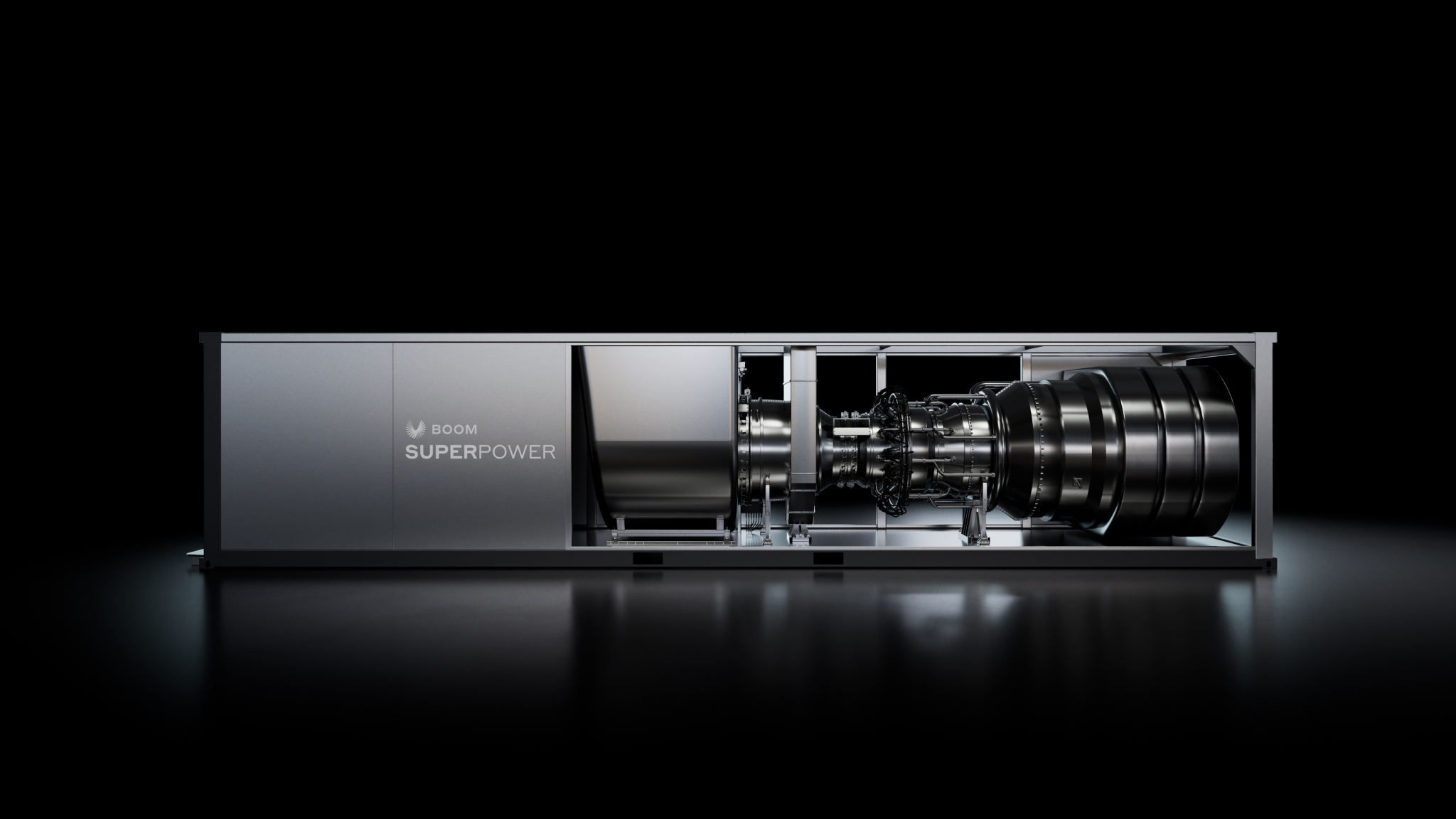
Boom Supersonic, another Denver company, is famous for developing the supersonic passenger aircraft "Overture". In order to expand its business and create new sources of income, Boom previously decided to expand the aero-engine technology it is developing into the energy field and launch a stationary natural gas power generation system called "Superpower".
According to Boom's design, the Superpower turbine shares about 80% of its core components with the "Symphony" aeroengine it is developing. The company hopes to generate revenue from data centers and energy markets while providing financial support for future supersonic passenger aircraft projects.
Last year, Crusoe became the first major customer in this business. According to the agreement reached at that time, Crusoe planned to spend US$1.25 billion to purchase 29 Superpower turbines, each with a power generation capacity of 42 MW, and a total installed capacity of more than 1.2 GW. According to the original plan, the first batch of equipment will be delivered in 2027.
However, this project, which was regarded as a model of innovative energy cooperation in the AI era, ultimately failed to advance.
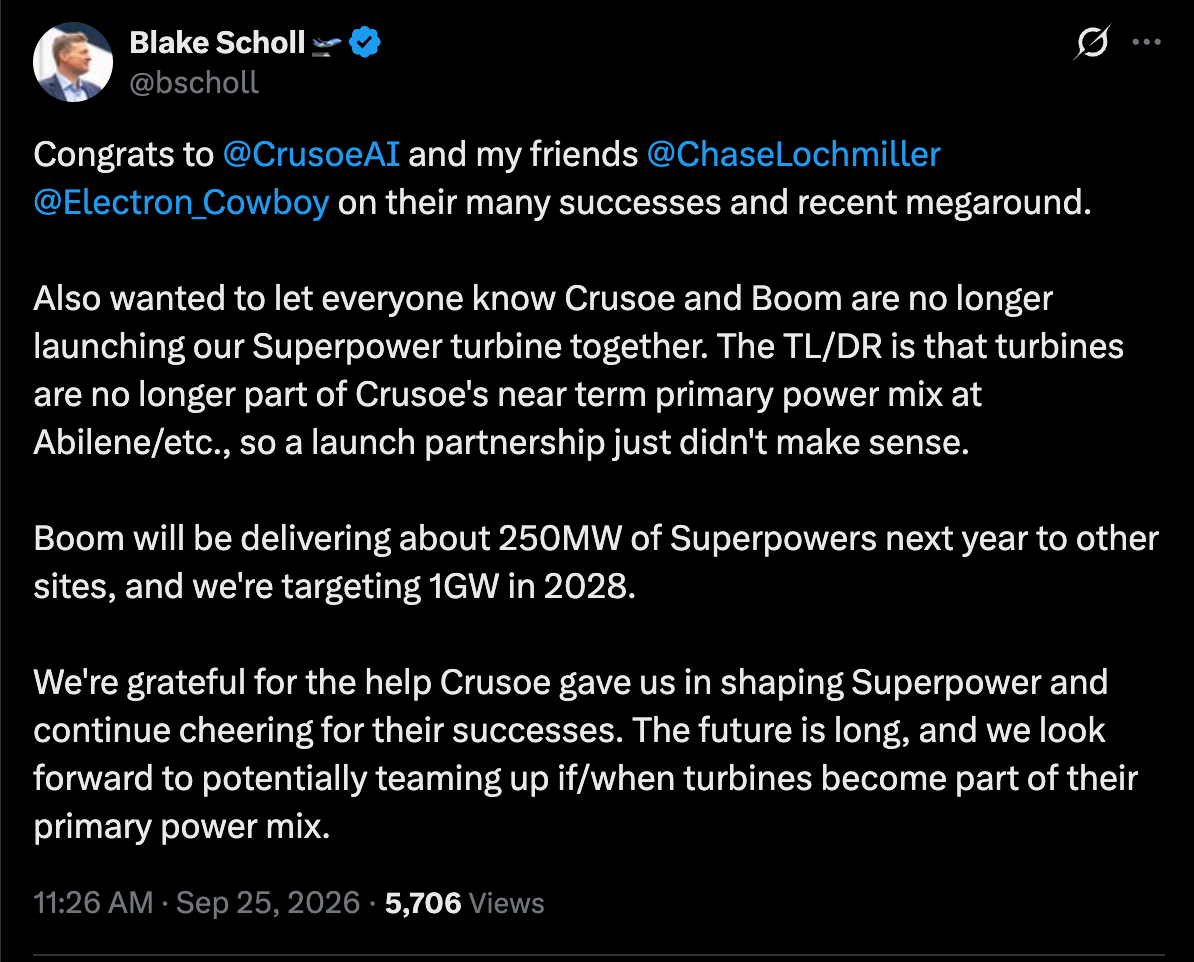
Boom Supersonic CEO Blake Shore recently posted on social platforms to confirm that the two parties have decided not to proceed with the turbine launch cooperation plan. He said that Crusoe currently does not list turbines as part of its main power supply solution in the near future, so the two parties have lost the realistic basis for continuing the first cooperation.
Despite the end of the partnership, Shore expressed his gratitude to Crusoe. He said that Crusoe provided important help in the research and development process of Superpower products, and the company will continue to pay attention to Crusoe's future development. If Crusoe re-integrates turbines into the main power supply system in the future, the two parties may still resume cooperation.
According to the information disclosed by Boom, the company has not given up its energy business as a result. Boom expects to deliver approximately 250 MW of Superpower generation equipment to other customers next year, and plans to achieve a total deployment target of 1 GW in 2028.
Crusoe also confirmed that the business relationship between the two parties has ended.
A company spokesperson said that Crusoe is building new AI computing parks across the country and continues to explore various energy solutions. As the project continues to expand, the company needs to remain flexible enough to choose the most appropriate power supply method based on the actual needs of different locations.
According to Crusoe, its energy portfolio will include turbines, wind power, solar energy, battery energy storage systems and traditional grid power supply in the future. However, for now, the solution provided by Boom is not the most suitable choice for the current stage of development.
Industry analysts believe that the termination of this cooperation also reflects the practical challenges faced in the construction of AI infrastructure.
As the demand for artificial intelligence training and inference grows rapidly, the demand for power in large data centers has reached unprecedented levels. In order to obtain reliable power supply, technology companies and infrastructure operators are trying various innovative solutions, including natural gas power generation, small modular nuclear reactors, wind power, photovoltaics and energy storage systems.
However, there is still a huge gap between concept and commercialization. Even with innovative technology and sufficient financial support, new energy solutions still need to face issues such as construction cycle, cost control, supply chain maturity, and actual customer needs.
The failure of the cooperation between Crusoe and Boom reflects that although the AI energy market is full of opportunities, solutions that can truly meet the needs of ultra-large-scale data centers still need to undergo rigorous commercial and technical verification. For Boom, losing its first large customer is undoubtedly a setback; for Crusoe, it means that its AI data center expansion plan will continue to rely on a more mature and flexible power supply system.
Comments