
Abstract:
In August 2026, Mercedes-Benz and BMW successively released short videos, pointing to the same question in different ways: is a car drawn or verified? In the Mercedes-Benz short film, a car drives out of the box dragged by the mouse, and the text on the screen gets to the point: "What is framed is the car. What is measured is the strength."
Crash cars are not the inevitable cause of the Death Valley for new cars, but when actual vehicle verification is replaced by simulation data, necessary tests are deleted, and consumers passively become test drivers, speed changes from competitiveness to the accelerator of Death Valley
BMW China started with a seemingly absurd test scene, then cut into the company's real collision laboratory and wind tunnel facilities, and ended with one sentence: "It is not BMW without hard-core baptism." The two traditional luxury brands jointly targeted what the industry calls "crash cars", that is, models that compress the development cycle, cut out the actual vehicle verification process, and rush to the market.
The speed of new car supply in China's auto market provides the most direct footnote to this controversy. Full-scale data from Bitauto's vehicle database shows that in the first half of 2026, a total of 576 new car models were launched in domestic passenger cars, involving 1,731 models, with an average of more than 3.3 models launched every day. The statistical caliber of the car expert is wider. After taking into account annual facelifts, configuration derivatives and limited edition cars, the number of new cars launched in China from January to June this year exceeded 600, with an average of more than 100 models per month.
The vehicle development cycle has been compressed from more than 36 months, which was common in the era of traditional fuel vehicles, to about 18 months today, and some new brands even approach 12 months. Speed brings not only efficiency, but also the continuous squeeze on the verification system and quality bottom line. Li Shufu, chairman of Zhejiang Geely Holding Group, publicly stated at the 2026 China Automobile Chongqing Forum that cars are related to human lives, and "cars cannot be produced with the concept of short, flat and fast." Li Fenggang, general manager of Beijing Hyundai, bluntly stated at the 2026 China Automobile Forum that some brands have deleted necessary tests in pursuit of speed to market, and "consumers have become test drivers."
What is even more alarming is that the speed of new releases has not translated into lasting market returns. Li Bin, the founder of NIO, previously proposed that the industry is falling into the "death valley of the new car effect". The short-term popularity of new products has significantly accelerated, and huge R&D investments are difficult to realize long-term market value. Wei Jianjun, chairman of Great Wall Motors, made it clear that cars are durable consumer goods and are not suitable for fast-moving consumer goods. "Blindly accelerating product iterations and overdrafting brand trust is killing the goose and taking the egg."
Is "fast" an efficiency revolution or a quality compromise? How far is the gap between fast cars and the Death Valley of new cars? The answer may be more complicated than "necessary" or "accidental."
The battle for express cars: outside of time, see if the process has shrunk
There is still no unified answer in the industry to determine whether a car is "quick". The starting point of the dispute is a seemingly simple question: a development cycle of 36 months is considered normal, and 18 months is considered quick, but what about 24 months?
The answer given by Lu Fang, chairman of Lantu Automobile, is that time itself is not enough as a criterion. The key, he believes, is whether the vehicle has gone through all required verification processes. "If a car goes against the rules, cuts corners, and cuts tests during development, it is a crash car; but if it has a shortened cycle but meticulously completes every test in regulations and industry standards, then it should be called a 'high-efficiency car.'"
This judgment is not Lu Fang’s alone. Corporate executives who hold similar views generally believe that the reuse of platform architecture, modular development, and improvements in simulation testing capabilities have made it possible to speed up development, and this speedup does not necessarily come at the expense of verification quality. In Lu Fang's words, "This is an efficiency revolution, not a quality compromise."
Lu Fang also expressed a level of concern. He believes that there is indeed a tendency in public opinion to use the label "quick car" to deny the overall progress of China's new energy vehicles and new power brands. He said bluntly: "One issue I am particularly worried about is that there are always some comments saying that this is a 'crash car' and labeling China's new energy vehicles and new power vehicles. I think this is not very good. We still have to judge objectively." In his view, judging whether a car is a "crash car" depends on whether the testing, analysis, simulation calculations and simulations that should be done during the development process are completed one by one. Lantu's approach is to parallel simulation and actual vehicle verification. Engineers continue to conduct actual vehicle tests in Turpan, Kunlun Mountain, Yakeshi and other places every year. "Time is not the only criterion, it is important to verify whether the process is complete."
But information from the front lines of R&D and supply chains presents another side. Some industry insiders said that some car companies' reliance on simulation testing in the verification process has exceeded the reasonable range. One mentioned case is that a new energy vehicle company tested new car door handles for a total of 10,000 times, of which only 2,000 were physical tests and the remaining 8,000 were all completed by simulation. A person in the industry chain said that this situation is not uncommon. "Some car companies only do 20% of real tests, and the remaining 80% of tests rely on simulation tests."
Deletions during the verification phase are more subtle. Li Fenggang pointed out that vehicle development verification is divided into two stages: DV (design verification) and PV (mass production verification), and the two are irreplaceable. DV verifies whether the design plan is feasible, and PV verifies whether mass production molds and production lines can stably output qualified products. His warning is: "Deleting any link will result in poor production consistency and large quality fluctuations." However, according to feedback from many parties, DV random testing, PV simple testing, and even skipping some extreme working conditions tests have become a means for some car companies to shorten the time to market.
Li Jun, executive director of SAIC Volkswagen’s Volkswagen brand marketing business, gave a more direct explanation. He said that the pace of research and development can be accelerated, but verification cannot completely replace time with technology. Metal fatigue, rubber aging, battery cycle charging and discharging, and vehicle durability are all items that "cannot be saved for even a minute, let alone replaced by AI simulation." He also warned that if this time is omitted, problems such as chassis rust, suspension breakage, and abnormal noise in the interior will be exposed in three to five years.
Li Xueyong, executive vice president of Chery Automobile, also expressed a similar position, but with a different focus. He acknowledged the outside world's criticism of Chery's slow car manufacturing, but did not shy away from this pace. He believes that cars are not fast-moving consumer goods. They are related to the safety of millions of families and must withstand the test of different road conditions, climates and usage habits around the world. He attributed Fengyun T7's four-year development cycle to three "cannots": R&D cannot be fast, and the product needs to be polished repeatedly; verification cannot be fast, and reliability requires real-life scenario testing; global user co-creation cannot be fast, and the voices of different markets need to be heard. "We really don't dare to save some time."
However, the current national standard does not impose mandatory requirements on the ratio of simulation testing to real road testing, and only stipulates the minimum test mileage for fuel vehicles and new energy vehicles. Key parameters such as the number of prototype vehicles and the frequency of testing fall within the scope of corporate internal control. This means that as long as the new car can eventually pass the standards, there is no clear institutional obstacle to the practice of "as soon as a vehicle passes, the project passes" during the testing process.
Therefore, the core risk of a crash car is not that the development cycle has changed from 36 months to 18 months, but that the verification process has been substantially compressed. When platformization and simulation technology are used to accelerate "complete verification", they are efficiency tools; when used to cover up "incomplete verification", they become risk transfer mechanisms. The boundary between the two is often clear only within the company.
How did triple pressure create a crash car?
The emergence of express vehicles should not be reduced to a moral issue for a certain company or a certain decision-maker. It is a collective behavior pattern formed by an industry under the superposition of multiple pressures. To understand this model, we need to return to the three levels of market structure, profit distribution and technical tools.
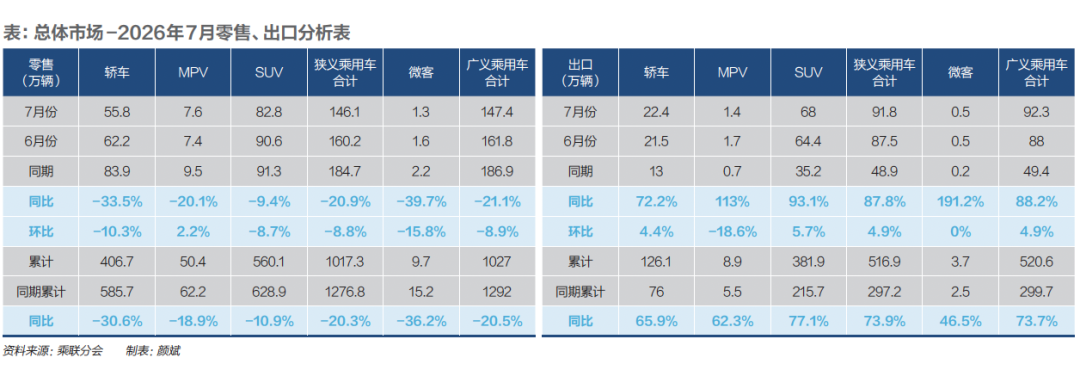
Let’s first look at the market structure. Data from the China Automobile Dealers Association Passenger Car Market Information Joint Branch (Passenger Car Association Branch) show that in July 2026, the national passenger car market retailed 1.461 million units, a year-on-year decrease of 20.9%; from January to July, the cumulative retail sales of 10.173 million units, a year-on-year decrease of 20.3%. The contraction of total market volume has been going on for some time. Some experts said that the domestic auto market has now entered the stock game stage, and the "crash car" controversy is a direct manifestation of the high-intensity involution of domestic automobiles.
In the existing market, one of the means to maintain sales growth is to speed up the introduction of new products. But the problem is that the market popularity of new cars is shortening. Companies are not unaware of this logic, but when the pressure on market share is strong enough, short-term behavior often overwhelms long-term judgment. This also explains why the two seemingly contradictory phenomena of "attenuation of the new car effect" and "acceleration of new car introduction" coexist at the same period.
Look at the profit structure. Chen Shihua, deputy secretary-general of the China Association of Automobile Manufacturers, revealed that the profit margin of automobile manufacturing has dropped to 1.5%. At this level, for a new car worth 100,000 yuan, the OEM’s profit is only 1,500 yuan. As a reference, the vehicle manufacturing profit margin will remain at 5% in 2023, which has shrunk by 70% in three years.
The sharp narrowing of profit margins has made reducing R&D and verification costs a "should not do" to a "must do" for some companies. Analysis by Zhang Yongwei, chairman of the Auto Baihui Research Institute, further revealed the structural reasons for this dilemma. Vehicle companies are under the triple pressure of rising prices of upstream raw materials, continued increase in investment in intelligent research and development, and terminal price concessions. At the same time, industry chain profits are concentrating upstream. The market structure of power batteries and high-end smart driving chips is highly concentrated, with a few leading suppliers gaining bargaining power by relying on technical barriers. However, the vehicle segment has converged technologies, numerous brands, and abundant production capacity. They are unable to refuse price increases on the cost side and dare not raise prices on the price side. Profits are squeezed in both directions.
When the profit margin of the entire vehicle is reduced to 1.5%, each test in the verification process corresponds to a visible cost. The question is whether this pressure will translate into a redefinition of the quality bottom line, and the power to redefine this is currently in the hands of the companies themselves.
The third level is the popularization of technical tools. Digital twins, AI (artificial intelligence) simulation, software and hardware decoupling, and standardized platforms have indeed improved development efficiency. Guan Mingyu, a global senior managing partner at McKinsey, believes that new energy vehicle companies have significantly increased the proportion of virtual simulation in the development process, using digital twin technology to build high-precision vehicle models in a computer environment to complete simulation verification of collision safety, thermal management, aerodynamics, battery thermal runaway and other scenarios. "A large number of tests that originally required real vehicles were transferred to the virtual environment, and the number of physical prototypes and test rounds were optimized."
But Guan Mingyu also emphasized: "No matter how the research and development process is optimized, the actual vehicle testing that must be done and the actual vehicle testing mileage that must be completed must be completed without compromise." Li Xiang, CEO of Li Auto, expressed a more restrained expression. He believes that AI in the field of automotive testing and verification has limited improvement in the efficiency of actual vehicle verification.
The reason why this judgment deserves attention is that it touches on the fundamental limitations of simulation technology. Simulation can simulate known extreme working conditions, but the uncertainty in the real road environment, the superposition of complex variables, and the occasional failures in the long-term aging process cannot be completely reproduced. When a company uses simulation data to fill the gap in actual vehicle road testing, it actually replaces uncertain reality with a deterministic model. The design basis of automobile safety is precisely to maintain redundancy for uncertainty.
At this point, the supply-side logic of the emergence of express vehicles has been basically clear. The competitive pressure of the stock market forces companies to maintain new frequencies. The profit margins that have been compressed to the extreme make verification costs the target of reduction, and the popularization of simulation technology provides a seemingly reasonable tool for this reduction.
But understanding express vehicles only from the supply side is not complete. What really accelerates the crash car into the valley of death are the structural changes taking place on the consumer side.
The ignored demand side: consumers are redefining “worth buying”
The fate of express cars is not only determined by the supply side. When car companies are gaming on compressing the verification process, the changes taking place on the consumer side may be more decisive than the pressure on the supply side.
The "2026 Two Types of Consumer Landscape" report jointly released by Nielsen IQ and World Data Lab tracks consumption data from 59 markets around the world, covering 82% of the world's population, and reveals a trend that is different from single narratives such as "consumption upgrade" or "weak demand": the global consumer market is experiencing polarization, and the mid-range market, which was once the main battlefield, is collapsing. The core finding of the report is that global FMCG prices will rise by a cumulative 26% from 2021 to 2025, and wage growth has not kept pace. The result is that consumers, instead of becoming simple and prudent, have become more picky.
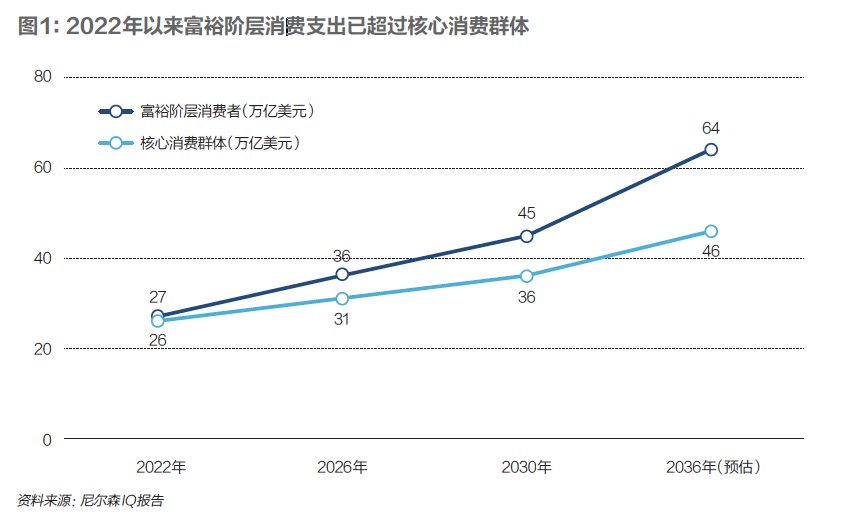
The report divides global consumers into two groups: affluent consumers and core consumers. In 2026, the former’s total expenditure is expected to be US$35.9 trillion, while the latter’s total expenditure is US$31.6 trillion. The size of the two groups is six times different, but they spend almost the same amount of money. This means that the strategic foundation of “grabbing the largest number of people in the middle” that companies were familiar with in the past is no longer effective. The report gives a more direct judgment when analyzing the Chinese market: China's fast-moving consumer goods market is declining as a whole, the mid-range is declining sharply in all categories, and value is gaining share. The report reads: "This is not a simple downgrade story. In a shrinking environment, positioning must be more precise. Brands must prove why they are worth the premium, why they can provide stronger value, and why they are important enough to stay in consumers' shopping baskets."
It is not far-fetched to extend this logic from FMCG to the automotive industry. The typical problem with express cars is that they provide a kind of vague value: they are aligned with competing products in terms of parameters, and they are additive in terms of configuration, but they lack a clear and irreplaceable value proposition. In a market with polarized consumption, this type of model will be the first to be squeezed by both ends. It can neither provide sufficient reasons for premiums for upgrading consumers who are willing to pay for quality and brand, nor can it provide truly ultimate value for money for price-constrained consumers who are proficient in calculations. Fuzzy positioning can also rely on traffic and freshness to obtain orders in the incremental market.
McKinsey’s “State of the Global Consumer 2026” report captures another key change. The report lists the rise of "smart consumers" as one of the four major trends. More than 80% of consumers have extended the use cycle of goods. The definition of value is no longer just equivalent to the lowest price, but includes the concept of the entire life cycle including durability, repairability and resale value.
For durable consumer goods such as cars, this means the migration of a decision-making framework. Consumers' focus is shifting from "parameters and price at the point of purchase" to "cost and experience throughout the life cycle." Orders exceeding 10,000 for a car in its first month on the market are just the beginning of the story; the value retention rate after six months, the failure rate after three years, and the maintenance cost after five years, these variables are entering consumption decisions at an unprecedented speed. Even if a quick-service vehicle achieves short-term sales through initial marketing, subsequent quality complaints, recalls, collapse in value retention, and word-of-mouth backlash will be fed back to the market in an increasingly shorter cycle. The new car effect can bring traffic, but it cannot offset the lack of long-term reliability.
Changes also occurred in the information acquisition process. The Nielsen IQ report shows that about three-quarters of shoppers use AI for product discovery and 20% use AI for shopping. AI-driven recommendation algorithms are becoming the new “shopping gatekeepers”, shaping consumer behavior by deciding which products enter consumers’ consideration range.
In the automotive field, this means that quality data, user complaints, recall records, value retention curves and other information are being more efficiently integrated and presented. Consumers’ ability to do homework is improving, and the bonus period for information asymmetry is shortening. In the past, express vehicles may have been able to maintain their "early adopter dividends" for a period of time by relying on information gaps and marketing efforts, but as AI and digital tools accelerate information symmetry, this window is closing at a speed visible to the naked eye. Consumers vote with their feet faster than car companies launch new products.
At this point, the difficulties faced by express vehicles have gone beyond simple supply-side problems. On the one hand, market competition, profit compression, and the accessibility of technological tools have combined to create the urge for quick results; on the other hand, consumers are punishing the consequences of quick results with more discerning and shrewd decision-making methods. The result of the superposition of the two forces is concentrated in one phenomenon. Some new cars peak when they are launched, and then quickly slide to the edge. This is the typical outline of the "Valley of Death for New Cars."
New car Death Valley: the mechanism of quick success
It can be seen from the changes on the consumer side that the external environment faced by express vehicles is tightening. But changes in the external environment are just the background. What truly determines the fate of a car is its ability to cross the "Valley of Death for New Cars."
Dou Huijuan, deputy general manager of FAW Toyota Auto Sales Co., Ltd., pointed out that although more than 600 new cars were launched in the first half of this year, only two new cars sold more than 10,000 yuan a month. Sales of most new cars dropped sharply three months after peaking, and the window period for new car bonuses narrowed significantly. She believes that behind the rapid development, the contradiction between focusing on iteration speed and neglecting long-term verification, focusing on short-term performance and ignoring full-cycle quality is rapidly becoming apparent. The intensive launch of new products has also disrupted consumers’ car buying rhythm. Authoritative research shows that over-packaged marketing rhetoric and obscure technical terms make more than half of users hesitate to choose. Product homogeneity and high hidden costs are overdrafting consumers' trust in new cars themselves. She further said that parameter configuration and new update speed can be quickly caught up and copied, but a car remains stable and reliable after long-term use. There is no shortcut to this ability and can only be tested by time.
The "Death Valley of New Cars" is not a strict academic concept, but a summary of a market phenomenon: new cars rely on marketing and novelty to gain short-term popularity in the early stages of their launch, and then orders and sales decline significantly within a few months, and are eventually marginalized by the market. There is no inevitable causal correspondence between the crash car and the death valley of new cars. Cars with long development cycles are also likely to fall into the valley of death, and cars with short development cycles are not doomed to failure. But quick fixing does significantly increase the probability of falling into the Valley of Death because it creates systemic vulnerabilities at several key nodes.
Dongfeng Nissan N7 provides an observable sample. In April 2025, N7 entered the medium and large pure electric car market with a price of 119,900 yuan to 149,900 yuan. This strategy received immediate results in the early stages of its launch. Orders exceeded 10,000 within an hour of its launch, and orders exceeded 20,000 units within 50 days. In August, sales once exceeded 10,000, making it the first joint venture pure electric car to enter the monthly sales club of 10,000 units.
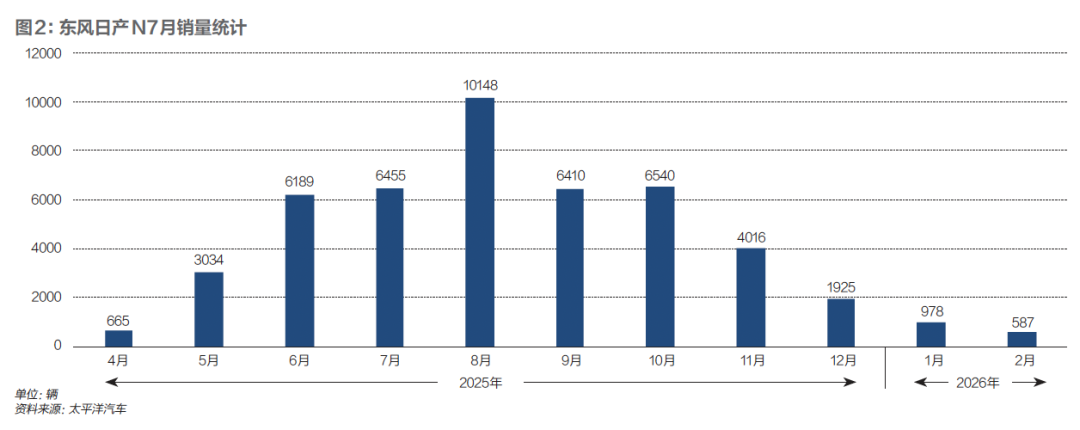
But this curve has not been maintained. Sales in September dropped by nearly 40% month-on-month, and then fell month by month. By January 2026, there were less than 1,000 units, and they fell further to 587 units in February. From the peak to the bottom, it only takes half a year.
Reviewing the fall of N7, we can see the transmission chain formed by the superposition of three factors: product definition, delivery rhythm, and quality issues. The entire N7 series uses a 400V platform, while self-owned brand models of the same price range have generally switched to 800V during the same period. The core smart driving functions were only pushed through OTA half a year after their launch, but early users failed to get the promised core experience in the first place. Dislocations also occurred on the delivery side. Orders surged in the early stages of the launch, but production capacity ramped up lagging behind. Some users took too long to pick up cars, which consumed market enthusiasm. In May 2026, Dongfeng Motor Co., Ltd. announced a recall of a total of 68,265 N7 and N6 vehicles, involving the hidden danger of the accelerator pedal assembly being worn and not returning smoothly. The recall itself is a responsible decision, but it occurred at a point when product sales had already declined significantly, which caused a second blow to user trust.
From N7 to N6, the first two cars in the Dongfeng Nissan N series have shown a similar trajectory of "high driving and low driving". Some industry insiders pointed out that the product definitions of these two cars have not yet gotten rid of the thinking inertia of the oil car era. The pricing of the mid- and low-end versions seems to be competitive, but the configuration is too simple and lacks persuasiveness in a competitive environment where independent brands generally have "high-end standard equipment for all series". In other words, the problem is not just "fast", but that being fast does not solve the problem of "what should be done" and "what should not be saved".
In contrast, the staged performance of the NX8, the third car in the N series, provides another set of reference. The NX8, which will be launched in April 2026, has a strategy for key configurations that is obviously different from the previous two models. The pure electric version comes standard with an 800V platform, and the extended-range version has a pure electric range of 310 kilometers. The 71 configurations of the entire series include the previously criticized L2 assisted driving and heat pump air conditioning. As a result, orders exceeded 8,423 units within 30 minutes of launch, and it took two and a half months from launch to delivery of the 10,000th unit. The pace was significantly better than that of N7.
Whether NX8 can continue to stand firm remains to be tested by time. But it at least illustrates one problem. The opposite of quick success is not slowness, but where companies choose to invest resources within a limited development cycle. Whether the product definition is accurate, whether key configurations are in place, and whether delivery promises are fulfilled, these variables are more important than the absolute length of the development cycle in determining whether a car can cross the valley of death.
There is therefore a significant positive correlation between the Death Valley of fast cars and new cars. But positive correlation does not mean inevitable causation. Those speedsters that don't fall into the valley of death usually find a fragile balance between speed and bottom line. How long this balance can be maintained depends on whether the external rules are strong enough.
Change of rules: when the bottom line changes from recommendation to compulsory
Faced with the chaos of fast cars, regulators have begun to take action and use systems to draw a bottom line for "fast".
What attracts the most attention is the unified adjustment of reliability driving test mileage. The National Automotive Standardization Technical Committee recently issued three recommended national standard revision orders in the automotive standard formulation and revision management system to solicit public opinions. The amendment sheet involves pure electric, hybrid and fuel cell vehicles, and it is planned to unify the total reliability driving test mileage of the three types of new energy vehicles to no less than 30,000 kilometers. A more noteworthy detail is that in the 30,000-kilometer test of pure electric vehicles, the proportion of DC fast charging conditions is required to be no less than 90%; for plug-in hybrid models, an additional 10,000 kilometers of special endurance testing in pure electric mode will be added.
The direct effect of this adjustment is to narrow the gap in verification standards between new energy vehicles and fuel vehicles. Cui Dongshu, secretary-general of the Passenger Union Branch of the China Automobile Dealers Association, pointed out the key: Unifying the standard mileage to 30,000 kilometers means that the industry has entered a mature stage and no longer relies on low-threshold support. A higher mileage threshold can more fully expose the aging problems of the three-electric system and chassis in long-term use, rather than letting these problems only show up in the hands of users. He emphasized that this adjustment is consistent with the Ministry of Industry and Information Technology's 2027 mandatory access requirements, which essentially clarifies the lower limit for vehicle launch verification.
Synchronized with the adjustment of the 30,000-kilometer standard, is the implementation of a number of mandatory national standards. In January this year, the "Safety Technical Requirements for Automobile Door Handles" (GB 48001-2026) was released, prohibiting fully hidden pop-up door handles and fully electronic door handles, and requiring each door to be equipped with independent mechanical outer handles and inner handles to ensure that it can still be opened with bare hands after a power outage or collision. In July, the "Safety Requirements for Electric Vehicles" (GB 18384-2025) and "Safety Requirements for Power Batteries for Electric Vehicles" (GB 38031-2025) were officially implemented. The battery thermal diffusion requirements have been upgraded from "alarm 5 minutes before fire and explosion" to "no fire or explosion". At the same time, a bottom impact test and a safety test after a fast charge cycle have been added.
These strong labels have a common feature. They target the links that have previously been the most controversial in the industry and where consumer risk exposure is most concentrated. Door handle safety is aimed at the fatal risk of being unable to open the door after a collision, and battery safety is aimed at the extreme risk of fire and explosion caused by thermal runaway. The process of these standards changing from "recommended" to "mandatory" itself shows that the previous industry self-discipline did not fully adhere to the bottom line.
On July 17, a symposium organized by the Equipment Industry Department of the Ministry of Industry and Information Technology released a clearer signal from the regulatory stance. The meeting required companies to carry out in-depth investigation of product safety risks, strengthen product innovation design testing and verification, and strengthen safety assessment of combined driving assistance and autonomous driving functions. A principle put forward at the meeting is worth recording: "The bottom line of quality cannot be compromised for efficiency, and compliance standards cannot be compromised for 'involution'."
On August 26, Xin Guobin, Vice Minister of the Ministry of Industry and Information Technology, further transformed this principle into clearer market access requirements at a press conference held by the State Council Information Office. When introducing the relevant situation of accelerating the promotion of new industrialization during the "15th Five-Year Plan" period, he said that product innovation design access review and testing verification management will be strengthened, and he clearly stated: "Products that have not been fully tested and verified are strictly prohibited from entering the market." He also said that the supervision and inspection of product production consistency will be increased to effectively safeguard the legitimate rights and interests of consumers and further standardize the order of industrial competition.
The adequacy of testing and verification is changing from an internal quality management matter within the company to an access condition that determines whether a product can enter the market. Put together, these regulatory actions send the same signal. After more than ten years of rapid expansion, China's automobile industry has completed the basic accumulation of market scale, production capacity construction and supply chain system. At this stage, the main conflict in the industry is shifting from "whether there are enough cars" to "whether the cars are reliable enough." In the short term, more stringent standards will raise the entry threshold and put direct pressure on companies that rely on quick-service models and have weak engineering verification capabilities; in the long term, the focus of competition will shift from new speed and surface parameters to verification completeness, product consistency, and long-term reliability.
Changes in rules are never just constraints, they are also reshaping corporate behavioral expectations. When 30,000 kilometers becomes the bottom line, when "no fire or explosion" becomes a mandatory requirement, when "products that have not been fully tested and verified are strictly prohibited from entering the market" become a clear official statement, the space for companies to compress the verification process is institutionally narrowed. Those companies that still try to find gray areas on the edge of the rules face not only market penalties but also compliance risks. This has drawn a clearer track for the competition in the second half, but the track has changed, which does not mean that all players can find their positions.
The way out is not to be faster, but to be more worthy of being chosen
The tightening of regulations has drawn a bottom line for the industry, but the bottom line can only prevent the worst case scenario from happening, and cannot replace the company's answer to a more fundamental question: When speed no longer forms a moat, how can a car company continue to be chosen by consumers?
The lessons learned from Dongfeng Nissan N7 and N6 show that relying on the new car effect to maintain sales is essentially a traffic logic. It used the short-term popularity of new models in exchange for orders, but did not use its product strength and user experience to accumulate trust assets that could support subsequent models. Traffic can bring first-month orders, but it cannot prevent the sales of new cars from falling off a cliff in the sixth month after they are launched. The difference between the two is that the former measures attention and the latter measures trust.
With the trend of consumer polarization and savvy, the focus of competition among automobile companies is shifting from "who gets the new car" to "who is worth buying". The direction pointed out by the Nielsen IQ report for enterprises is to establish a dual-track innovation model. One track is oriented to upgrading consumers and provides demonstrable high-quality products; the other is oriented to price-constrained consumers and provides smarter affordable solutions. Brands must identify which appeals, attributes and configurations truly drive purchase behavior and translate this insight into product definitions rather than continuing to pile on parameters.
When it comes to the automobile industry, this judgment means at least three levels of adjustment.
At the product definition level, you must answer "Why users must buy you". The ambiguity in the positioning of the express car is precisely the reason why it was eliminated in the first place. When a car offers neither a strong case for a premium nor a compelling case for saving money, it has little room to stand in a consumer-polarized market.
At the verification system level, the R&D rhythm can be adjusted, and there are no shortcuts in the verification process. The verification cycle of two winters and two summers means that the first test exposes all the problems, and the second correction is followed by a complete verification. The essence of this logic is the recognition that verification has its incompressible physical boundaries. Maintaining this boundary is part of the long-term equity of the brand.
At the user relationship level, the focus needs to shift from "selling cars" to "full life cycle operations". “Smart consumers,” as the McKinsey report describes them, are factoring durability, repairability and resale value into their decision-making frameworks. The value retention rate of second-hand cars, software upgrade capabilities, and after-sales service quality are becoming as important competitive variables as first-release parameters. For companies that only focus on new car sales and ignore existing user experience, their new car effect will only decay faster and faster.
The direction of industry reshuffle has become clear. In a polarized consumer market, brands that can prove "why they are worth the premium" will continue to be chosen by upgrading consumers; brands that can prove "why it makes sense to save money" will win among price-constrained consumers through cost control and differentiated value positioning. Brands caught in the middle, with neither enough differentiation to warrant a premium nor enough value to win as a budget-conscious choice, will be the first to go.
Chen Shihua believes that in the short term, companies need to find accurate positioning, streamline product lines, and break away from the logic of simply competing for the number of models; in the medium and long term, they need to transform from manufacturing companies to technology companies and ecological companies. Future competition is no longer a single contest of manufacturing capabilities, but a comprehensive competition of intelligent capabilities, software capabilities, and ecological capabilities.
This means that the end of the crash car phenomenon will not come automatically just because of regulatory tightening. It requires enterprises to complete a switch in growth logic, from the pulse-like growth of chasing new models to the compound interest growth of building user assets. Speed is still important, but it's no longer the most important variable.
Back to the original question: Is there an inevitable connection between fast cars and new cars in Death Valley?
The answer is no. Cars with a short development cycle will not necessarily fall into the valley of death, and cars with a long development cycle will not necessarily survive. But a more accurate judgment is that in the current Chinese automobile market, quick-service is the most effective accelerator for falling into the Valley of Death. As cycle shortening turns from a capability into a common strategy, the costs of omitted verification, risks transferred to consumers, and centralized cashing out until three to five years later are accumulating into a systemic reckoning.
The short films of Mercedes-Benz and BMW are more like a mirror than an attack on their competitors. When it is technically possible to "draw" a car by dragging a box with the mouse, what is it that is really difficult to copy? It is the time that cannot be compressed, it is the restraint that still chooses to complete the verification under the pressure of speed, and it is the trust accumulated by consumers in long-term use.
Quickness itself is not the problem, the problem is what is saved while being fast. When speed is based on sacrificing verification, sacrificing user experience consistency, and sacrificing system synchronization, the Valley of Death for new cars changes from a possibility to a high-probability event. And when consumers begin to use AI tools, public data and full life cycle costs to review each new car, the last bit of time difference and information gap that quick success relies on is quickly disappearing.
In the second half of the industry, the competitive targets have changed. The competition is no longer about who launches the car first, but whose car is still worth choosing after three or five years.
Article | "Finance" special writer Zhao Cheng Yang Zheng
Editor|Zhao Cheng
Comments