
Abstract:
With the rapid proliferation of generative artificial intelligence content on the Internet, it is becoming increasingly important to identify the authenticity of digital content. Google officially launched a SynthID detection website open to the public on October 7, allowing any user to upload images, videos or audio files to verify whether they were generated or edited by artificial intelligence.
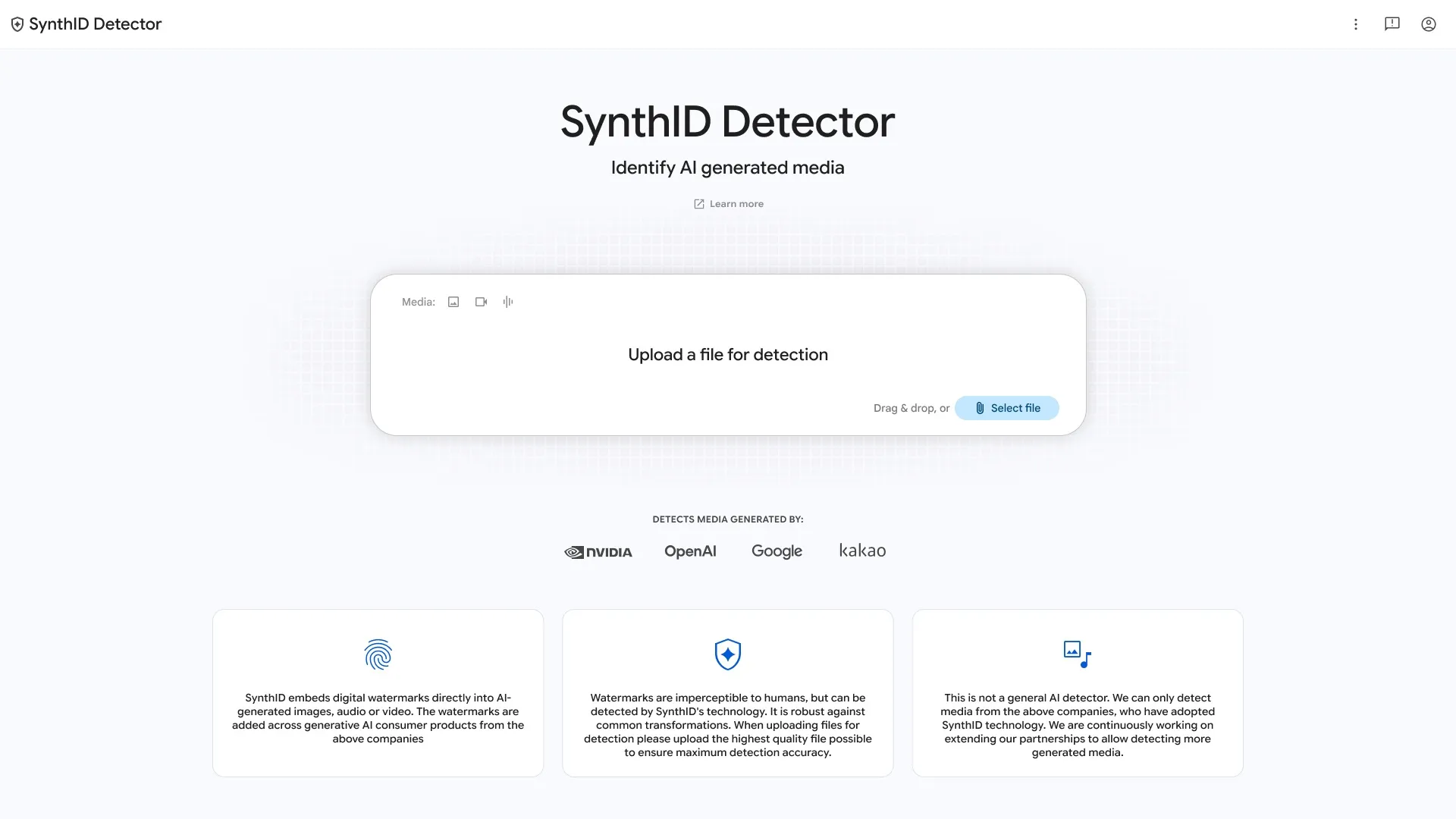
In fact, this tool is not debuting. Google opened the test version to some journalists, media organizations and researchers as early as last year's I/O Developer Conference, and now it is officially open to users around the world, hoping to enhance the public's ability to identify AI content.
SynthID, initially launched in 2023, is a set of digital watermarking technologies developed by Google. Unlike traditional visible watermarks, SynthID embeds hidden marks that are imperceptible to the naked eye and ear when generating content, so that the content will not be affected during normal use and can be identified in subsequent detections.
At present, many of Google's artificial intelligence models and services have adopted this technology, including Nano Banana image model, Veo video model, Lyria audio model, and platforms with content generation functions such as Gemini, Flow, ProducerAI and Vids. All media content generated through these tools will automatically embed SynthID digital watermarks.
The detection platform launched this time supports a wide range of file formats. For pictures, it supports JPG, JPEG, PNG, BMP, WEBP, AVIF, HEIC, HEIF, TIFF, TIF and GIF; for videos, it supports MP4, MOV and WEBM; for audio, it supports mainstream formats such as WAV, MP3, OGG, FLAC, AAC and M4A.
In addition to Google's own ecosystem, SynthID is gradually developing into a cross-industry standard. OpenAI, Nvidia and Korean Internet company Kakao already support this technology, and Apple is said to be joining the support camp in the future. This means that in the future users will not only be able to identify content generated by Google AI, but also detect media files from other partner systems.
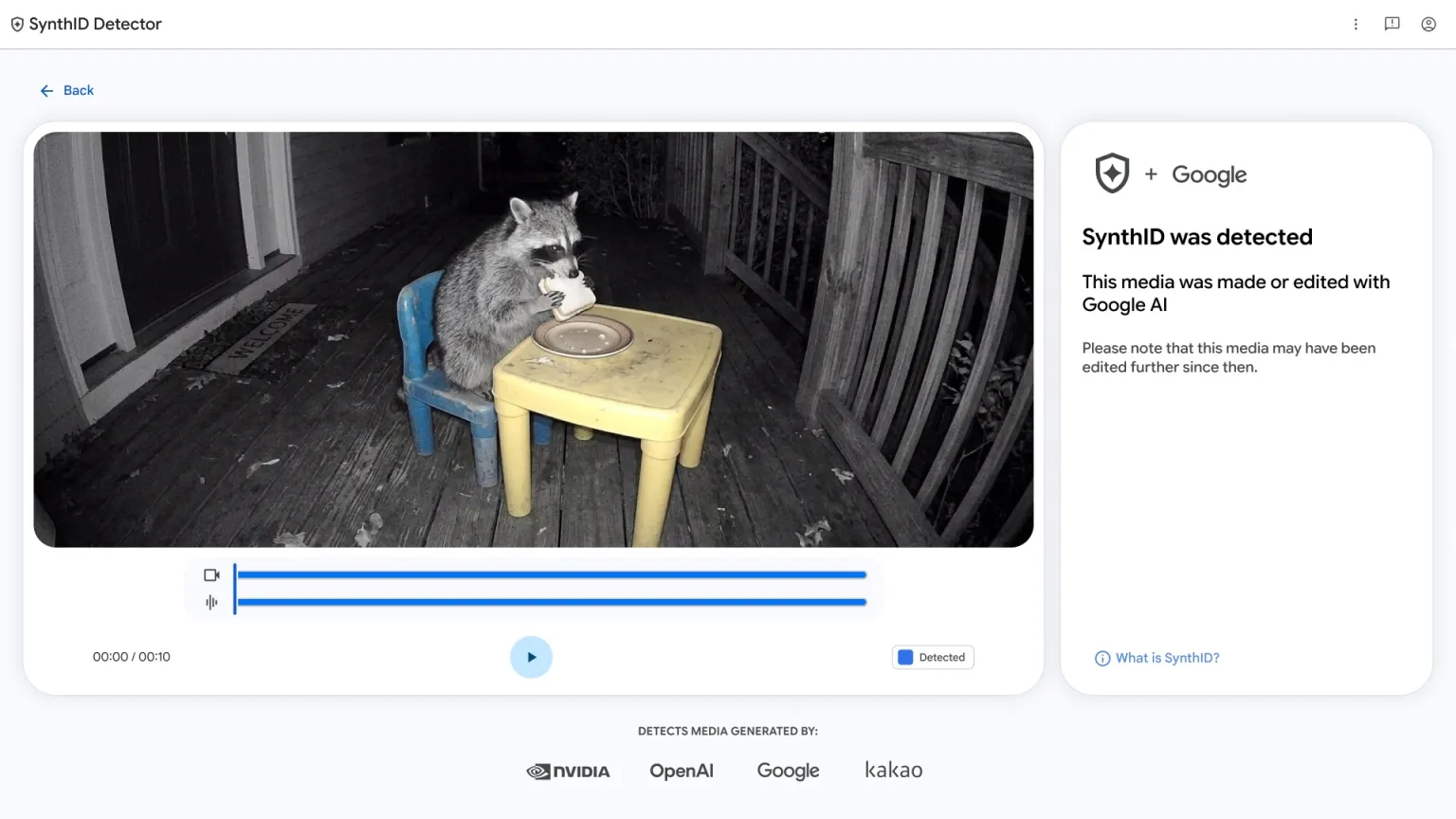
Google stated that the upgraded detection service can already identify digital watermarks from partners and is no longer limited to content generated by Google’s own model. At the same time, OpenAI also retains its own content detection platform to provide users with independent verification channels.
In addition to standalone websites, Google has integrated SynthID detection capabilities into the Gemini app and Chrome browser. According to officially disclosed data, the number of content verification requests initiated by users through these channels every day has reached approximately 1 million, showing that the public's demand for identifying the authenticity of AI content is growing rapidly.
However, Google also admits that the current AI content detection technology is not foolproof. Digital watermarking solutions can only identify content generated using relevant standards, and may not be able to detect AI works that do not use SynthID or other compatible standards. In addition, different marking and verification systems are still used by different companies, and the industry has not yet formed a unified standard.
At the same time, technology companies such as Microsoft and Meta are also advancing their own digital watermarking and content verification solutions. However, it is generally believed in the industry that detection tools, whether launched by Google or other manufacturers, still have certain limitations. In some cases, they cannot even accurately identify content generated by their own models.
Nonetheless, as the amount of AI-generated content continues to increase, including deepfake videos, AI pictures, and speech synthesis content becoming more and more common, Google's opening of the SynthID platform to the public is seen as an important step for the technology industry to improve content transparency and combat false information. In the future, as more companies join the unified digital watermark ecosystem, Internet users may have more reliable tools to determine the true source of online content.
Comments