
Abstract:
SpaceX’s satellite communications business is further extending into the traditional mobile communications field. The U.S. Federal Communications Commission (FCC) recently approved SpaceX to deploy and operate up to 15,000 Starlink Mobile satellites, which means that SpaceX is one step closer to establishing a satellite network that can directly provide mobile communication services to ordinary mobile phones.
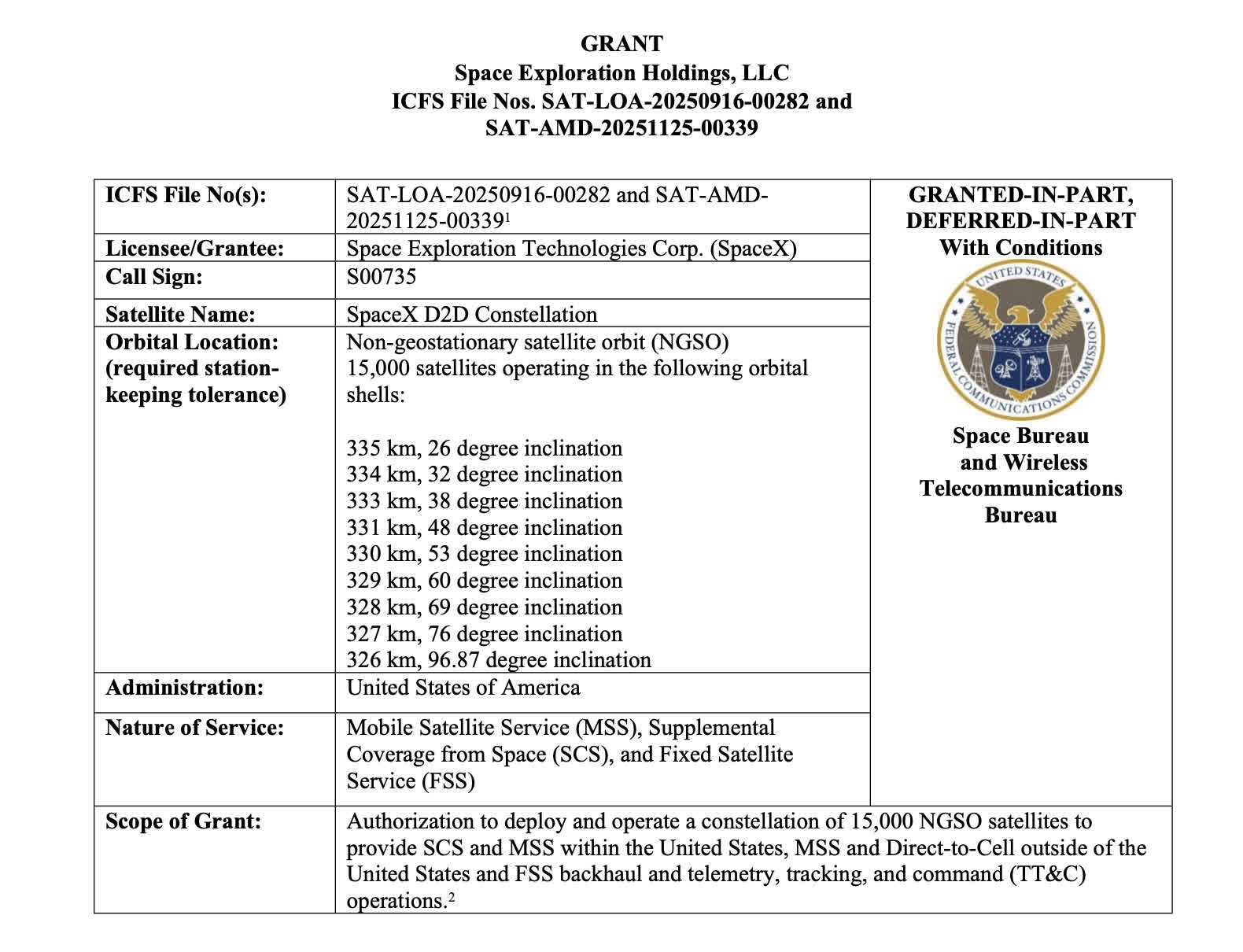
The FCC approved SpaceX’s application for the Starlink Mobile mobile satellite communications system on October 6. At the same time, regulators also granted SpaceX an important exemption, allowing it to provide satellite wireless communications services without signing a spectrum lease agreement with a terrestrial mobile network operator.
The significance of this decision is that SpaceX can theoretically use the spectrum resources it has obtained to directly provide mobile communication services in the future, without having to rely entirely on the networks of traditional operators such as AT&T and Verizon. This also means that Starlink Mobile may gradually develop from a "supplementary network" of traditional telecom operators to a mobile communications platform with independent commercial competitiveness.
The satellites approved this time will use part of the spectrum obtained by SpaceX from EchoStar, and can also use T-Mobile related frequency bands. SpaceX has previously cooperated with T-Mobile to provide communication services to ordinary mobile phones through satellites, but the latest regulatory approval clearly further expands SpaceX’s space to operate this business independently.
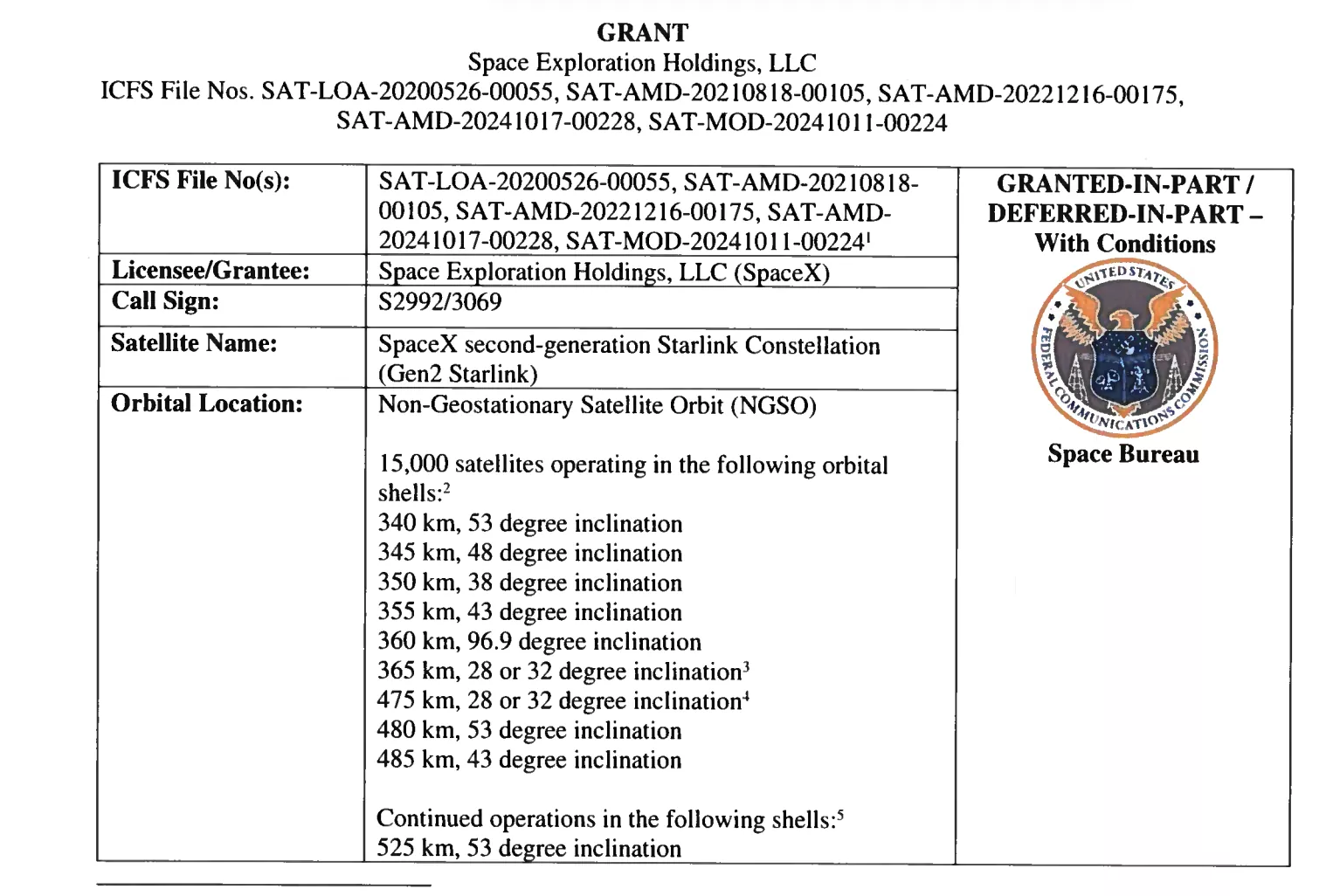
It is worth noting that the number of 15,000 is not a sudden increase in the total number of Starlink satellites to 15,000. In January this year, the FCC approved SpaceX to deploy an additional 7,500 second-generation Starlink satellites, bringing the authorized scale of the second-generation Starlink system to 15,000. The approval at that time was mainly aimed at the expansion of the capacity of the traditional Starlink broadband network, and also included the ability to directly connect mobile phones and other mobile communications.
This approval comes from another application submitted by SpaceX in September 2025, for an independent mobile satellite communications system. According to the plan originally submitted to the FCC, the system can deploy up to 15,000 satellites with an orbital altitude of approximately 326 to 335 kilometers, which is significantly lower than the orbital altitude of approximately 550 kilometers for some traditional Starlink satellites.
If the two systems approved by the FCC this year are combined, the number of second-generation Starlink and new Starlink Mobile satellites currently authorized by SpaceX will reach approximately 30,000, not including the first-generation Starlink satellite system.
As of early October 2026, SpaceX has launched nearly 13,000 Starlink satellites, of which approximately 11,150 are still in orbit. If all approved satellites are eventually deployed in the future, the scale of the satellite network established by SpaceX in low Earth orbit will be further expanded.
Starlink Mobile's goals are no longer limited to early text messages and low-speed data communications. Next-generation systems are planned to provide services that more closely resemble traditional cellular networks, including native voice calls, web browsing, video streaming and other applications that require more data bandwidth.
Japan’s KDDI has reached Starlink Mobile-related cooperation with SpaceX. KDDI said that the new generation of services will be able to provide functions such as voice calls, streaming media and web browsing in areas without terrestrial mobile network coverage in the future, and plans to gradually provide related services to areas that cannot be covered by Japan's terrestrial networks before the end of 2027.
This also shows that SpaceX's obtaining independent operating qualifications does not mean that it will give up cooperation with traditional telecom operators. For operators, satellite networks can still serve as an extension of ground base stations, helping them cover mountainous areas, oceans, remote areas and other areas where the cost of building traditional communications infrastructure is too high.
For ordinary users, the most attractive aspect of Starlink Mobile is that it makes it possible for mobile phones to establish communication connections directly with satellites without nearby base stations. Users do not necessarily need to carry traditional satellite phones or additional satellite communication terminals, but can use ordinary adapted smartphones to complete communications.
However, this does not mean that future mobile phones will be able to connect to Starlink as stably as connecting to 5G base stations under any circumstances. The link between satellites and mobile phones is limited by various factors such as spectrum, number of satellites, mobile phone transmission power, antenna capabilities, and satellite coverage density. For high-speed data services, network capacity is still a problem that needs to be solved.
At the same time, SpaceX’s large-scale increase in the number of low-orbit satellites has once again triggered concerns in the astronomical community about orbital congestion. The American Astronomical Society has previously expressed opinions on the Starlink Mobile project, fearing that a large number of satellites may affect astronomical observations and increase orbital debris and the environmental impact caused by satellites re-entering the atmosphere.
As the number of satellites continues to increase, low Earth orbit is gradually transforming from a relatively sparse space environment in the past to a highly dense infrastructure area. Starlink satellites themselves have a limited service life and need to continuously launch new satellites to replace old equipment. This means that even if the Starlink network maintains stable operation in the future, there will be a large number of satellite launches and de-orbit reentry activities for a long time.
Therefore, although the FCC's approval is an important step in SpaceX's transformation into a "space mobile communications operator", it still has a long way to go before it can truly form a satellite mobile phone network covering the world. SpaceX still needs to complete satellite deployment, ground network construction and terminal compatibility verification, and prove that this system can provide stable voice and high-speed data services as promised.
If these plans are finally realized, Starlink's positioning will change significantly: it is no longer just a system that provides broadband Internet to fixed user terminals through satellites, but may gradually become a complete low-orbit communication network covering satellite broadband, mobile phone direct connection, voice communication and mobile data services, and directly enter the mobile communication market that traditional telecom operators have long occupied.
Comments