
Abstract:
As generative artificial intelligence continues to develop rapidly, "whether AI will take away human jobs" has become a hot topic of global concern. Microsoft AI CEO Mustafa Suleiman recently said that in the next ten years, the proportion of human jobs that artificial intelligence will truly replace may only be about 5%, which is far lower than the level that many people had previously worried about.
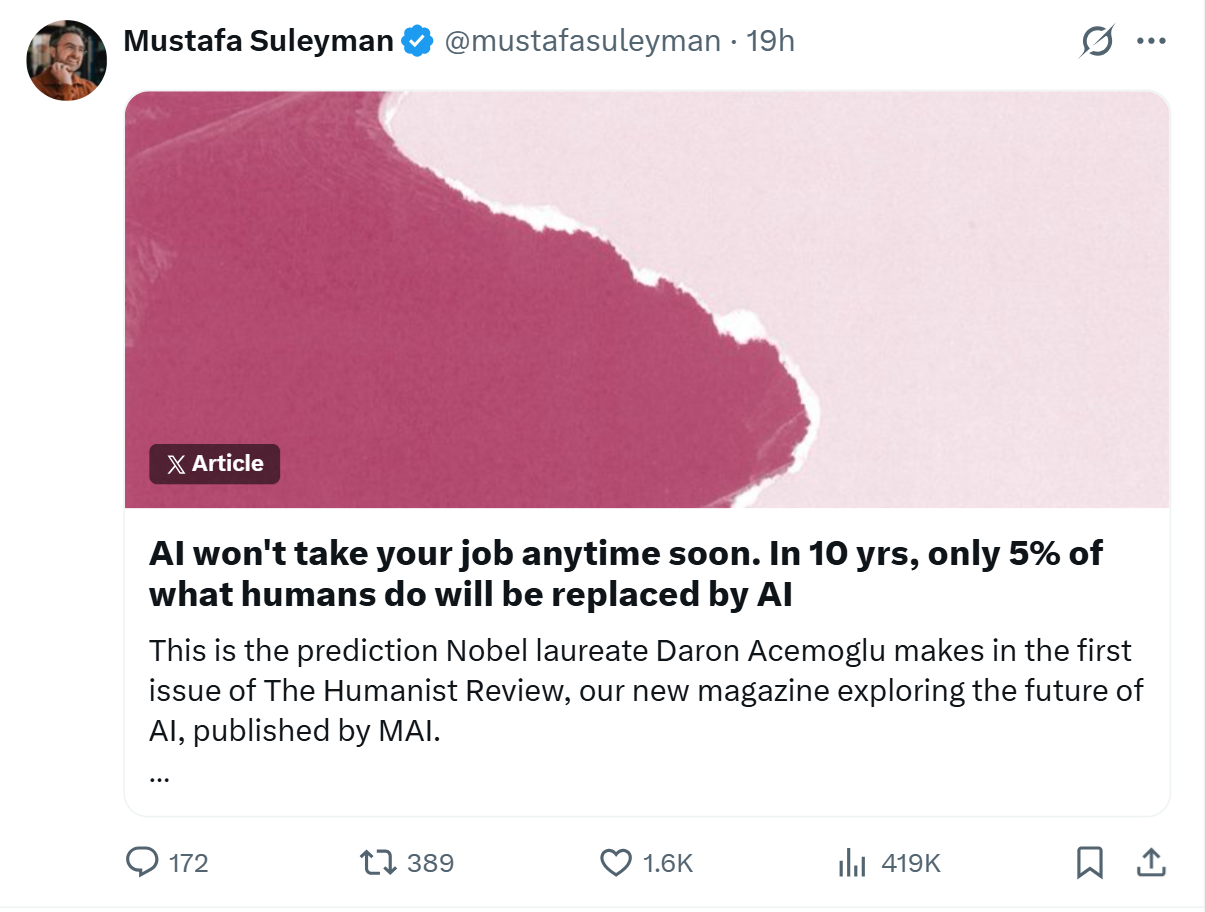
This view comes from the research judgment of Nobel Prize winner Daron Acemoglu. When introducing the new publication "The Humanist Review" under Microsoft AI, Suleiman cited relevant views and said that in the next ten years, artificial intelligence will not replace more than 5% of human work content. He also believes that society’s concerns about large-scale unemployment caused by AI are obviously exaggerated.
However, this statement also triggered discussions about the change in its position. Because just earlier this year, Suleiman predicted that for professions such as lawyers, accountants, project managers, and marketers that rely mainly on computers to work, most work tasks may be automated within 12 to 18 months.
In this regard, Suleiman later further explained that he was talking about "task automation" rather than "the disappearance of positions." In his view, even if a large number of work links can be completed by artificial intelligence, it does not mean that the corresponding occupations will be eliminated, but it means that these tasks can be completed with higher efficiency.
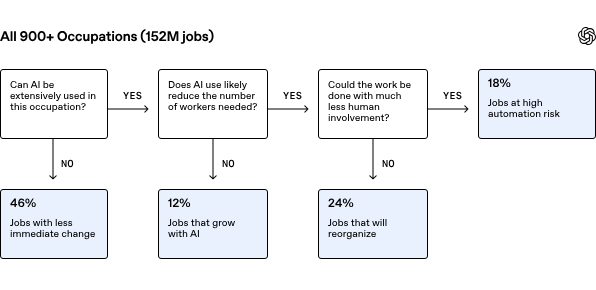
Acemoglu's analysis also highlights this difference. He believes that from the perspective of technical capabilities, artificial intelligence may theoretically automate about 20% of American work content, most of which are relatively simple office and cognitive tasks. But over the next decade, actual deployment of automation is likely to account for only about a quarter of these potential tasks, resulting in an eventual replacement of about 5% of the overall workforce.
He also admitted that the number itself is closer to an estimate based on existing technology development trends, rather than a strictly accurate forecast. In addition, although large model technology has advanced faster than many experts expected in recent years, the development speed of actual tools that enterprises can implement on a large scale has not kept pace.
In Acemoglu’s view, current artificial intelligence has demonstrated impressive capabilities in areas such as coding, software design, and medical imaging diagnosis, but many of these results have been achieved in experimental environments. In real work scenarios, problems are often more complex. For example, engineers still need to spend a lot of time debugging and correcting the code generated by AI, and doctors and radiologists have not yet been able to form ideal collaboration with AI tools, so the actual benefits are not as significant as experimental results show.
In response to public concerns about the job market, Suleiman pointed out that more than half of Americans are currently worried that artificial intelligence will affect their jobs, but this anxiety is affecting people's objective judgments about technological development. He believes that artificial intelligence should be viewed more as a tool to enhance work capabilities rather than as a machine that simply replaces human labor.
Acimoglu proposed that the future development direction of artificial intelligence should be to assist and enhance human capabilities, rather than copy or replace humans. He believes that the industry needs to stop developing AI with the goal of "replacing employees" and instead focus on helping employees improve their productivity and professional capabilities, making artificial intelligence a partner in human work.
Both of them are also relatively cautious about the possible economic impact of AI. Acemoglu predicts that artificial intelligence may only contribute about 1.5% to GDP growth in the next decade, rather than immediately triggering a huge economic change like the Industrial Revolution. He pointed out that artificial intelligence has not yet reflected a clear impact in macro productivity statistics, and many companies are still in the testing and exploration stage.
To illustrate how technology adoption is often slower than expected, Suleiman compared the development of artificial intelligence to the electricity revolution. Although power generation facilities were built in New York and London as early as 1881, electricity did not reach approximately half of all factories and homes until around the 1920s. In contrast, the rollout of AI technology may be even slower, as companies not only need to deploy new tools, but also need to readjust management models and business processes.
He also emphasized that even if the accuracy of future artificial intelligence systems reaches 99%, it may not be able to achieve complete automation, because the most difficult thing is often the remaining 1%. Many occupations involve complex judgment, multi-dimensional reasoning, interpersonal communication and social interaction abilities, and these abilities are still difficult to be fully replicated by artificial intelligence in the short term.
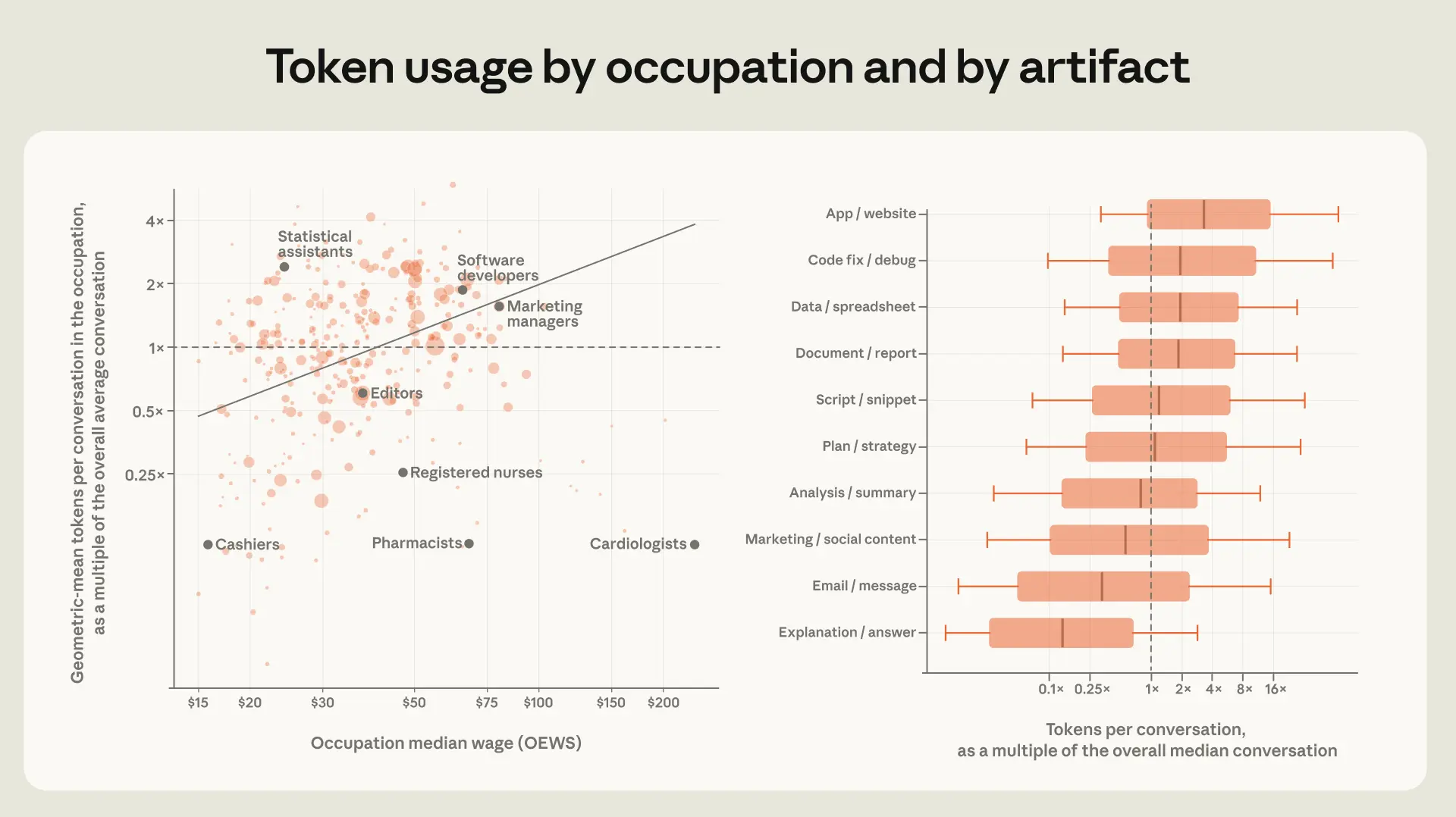
Acimoglu further pointed out that in addition to office work, the automation process in industries that rely on physical operations such as manufacturing and construction may be slower. The reason is that current robotics and artificial intelligence still have significant limitations in their ability to understand real spatial environments and causal relationships.
As more and more companies introduce generative artificial intelligence into daily business processes, the debate over whether AI will replace human jobs on a large scale is expected to continue. However, judging from the latest information released by Microsoft’s head of AI and Nobel Prize winner in economics, the mainstream trend in the next decade is more likely to be “human-machine collaboration” rather than “human-machine substitution.” Artificial intelligence will play a greater role in improving work efficiency rather than directly replacing most human positions.
Comments