
Abstract:
For electric trucks that rely on long-term driving to generate income, the parking time required for charging has always been an unavoidable problem in the promotion process. Honda is exploring a more radical solution: burying wireless charging equipment directly into the road so that electric trucks can continue to obtain power while driving at high speeds without stopping.
Honda's research arm is currently developing the system in cooperation with Japanese construction company Dasei Construction and road construction company Dasei Road. According to the plan, relevant companies will participate in the "Tateyama Project" on the Tateyama Expressway in Chiba Prefecture, Japan, starting in fiscal 2027. Japan's fiscal year 2027 will begin on April 1, 2027.
Honda currently hopes to apply this technology to the logistics and transportation fields first, because electric trucks have much higher requirements for battery life and charging time than ordinary passenger cars. For transport vehicles that need to run continuously for a long time, if they can replenish electric energy while driving, they can reduce or even avoid the parking time at the charging station.
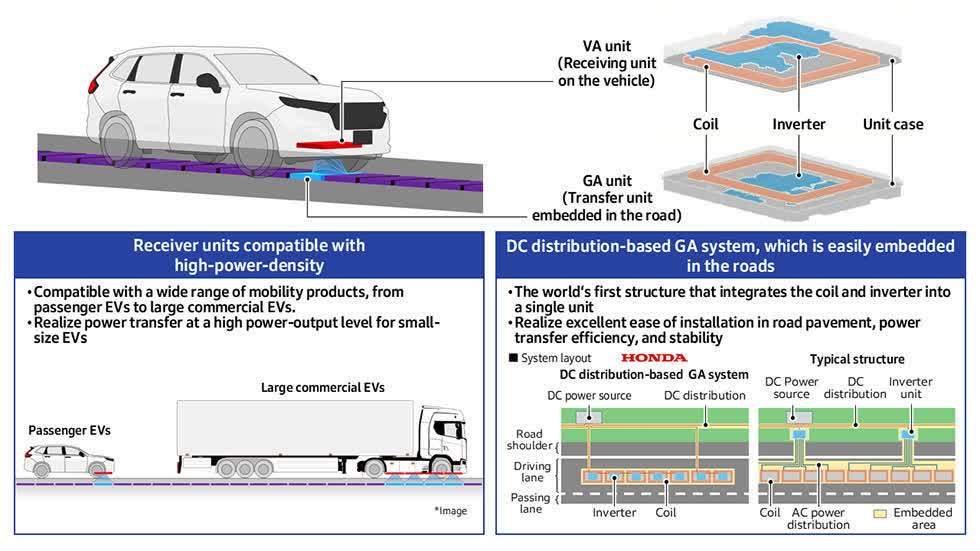
This system uses magnetic coupling to transmit electrical energy. The transmitting coil is buried inside the road, and the receiving coil is installed at the bottom of the vehicle. When the vehicle passes through the charging area, the coil under the road generates a magnetic field, and the receiving coil on the vehicle obtains energy through electromagnetic coupling, and then transmits it to the vehicle battery.
Honda's design also uses a DC power distribution system to connect multiple wireless charging units beneath the road. Each road charging unit has an integrated inverter and coil. According to Honda, this structure simplifies electrical wiring while reducing the number of components and construction work required for the system.
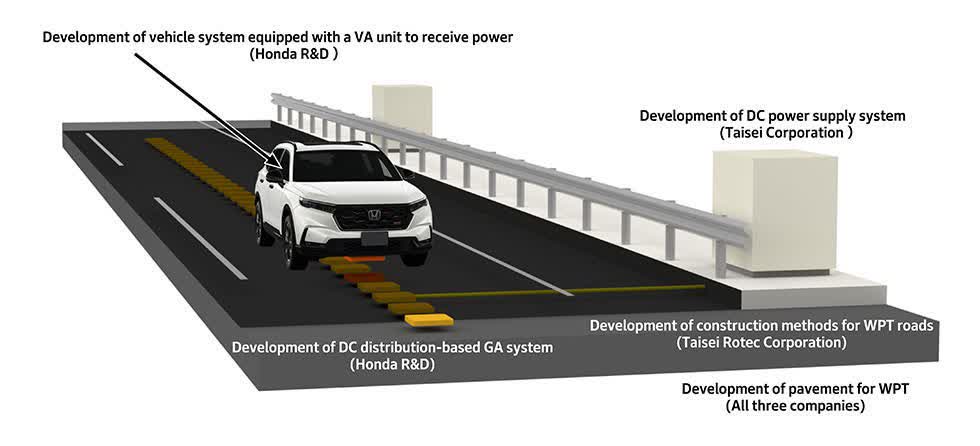
Another important feature is that the equipment does not require a complete reconstruction of the road. Charging units can be installed within areas created by cuts into existing road surfaces, reducing the degree of infrastructure modifications required for large-scale rollouts.
However, in order for wireless charging equipment to be buried under the highway for a long time, the problem of road carrying capacity must first be solved. The weight of large trucks puts constant pressure on the road, so Honda and its partners have developed road structures and charging units that can withstand repeated crushing by heavy vehicles. According to reports, the relevant systems need to bear the long-term load brought by vehicles weighing about 20 tons.
The partners also plan to build a new test road, with construction starting at the end of 2026. The test facility will simulate a durability test equivalent to one million wheel crushes, with a load of 49 kilonewtons per wheel, while also testing wireless charging performance and electromagnetic field leakage.
Follow-up tests will further verify the wireless power supply capability of up to 150 kilowatts and the system reliability when the vehicle passes through the charging section at high speed. However, Honda currently regards 150 kilowatts as a follow-up test target, rather than the actual output power that has been confirmed on the planned highway demonstration project. Therefore, it cannot be simply understood that this system has been able to stably provide 150 kilowatts of charging.
Similar road wireless charging technology has previously appeared in some projects in the United States. For example, Florida plans to build a wireless charging roadway about three-quarters of a mile long on State Route 516, with the goal of providing up to 200 kilowatts of charging power to compatible vehicles. A similar project promoted by Electron has previously appeared in Detroit, USA, which also achieved driving charging by burying road coils and vehicle receivers.
However, there are still obvious challenges to large-scale commercialization of road wireless charging distance. The first is cost. A large amount of electrical equipment needs to be laid under the road, and a supporting power supply network must also be built and long-term maintenance costs must be borne. If a charging facility malfunctions, repairs can also be more complex than with regular chargers because the equipment is located inside the road structure.
Honda has not yet stated how much cost this system can save compared with traditional fast charging networks. A Honda engineer said the economic feasibility of the technology still needs further evaluation.
In addition, ordinary electric vehicles cannot directly use this kind of road. Vehicles must be equipped with specialized wireless charging receiving equipment to obtain power from coils buried under the road. This means that if we really want to promote it on a large scale in the future, in addition to transforming roads, we must also promote the simultaneous development of vehicle-side hardware and industry standards.
For electric trucks, the greatest value of this technology is not necessarily the complete elimination of charging stations, but the transfer of "charging time" from the vehicle's parked state to normal driving. For logistics vehicles that need to run for a long time every day, even if only some road sections have wireless charging capabilities, it may reduce the time loss caused by parking and charging and improve vehicle utilization.
But for this model to truly become a reality, a key question still needs to be answered: whether the increased infrastructure costs of building and maintaining a large number of "charging roads" can be compensated by reducing charging parking time, reducing vehicle battery capacity requirements and improving transportation efficiency.
Therefore, Honda's current project is more like a technical verification for the future logistics and transportation system, rather than turning all highways into wireless chargers in the short term. In the next few years, the system's durability, actual charging efficiency, electromagnetic safety, high-speed operation reliability, and overall economy will determine whether this "charging while driving" model can move from an experimental road to a real commercial highway.
Comments