
Abstract:
Electric vehicle charging technology is developing in new directions. Japan's Honda Motor Co. is developing technology that allows electric vehicles to wirelessly harvest power while driving. By embedding wireless power transmission equipment into roads, vehicles can replenish their batteries without stopping or connecting to charging lines as long as they drive through specially modified road sections. This system is not only suitable for ordinary passenger cars, but also plans to be applied to large commercial electric vehicles to reduce the charging waiting time of logistics transportation vehicles.
Honda's research and development department, Honda Technical Research Institute, announced on October 5 that it has jointly developed a set of basic technologies for dynamic wireless power transmission road systems with Japan's Taisei Construction Co., Ltd. and Taisei Road Co., Ltd. The system uses magnetic coupling wireless power transmission technology, and its English name is Dynamic Wireless Power Transfer, or DWPT for short. The three companies plan to carry out relevant demonstration tests on public roads starting in fiscal year 2027. Japan's fiscal year 2027 will begin on April 1, 2027.
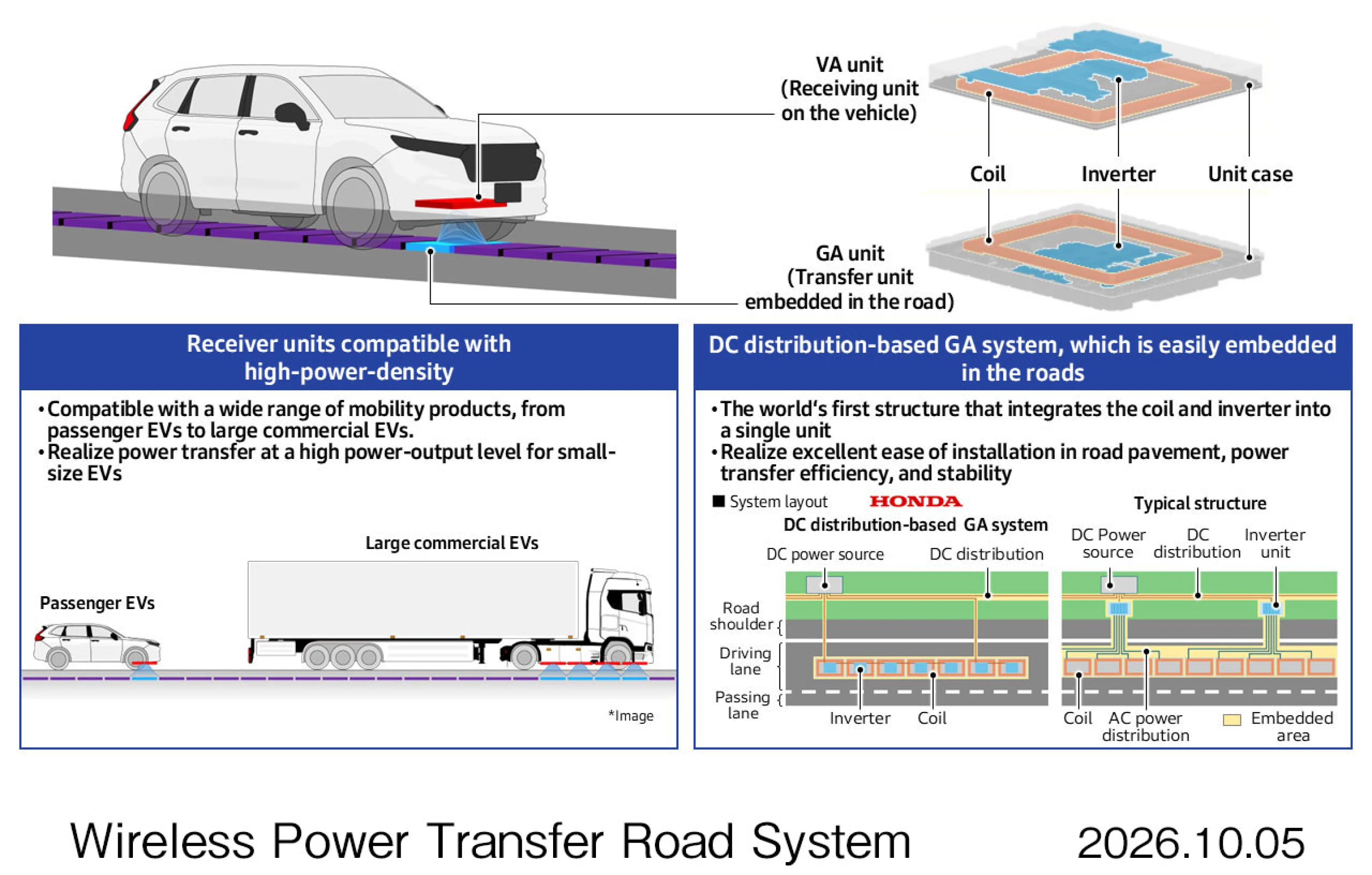
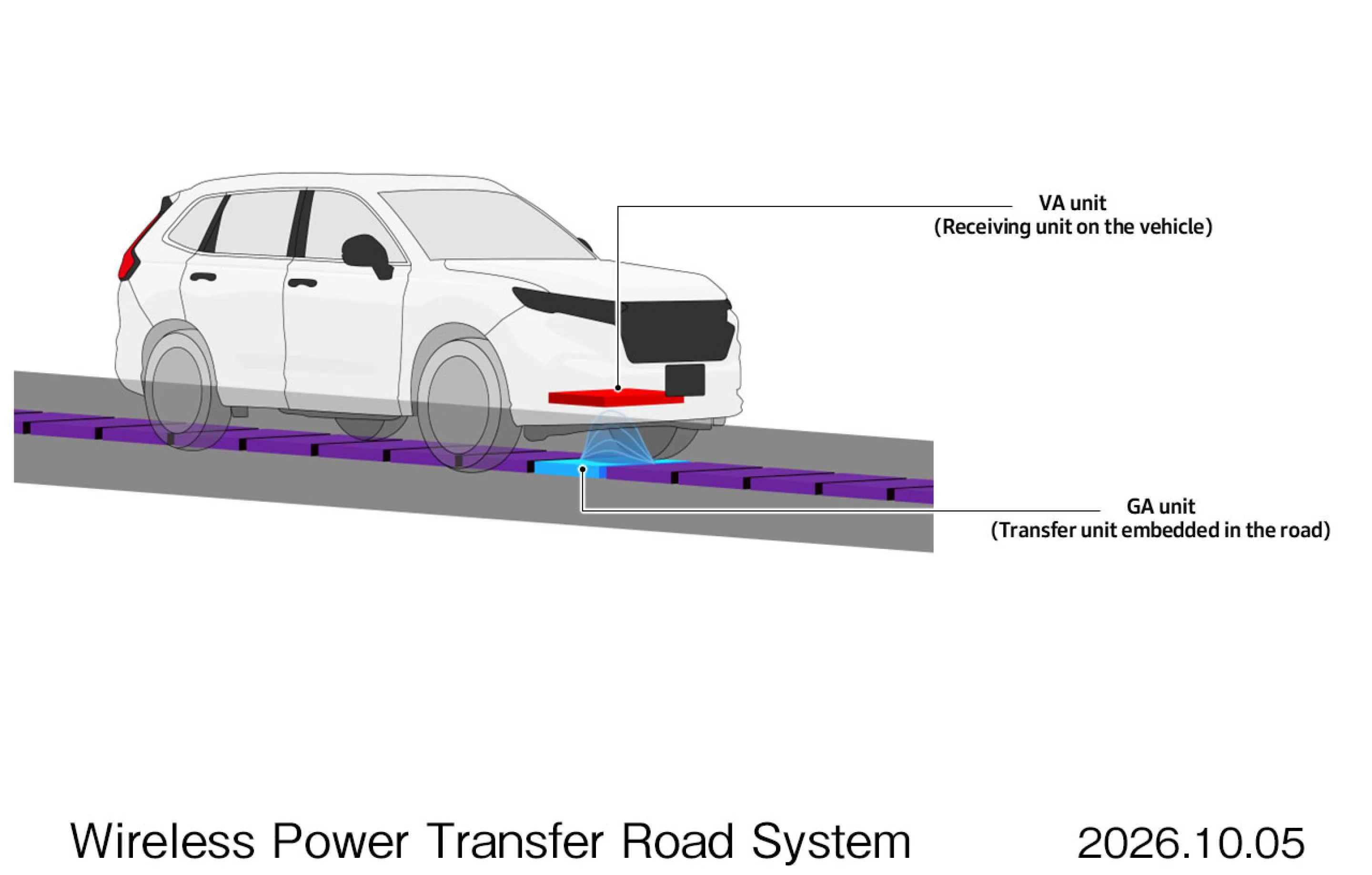
Different from the current method that requires the vehicle to park at a charging pile and transmit power to the battery through cables, the dynamic wireless charging system installs the power transmission equipment inside the road and installs the corresponding receiving device at the bottom of the vehicle. When a vehicle passes through a road section equipped with this system, the transmitting device on the road and the on-board receiving device realize wireless power transmission through magnetic field coupling, and the received power is then transferred to the vehicle battery.
This means that the energy replenishment method of electric vehicles in the future may no longer rely entirely on parking charging. If the vehicle often drives on roads equipped with wireless power supply equipment, it can continue to obtain part of the electric energy during daily driving, thereby reducing the frequency of parking for charging. This technology is particularly attractive for commercial vehicles that need to operate for long periods of time and have long ranges.
However, this system is not simply a huge wireless charging pad installed under the asphalt road, but consists of multiple devices that cooperate with each other.
The entire system mainly includes a ground DC power supply system, ground components on the road, and on-board components installed on the vehicle chassis. The ground power supply system is responsible for providing electrical energy, the ground component in the road is responsible for transmitting power through the transmitting coil, and the on-board component is responsible for receiving the electrical energy and delivering it to the battery.
An important feature of Honda's development is the integration of the inverter and transmitter coil into a single road-embedded unit. Multiple such units are connected through DC lines to form a road wireless power supply system. According to information released by Honda, this is the first time the company has publicly demonstrated a dynamic wireless power transmission unit using this structure.
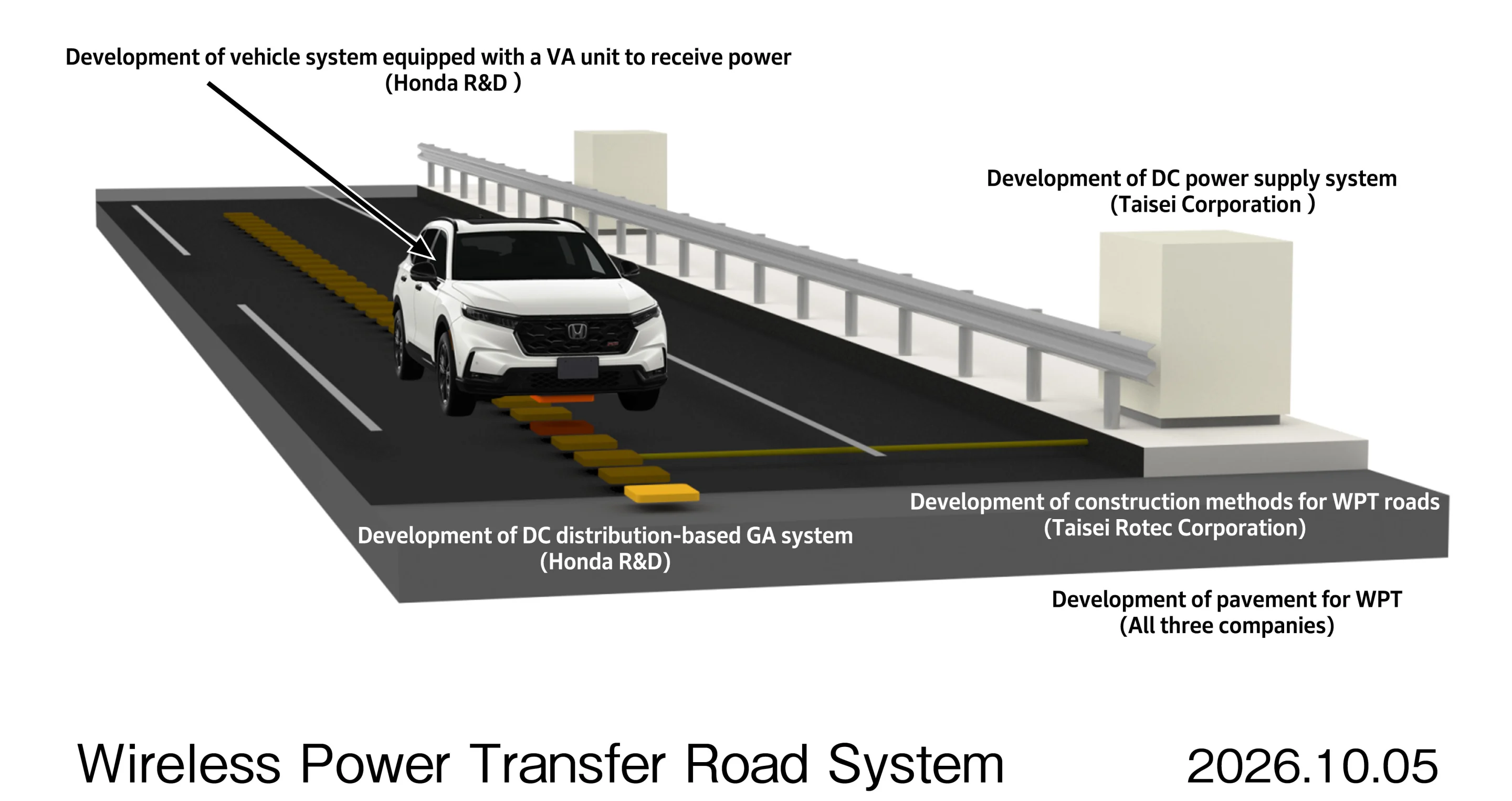
By adopting a DC power distribution structure, the system can simplify the wiring layout inside the road and reduce the required components and construction workload. At the same time, the ground DC power supply system can cooperate with the transmitting unit on the road to achieve high-power wireless power transmission with faster response and more stable output.
Road construction is also key to the practical application of this technology. If the traditional road power supply system requires large-scale road reconstruction, it may face problems such as high construction costs, long traffic interruption time, and subsequent maintenance difficulties. Honda and its partners therefore specifically considered how the equipment would be installed on existing roads.
According to the published design, road construction workers can mill the existing road surface, embed wireless power supply equipment in the resulting space, and then restore the road surface through subsequent construction. The system also takes corresponding measures to address possible unevenness in the road surface after milling to improve the adaptability of equipment installation. Since the DC power distribution structure can simplify the wiring embedded within the road section, it is expected that equipment installation or upgrades will be completed in conjunction with regular road renovation projects in the future.
Another focus of this system is its adaptability to large commercial electric vehicles. Honda hopes to first promote the practical use of dynamic wireless charging technology in the logistics and transportation fields, because the operating efficiency of freight vehicles is often directly related to the recharge time.
For ordinary private cars, the vehicle may only travel tens of kilometers per day, and parking for charging at night or recharging at public charging stations can usually meet the demand. But for long-distance freight trucks, frequent charging stops will affect transportation efficiency. If wireless power supply equipment can be deployed on highways or freight trunk lines, trucks will have the opportunity to continuously replenish power while driving, reducing the time required to stop for charging.
Additionally, automakers may be able to re-evaluate the battery capacity required for vehicles in the future if vehicles can continue to receive power on part of the road. For commercial vehicles operating on fixed routes, if there are reliable wireless power supply facilities along the route, it may not be necessary to rely entirely on large-capacity batteries to cover the entire journey. However, whether this model can truly reduce vehicle costs still depends on many factors such as road coverage, transmission efficiency, equipment investment, and vehicle operation methods.
Honda is not the first company to explore dynamic wireless charging on the road. Several similar projects have emerged in Europe, the United States and elsewhere in recent years, as researchers and companies try to install wireless power transmission equipment on or beneath road surfaces.
In France, Electreon collaborated with highway operator VINCI to test an embedded wireless charging system on a stretch of approximately 1.5 kilometers of highway near Paris. Vehicles taking part in the test include trucks, vans, passenger cars and buses. Early test reports indicate the system's peak power transmission power exceeds 300 kilowatts.
Detroit in the United States has also built public roads equipped with wireless charging technology, and car manufacturer Stellantis has verified an inductive wireless charging system on a dedicated test road in Italy. The UK has also explored electric highway solutions, hoping to improve the range of electric vehicles through power supply facilities along the way.
These projects show that road wireless charging is not just an idea that remains in the conceptual stage, but that related technologies have entered varying degrees of actual testing. However, the equipment structure, transmission power and operating environment used in different projects are different, so the test results cannot be directly equivalent to all road wireless charging systems reaching the same level.
Honda will also enter a larger-scale testing phase next. According to the plan announced by the company, the partners will build a special test section in the second half of 2026 to evaluate the power transmission performance, equipment safety and long-term durability of the system.
The test content will include electromagnetic field leakage control, structural reliability of road embedded equipment, and whether the system can continue to work normally after repeated vehicle crushing. Durability testing will use test conditions equivalent to one million wheel loads, with a reference load of 49 kN on a single wheel. Researchers will use this to evaluate whether the equipment can still maintain stable operation after being subjected to the weight of the vehicle and the impact of the road operating environment for a long time.
For electrical equipment installed on roads, long-term carrying capacity is an issue that cannot be ignored. Roads need to withstand repeated vehicle rolling, temperature changes, rainfall and other environmental factors, and embedded wireless power supply units must not only ensure structural strength but also maintain stable power transmission performance. If the equipment is damaged, it may not only affect the power supply, but also increase road maintenance costs.
Electromagnetic safety also needs to be strictly verified. Wireless charging relies on magnetic fields to transmit energy, so the system must control the distribution of electromagnetic fields around the road and evaluate its potential impact on vehicles, road users, and surrounding equipment. Only when it is verified in aspects such as power supply performance, structural durability and electromagnetic safety can the technology enter a wider range of public road applications.
Follow-up testing will also evaluate whether the system can reach a maximum power transmission power of 150 kilowatts and verify whether the vehicle can reliably receive power at higher driving speeds. This power level is a target that Honda plans to further verify and does not mean that it has been proven that the vehicle can continuously obtain 150 kilowatts of wireless charging power in all road conditions.
In addition to joint research and development between Honda, Daisei Construction and Daisei Road, the three companies also plan to participate in the "Tateyama Project" promoted by Japan's East Japan Expressway Corporation. The project plans to carry out demonstration testing of dynamic wireless power transmission technology on Tateyama Expressway in Chiba Prefecture starting in Japan's fiscal year 2027.
Honda also plans to showcase relevant research and development results at multiple industry events, including the Japan Mobility Show Bizweek to be held in Chiba Prefecture, Japan, in October 2026, and the 2026 International Intelligent Transportation System World Congress to be held in Gangneung, South Korea from October 19 to 23.
Although the technical prospects have attracted attention, road wireless charging still faces many practical problems before it can be truly put into large-scale commercial operation.
The first is the construction cost. Compared with ordinary charging piles, dynamic wireless charging not only requires vehicles to be equipped with special receiving devices, but also requires laying transmitting equipment on the road, connecting power supply lines, and building corresponding power control systems. If vehicles are to continue to obtain electric energy during long-distance driving, a considerable part of the road will need to be modified, and the initial investment may be considerable.
The second is energy transmission efficiency. Wireless power transmission inevitably involves energy loss, and factors such as vehicle speed, distance between coils, and layout of road equipment may affect the actual transmission effect. Even if the system can achieve a higher peak power, it does not mean that the vehicle can charge stably at this power throughout the entire driving process.
The third issue is infrastructure coverage. If only a few road sections are equipped with wireless power supply equipment, the vehicle still needs to rely on batteries to complete other road sections. Therefore, dynamic wireless charging may significantly change the way vehicles replenish energy only if a sufficiently continuous power supply network is formed on freight trunk lines, highways, or other high-traffic roads.
Finally, the operating model also needs to be addressed. Road construction, equipment installation, maintenance and power supply all require capital investment. Whether these costs will be borne by the government, highway operators, logistics companies or energy companies in the future, and how vehicle users pay for the electricity they obtain, will affect the commercial viability of this technology.
From the perspective of application scenarios, dynamic wireless charging may first play a role in the field of logistics and transportation with fixed lines and high-frequency operations. Compared with comprehensive reconstruction of all roads, prioritizing the deployment of equipment in busy freight corridors, near logistics hubs, or on sections frequently traveled by large commercial vehicles may be easier to generate stable demand and improve infrastructure utilization.
Honda has not announced a formal commercialization timetable for this system, nor has it given the specific cost and final energy transmission efficiency required for large-scale deployment. Therefore, at this stage, it is more suitable to regard it as a research and development project that has completed basic technology development and is about to enter the further verification stage, rather than a mature charging solution that is about to be fully popularized.
If subsequent tests can prove that the system has reliable high power output, sufficient energy transmission efficiency and low maintenance requirements, road wireless charging may bring a new way of replenishing energy for electric vehicles. Especially for large-scale commercial electric vehicles, reducing parking charging time, improving vehicle utilization, and even reducing dependence on ultra-large-capacity batteries may become directions worth exploring.
However, what really determines whether this technology can change the electric vehicle industry is not just whether the vehicle can be charged while driving, but whether road construction costs, energy efficiency, equipment durability and business operation models can form a sustainable balance. Over the next few years, road testing by Honda and its partners will provide a more critical basis for judging the actual value of this technology.
Comments