
Abstract:
"I feel something is wrong. If I invest any more, it will be a bottomless pit." By the time the salesman Aqiang (pseudonym) realized this, he had already spent nearly 10,000 yuan on Xinyu App. From then on, he began to defend his rights on various complaint platforms. Xinyu is a stranger social app launched by NetEase Cloud Music in 2020. It defines itself as "a real-life, same-city, and safe real-person dating app." It claims to have completed over 100 million matches for users, and promises to filter out scammers and vest accounts from the source. In addition to real-time chat, Xinyu also provides live broadcast, multi-person voice chat, KTV and other gameplay.
Aqiang was initially moved by this rhetoric. After downloading and registering, people started chatting with him as soon as he went online, sending ambiguous messages, making videos, and even flirting with him while wearing revealing clothes. This "enthusiasm" soon turned into the platform's recharge prompt, "tens of dollars were spent in an hour or two."
In order to get the contact information of the other party, Aqiang kept recharging according to the platform rules to increase the "intimacy".
In the conversation interface, the platform clearly prompts "You can send contact information after the intimacy level has been upgraded to level 9." But after he spent nearly ten thousand yuan to reach the target, his contact information was not automatically unlocked. "The platform cannot force", Xinyu gave another version of the explanation.
Why not make it clear in advance? Is this inducing consumption? Ah Qiang was not the only one confused. On the Black Cat Complaint Platform alone, a large number of similar cases can be found among the more than 1,200 complaints including "Xinyu". There are also people who have never downloaded Xinyu but received marketing text messages; more people have recharged and chatted, but they suspect that the person on the other side of the screen interacting ambiguously with them is actually an AI (artificial intelligence) robot.
The user doesn’t know who is on the other side of the screen, but every recharge will eventually be returned to a listed company’s report. In the first half of 2026, NetEase Cloud Music achieved revenue of approximately 3.959 billion yuan, a year-on-year increase of 3.4%, and adjusted net profit dropped to approximately 860 million yuan from approximately 1.946 billion yuan in the same period last year.
2-4 cents per message
"This is very addictive. The girls on it are very beautiful and revealingly dressed. As soon as you log in, many people post ambiguous topics." A user admitted to a Beijing Business Daily reporter that he had no resistance.
In the app store, Xinyu’s introduction to himself is more direct, “It’s easy to find a partner” and “It’s not a dream to reply instantly”, but in the real experience of users, the price of instant reply is clearly marked.
When entering Xinyu, every step of user interaction is marked with a price by the platform. According to the rules of the platform, whether there is a fee for striking up a conversation or chatting depends on who initiates it. Whoever initiates it first pays, and the other party can get points as a reward. When both parties successfully follow each other, they can chat via text and audio and video for free.
Regarding fees, Xinyu has detailed rules and even refines them to specific functions: text chats are 3-5 gold coins per message, voice calls are 16 gold coins/minute, and video calls are 45-58 gold coins/minute.
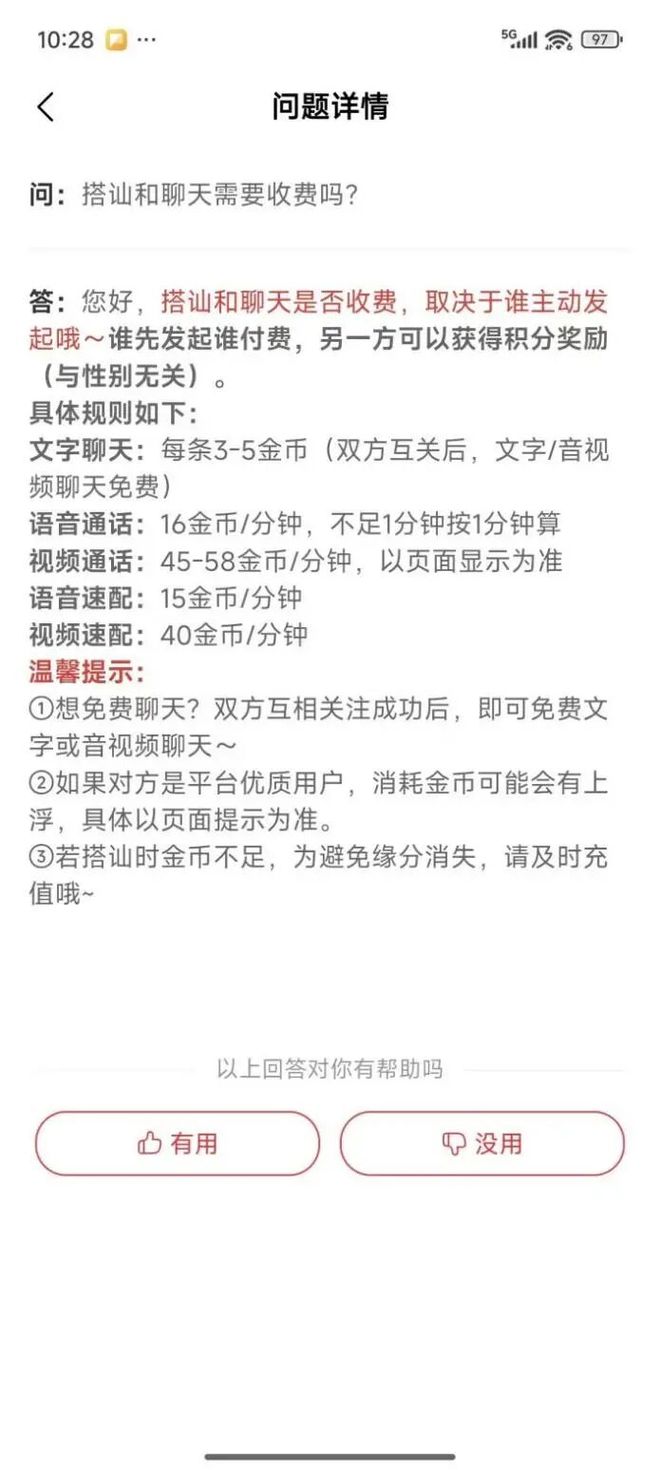
Picture source: Screenshot of Xinyu App
According to the platform rules, gold coin recharge is divided into 6 levels. The minimum recharge of 6 yuan can be exchanged for 70 gold coins, and the highest level of one-time recharge of 1,098 yuan corresponds to 13,720 gold coins. Calculated according to the exchange ratio, sending a message requires 3-5 gold coins, which is approximately 0.24-0.43 yuan/message. A reporter from Beijing Business Daily recharged 70 gold coins, and received a recharge reminder of "insufficient gold coins" from the system only 9 minutes later, sending a total of 22 messages.
In Xinyu, gold coins are directly linked to intimacy, 1 intimacy = 1 gold coin, and intimacy corresponds to different user levels. New interactions can be unlocked when the level is increased. For example, reaching level 2 can unlock voice call permissions, and reaching level 3 can unlock video call permissions.
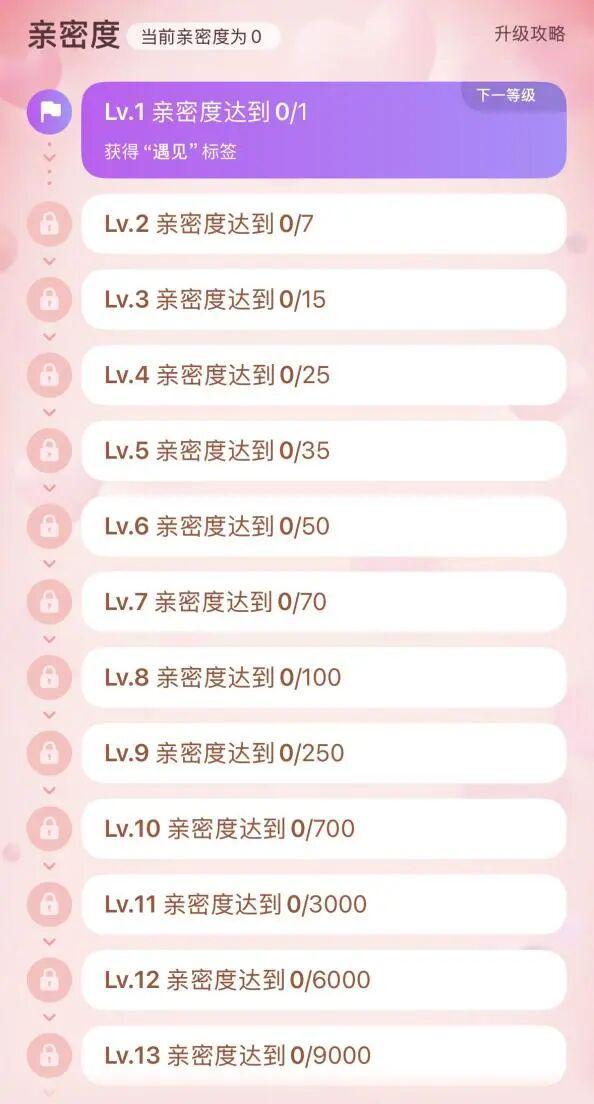
Picture source: Screenshot of Xinyu App
Liang Zhenpeng, a senior industrial economic observer, told a reporter from Beijing Business Daily that platforms such as Xinyu set chat and voice and video as gold coins before they can be used. In essence, they are taking advantage of people's loneliness and emotional needs to design payment points. "This model itself is not illegal, but it can easily lead to induced consumption and emotional harvesting."
"We started chatting very sincerely, saying there was no rush, and we would wait for a few months after knowing each other. After a few months, we spent a lot of money chatting and making videos on the platform, and (the other party) found reasons not to meet. (I) wanted to give up, but there was a new temptation. Over the past year, I don’t know how many we chatted with, and each time we chatted, we spent money." A user shared with a reporter from Beijing Business Daily the feeling of pull of using Xinyu.
Some users also shared "making money strategies" on social media. A reporter from Beijing Business Daily browsed social media and found more than one post on "How to make money in the heart". Some comments said "making money is easy" and "earned 3,000 yuan a month."
The authenticity of Xinyu’s emphasis is also questionable. A female user reported to a Beijing Business Daily reporter that the process of registering as a male was very smooth, and that the platform did not conduct substantive verification of gender, age or real person's face.
After successful registration, the user immediately received several chatting messages with a friendly tone: "Handsome guy, I like you, can you fall in love with me?" "Can I go play with my brother?"
Zhao Zhanhan, a special researcher at the Intellectual Property Research Center of China University of Political Science and Law, pointed out, "The issue of emotional consumption has become a new hotspot for complaints, mainly focusing on merchants' use of various tricks to induce consumption and the difficulty of refunding fees. If the operator actively recruits fake chatters and condones deceptive inducement of consumption, the operator and related personnel may be deemed to be jointly guilty of fraud."
Unclear hierarchical permissions
Recalling the experience of using Xinyu, Aqiang believed that he was probably the target of being induced to consume.
At the beginning, he did not expect that he would spend so much money on a social platform. After downloading Xinyu with the mentality of "take a look", he was attracted by the sweet girls' proactive chatting.
At first, Aqiang only charged a few dozen yuan, and it was all spent in less than two hours. In order to get enough "intimacy", he spent eight to nine thousand yuan on the platform. He also successfully added the other party's WeChat several times, but the results were similar: the other party asked to transfer a small amount of money on WeChat for various reasons. As soon as the money passed, he was immediately blocked.
There are many users who spend tens of thousands of yuan. On the Black Cat Complaint Platform, a user posted a record, saying that he had recharged up to 32,025 yuan in Xinyu over the years. The user pointed out that a large number of accounts on the platform actively send messages, and the system strictly restricts the exchange of contact information between the two parties, which continues to induce payment and is not a real friendship. The user believed that "virtual gold coins consumed will not be refunded" was an overlord clause. After requesting a refund from the platform, it was rejected.
Another user wrote: "I have recharged gold coins many times, spending thousands of yuan in total, but I have not been matched with real users who can communicate offline. The platform has set hard blocking rules, and WeChat and mobile phone numbers cannot be sent during chats. It claims to increase the intimacy and recharge more money to exchange contact information. After recharging, I still cannot get the other party's private contact information. It is completely a closed-loop recharge."
At what level can I get the contact information of the other party? Why can't I get contact information when I reach the corresponding level?
According to the screenshot provided by user Zhang Yu (pseudonym), after he sent relevant information requesting contact information on the conversation interface, the platform will prompt that the message was not sent successfully, and clearly stated that "to protect user privacy, contact information can be sent after the intimacy level is upgraded to level 9."
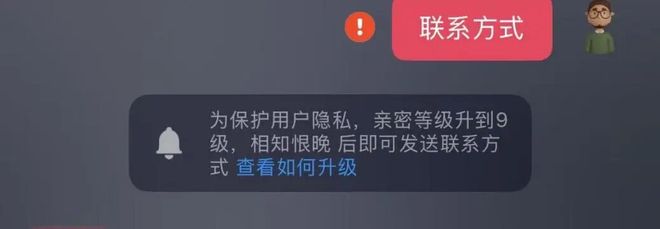
Picture source: Screenshot of Xinyu App
Zhang Yu consulted customer service on related issues, and the customer service replied, "If the intimacy level is 250 (that is, the intimacy level is upgraded to level 9), you can send contact information." However, when he asked, "What if the other party doesn't send it, then my recharge will be in vain?", the customer service said, "Whether the other party is willing to send you contact information depends on the other party's wish. The platform cannot force it."
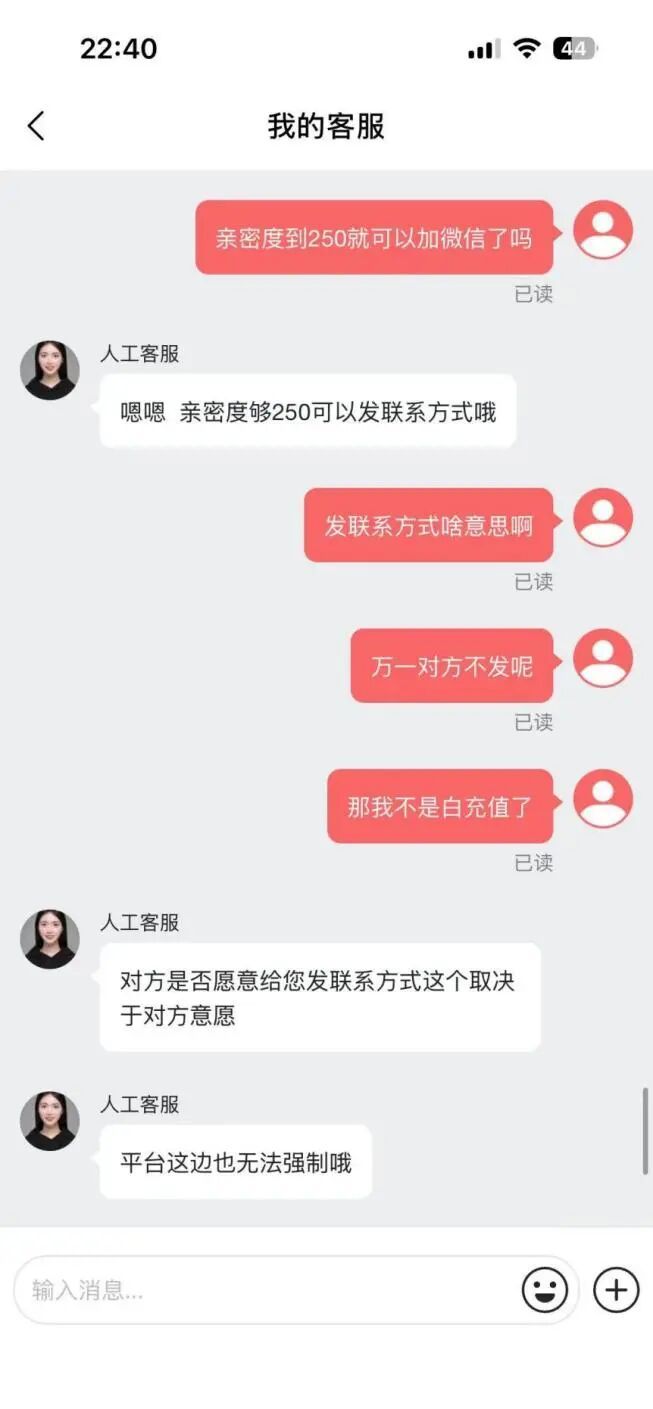
Picture source: Screenshot of Xinyu App
In addition to Black Cat complaints, a large number of users on platforms such as Consumer Protection and Legal Affairs Network reported the same problem: reaching the threshold declared by the platform, but contact information is still blocked.
In response to issues such as inconsistent intimacy rules and disputes over induced top-ups, relevant people in Xinyu responded to a Beijing Business Daily reporter: "To ensure a better interactive experience, platform users can voluntarily send their contact information after the intimacy reaches certain requirements."
However, the person did not provide a relevant answer as to why the platform did not clearly inform users of the core restriction that "reaching the intimacy level only means obtaining permission to send, and the other party can still refuse" before recharging.
Manual customer service with layers of obstacles
It is not easy to effectively communicate with the platform on various issues.
According to the experience of a Beijing Business Daily reporter, you can click "My" in the lower right corner of the Xinyu homepage to enter "My Customer Service - Contact Customer Service", but "This message is generated by AI" is displayed under each reply; when entering "manual customer service", the dialog box still contains the AI-generated reply: "Hello, you can briefly describe the problem you encountered with the assistant, and I will try my best to help you solve it."
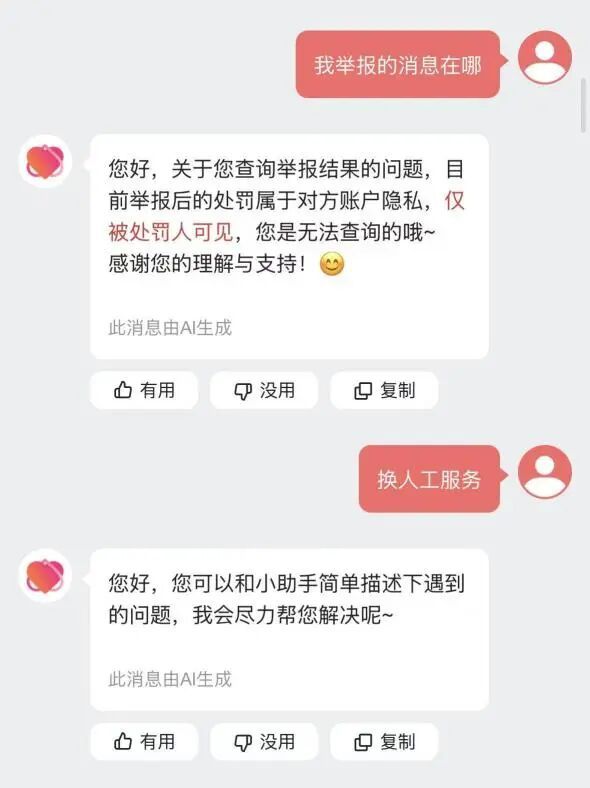
Picture source: Screenshot of Xinyu App
According to the screenshot provided by Li Lin (pseudonym), when he communicated with the corporate WeChat account labeled Hangzhou Ledu Technology Co., Ltd. (operator of Xinyu), the account prompted: For urgent matters, you can contact the platform's manual customer service, click "Contact Customer Service", enter "Manual Customer Service" three times, and the employee number that appears is a real person.
According to this method, Beijing Business Daily reporters have experienced it many times. After entering "manual customer service" three times, no real customer service was called. After entering "manual customer service" four times in a row, a link to online human service popped up on the dialogue interface.
On September 1, 2026, my country's first national standard "Customer Contact Service - Requirements for Collaboration of Artificial and Intelligent Customer Service" (GB/T 47746-2026) (hereinafter referred to as the "Standard") focusing on the collaboration mechanism of artificial and intelligent customer service was officially implemented. The standard clearly requires that the customer service system should provide a manual service entrance in a clear and unambiguous way; the switching between intelligent customer service and manual customer service must provide a convenient entrance, ensure smooth connection, and synchronize customer information without repeated inquiries.
Mo Biqi, a lawyer at Guangdong Bonda Law Firm, analyzed to a Beijing Business Daily reporter that the standard is a recommended national standard and cannot be directly used as a basis for punishment. "But once a company publicly declares its adoption, it must provide services in accordance with the standard. When the service standard is unclear, the court can refer to the standard to determine whether the service quality is up to standard."
In response to questions such as whether Xinyu adopts the above standards and the hidden settings of manual customer service, a Beijing Business Daily reporter sent an interview outline to relevant company personnel via email. As of the time of publication, the other party had not responded.
Talking about the path for Xinyu users to find manual customer service, Zhao Zhan pointed out that if the platform substantially hinders consumers from obtaining manual services through complex menus, it may violate the legal obligations stipulated in Article 44 of the "Consumer Rights Protection Law Implementation Regulations", and the clear commitment made by AI customer service to consumers cannot be refused on the grounds that "AI replies do not represent the company's position."
Illegal live streaming rooms are recommended
Back to the business level, in addition to instant chat, Xinyu also provides functions such as billiards, KTV, voice, video, and live singing.
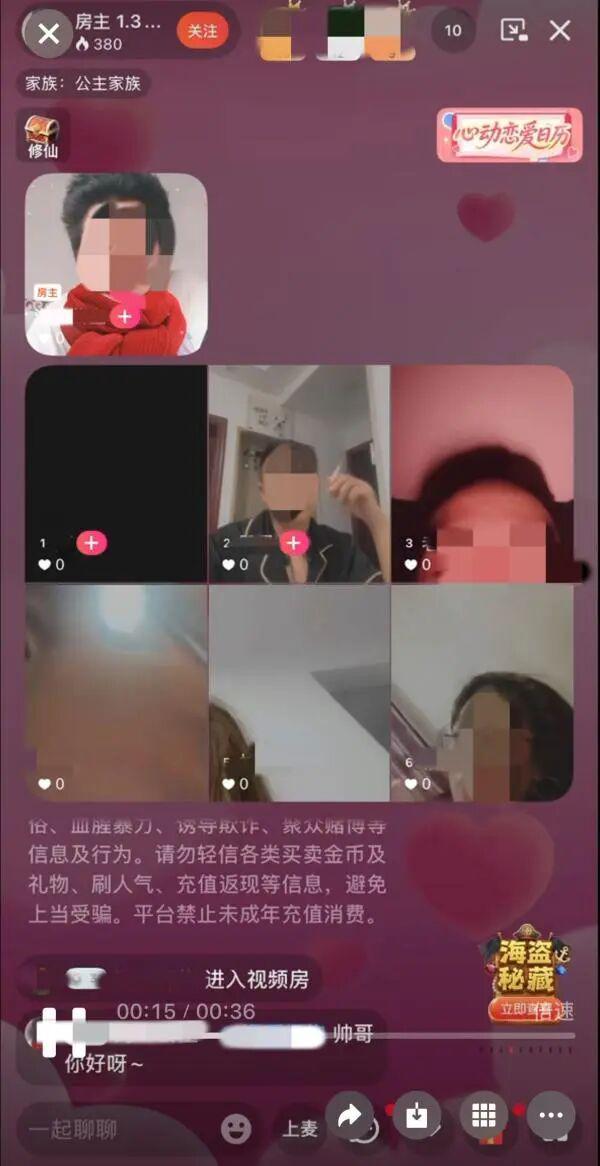
Reporters from Beijing Business Daily found through actual testing for several consecutive days that the live broadcast rooms that occupy the core positions often appear with suspected violations.
In individual live broadcast rooms, reporters found a variety of situations. For example, in front of the camera, a female anchor was wearing revealing clothes, twisting her body, and making ambiguous movements towards the camera from time to time. In another live broadcast room with multiple people connected, an anchor smoked and faced the camera the whole time, while also picking up and drinking canned beer.
Picture source: Screenshot of Xinyu App
In addition, an anchor with obvious tattoos on his chest did not do any physical covering. During this period, the status of the live broadcast room was normal and there was no obvious system warning.
These phenomena run counter to the rules of the platform. The "Xinyu Community Code of Conduct" clearly states that users are not allowed to post "audio, video, text, pictures and other information that are pornographic, suggestive, provocative, or cause similar feelings in others", nor are they allowed to post "content that may cause minors to imitate unsafe behaviors and violate social ethics, or induce bad habits in minors."
Every time the user enters the live broadcast room, the dialog box also reminds that "the platform inspects the live broadcast content 24 hours a day. If you find any illegal, pornographic, vulgar, induced fraud, etc., please report it in time. Please do not transfer money privately, and pay attention to personal and property safety."
In response to issues such as illegal content and review mechanisms found in live broadcast rooms, Xinyu related people responded to a Beijing Business Daily reporter: "For users who have violated regulations on the platform, the platform will take punitive measures ranging from time-limited bans to permanent bans based on the actual situation. Regarding the relevant live broadcast rooms Content, the platform will conduct real-time security inspections, and once a violation is identified, real-time interception or manual intervention will be adopted to deal with the violation. If it is verified that there are violations such as smoking or displaying tattoos, the platform will ban the relevant account for a certain period of time. ”
However, just after relevant people responded, Beijing Business Daily reporters entered multiple live broadcast rooms to check again and still encountered similar situations.
AI social impact
In addition to illegal content and questions from Aqiang, AI social products are bringing new impacts to traditional stranger social applications.
Sensor Tower data shows that in the first quarter of 2026, the mobile in-app purchase revenue of AI Companion (AI Companion) apps was approximately US$150 million, more than 12 times that of the same period in 2023; QuestMobile’s spring report shows that ByteDance’s multi-flash monthly active users have exceeded 30 million, and Soul is also vigorously promoting self-developed large models.
Liang Zhenpeng judged: "The moat for paid chat products like Xinyu is actually very shallow. AI social products can also do matching and instant chat in the same city, and AI companions can respond infinitely and do not require real people to pay to unlock. The cost is lower and the experience is more stable."
"The rapid growth of AI social products is indeed diverting the traditional stranger social track." Zhao Zhanzhan analyzed to a Beijing Business Daily reporter, "The moat of Xinyu, a product with paid chat as its core, is the authenticity of real-person social interactions. Only by shifting the focus of competition from 'paid unlock' to improving real-person social matching efficiency and service quality, and building differentiated advantages with real interactive experiences, can we remain competitive under the impact of AI social."
Faced with the social media giant, which is a track coveted by all, NetEase Cloud Music has made many attempts, including "Xinyan", which was previously removed from the shelves, and "Miaoshi", an AI emotional companion application that was discontinued in July 2026.
In the first half of 2026, NetEase Cloud Music achieved revenue of approximately 3.959 billion yuan, a year-on-year increase of 3.4%; adjusted net profit halved from approximately 1.946 billion yuan in the same period last year to approximately 860 million yuan.
NetEase Cloud Music’s revenue sources include online music services, social entertainment services and two other sectors. Among them, in the first half of 2026, online music service revenue was approximately 3.067 billion yuan, a year-on-year increase of 3.4%; social entertainment services and other revenue was approximately 891 million yuan, a year-on-year increase of 3.7%. A Beijing Business Daily reporter sent an interview outline to NetEase Cloud Music regarding Xin Yu’s revenue segment ownership and revenue contribution in NetEase Cloud Music. As of press time, the other party had not responded.
Comments