
Abstract:
Microsoft recently responded to Windows security issues. Faced with the one-time fix of more than 1,100 Windows security vulnerabilities in October 2026, the company emphasized that this does not mean that the security of Windows 11 is declining. Instead, it shows that Microsoft is using artificial intelligence technology to examine software code on a larger scale and more deeply to discover and fix security issues that may have been ignored in the past.
However, Microsoft also issued a warning that deserves vigilance: With the development of artificial intelligence technology, attackers may now only need a few hours to analyze the security patches released by Microsoft, reversely deduce the principle of the vulnerability, and develop corresponding attack tools.
According to Microsoft's October 2026 Security Update Guide, a total of 1,413 CVEs (Common Vulnerabilities and Exposure Numbers) were fixed by Microsoft's products that month, of which 1,102 were fixed by the Windows system itself. This number far exceeds previous regular months and continues the trend of a sharp increase in the number of security vulnerability disclosures in the second half of 2026.
The growth in the number of Windows vulnerability fixes is particularly noticeable. The number of vulnerabilities fixed by Windows every month in 2026 will increase significantly compared with 2025.
Among them, 413 items were repaired in July 2026, 233 items were repaired in August, 726 items were repaired in September, and it climbed to 1,123 items in October. For comparison, Windows has only fixed 134 vulnerabilities in October 2025.
Microsoft believes that this change cannot simply be understood as Windows becoming more insecure. In the past, some security vulnerabilities may have been hidden in huge code bases for a long time, and only entered the repair process until external researchers discovered and reported them, or attackers had begun to exploit them. Now that Microsoft has begun using artificial intelligence systems to scan more code and proactively look for potential security flaws, the number of vulnerabilities discovered and disclosed has naturally increased.
Nuno Costa, head of Microsoft's Windows Service and Delivery Department, said that the number of vulnerabilities alone does not fully reflect the security level of the operating system. More importantly, companies can detect vulnerabilities, fix problems, and deploy security protection measures to user devices in a timely manner.
Microsoft also emphasized that public disclosure of vulnerability information is not a simple increase in security risks, but allows security researchers and enterprise IT managers to more accurately understand the impact scope, severity and repair methods of the vulnerability, so as to take targeted protective measures.
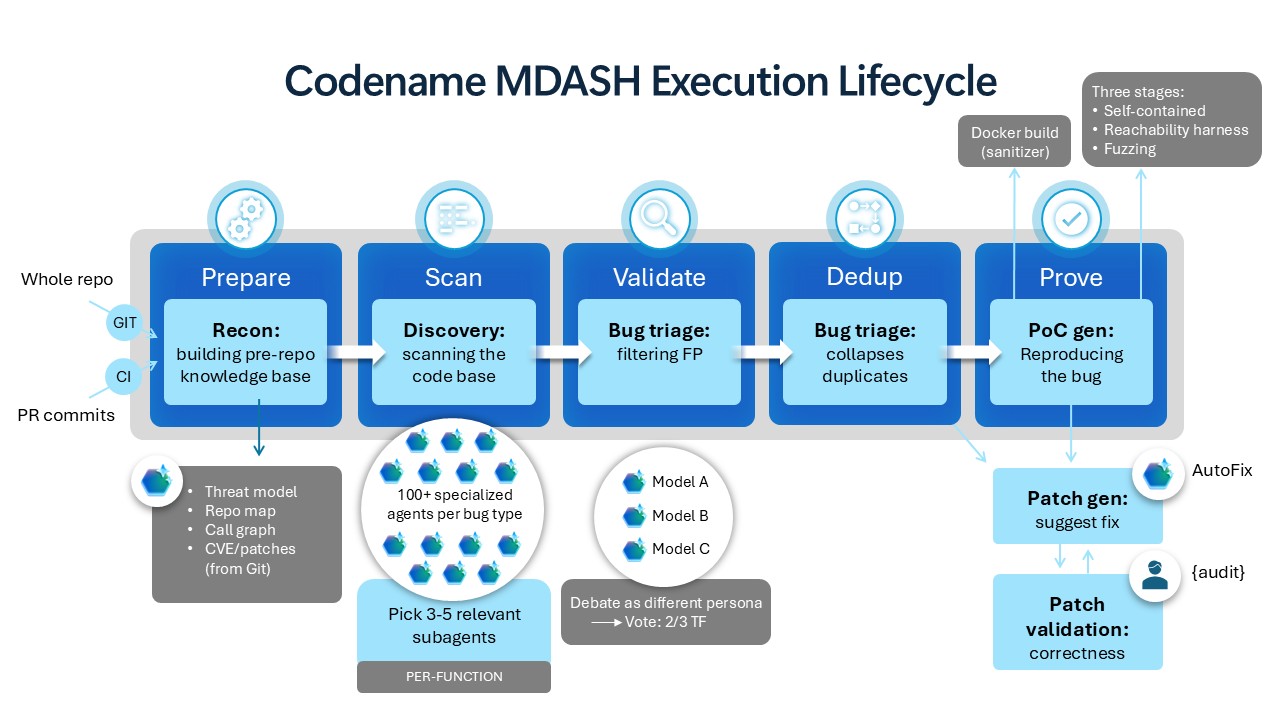
In order to improve the efficiency of vulnerability discovery, Microsoft is using an artificial intelligence security scanning system called MDASH on a large scale. The system combines Microsoft's own security model, as well as partner technology including Anthropic Mythos, and uses a specially designed AI agent to find and verify potential vulnerabilities.
Artificial intelligence can not only help identify anomalies in the code, but also assist engineers in determining which Windows versions are affected, what consequences the vulnerability may have, and what repair measures should be taken. However, Microsoft emphasized that artificial intelligence has not replaced security engineers, and human engineers are still responsible for the final vulnerability judgment and repair decisions.
However, the application of artificial intelligence in the security field is a double-edged sword. Microsoft pointed out that AI can not only help defenders discover vulnerabilities faster, but also help attackers find unfixed security flaws, and even analyze patches that have been released to deduce problems existing in the original code.
In the past, attackers often had to invest considerable time studying software code to understand how a vulnerability worked. But now, after Microsoft makes the patch public, attackers can use AI to quickly compare the code changes before and after the fix, locate the modified parts, and then infer the triggering conditions of the vulnerability.
This means that after a security patch is released, user devices will not automatically become secure immediately. As long as users have not installed updates, they may be in a risky stage known as the "Patch Gap."
Microsoft specifically warned that the process for attackers to use AI to analyze patches and develop exploits may now be shortened to hours instead of days or even weeks in the past.
Jeremy Chapman, director of Microsoft 365's work with Windows customers, has previously warned that companies should no longer delay monthly security updates for three days or more as in the past. He believes that if critical security updates are deployed weeks after their release, enough time has been left for attackers who can use AI to quickly analyze vulnerabilities.
Enterprise device diagnostic data released by Microsoft also shows that the deployment speed of security updates is still not ideal. In the sample collected in August 2026, two weeks after the security update was released, less than half of the enterprise devices had the update installed; four weeks after the release, about a quarter of the devices still did not have the corresponding update installed.
This means that even if Microsoft has completed vulnerability fixes, a large number of enterprise devices may still be exposed to known security risks for a considerable period of time.
Microsoft therefore hopes that enterprises will change their traditional update management strategies and no longer regard security updates as routine maintenance tasks that can be deployed slowly on a fixed cycle. Instead, they should incorporate the actual deployment time after vulnerability repairs into the overall security management system.
It is worth noting that the October 2026 security update also contains a Windows Shell security feature bypass vulnerability that has been found to be exploited, numbered CVE-2026-96951. In addition, a .NET Framework security feature bypass vulnerability has been publicly disclosed.
Microsoft believes that in the future, security management will increasingly rely on risk priority, rather than simply determining the order of updates based on the number of vulnerabilities. Enterprises should prioritize protecting devices that connect directly to the Internet, authentication infrastructure, and systems that hold critical data.
For ordinary Windows 11 users, the message conveyed by this incident is relatively straightforward: the increase in the number of vulnerabilities fixed by Microsoft does not mean that the system must become more vulnerable, but the timeliness of security updates is becoming more important than ever.
Especially when AI can accelerate vulnerability research and attack tool development, if users delay system updates for a long time, they may allow already disclosed security flaws to become entry points for attacks. Microsoft recommends that users install monthly cumulative security updates as soon as possible and not delay patch deployment for long periods of time without good reason.
This change also means that network security is entering a new stage. Artificial intelligence is simultaneously improving the efficiency of software manufacturers in discovering vulnerabilities and hackers in exploiting vulnerabilities, and the attack and defense cycles between the two parties have been greatly compressed. In the future, the security level of operating systems will not only depend on how many vulnerabilities manufacturers can discover, but also on how quickly the entire process can be completed from vulnerability discovery, patch release to final deployment to every device.
Comments