
Abstract:
ChatGPT official announcement:
Starting from October 14th, GPT-5.5 will be completely offline in the full package of ChatGPT, ChatGPT Work and Codex.
There is no buffer period, no retreat, one-size-fits-all on the consumer side, enterprise side, and programming side. Instead, there was an official understatement:
Please migrate to GPT-5.6 Sol or GPT-6 Astra.
The official post even included a saluting emoji: "Thank you for your continued support, 5.5."
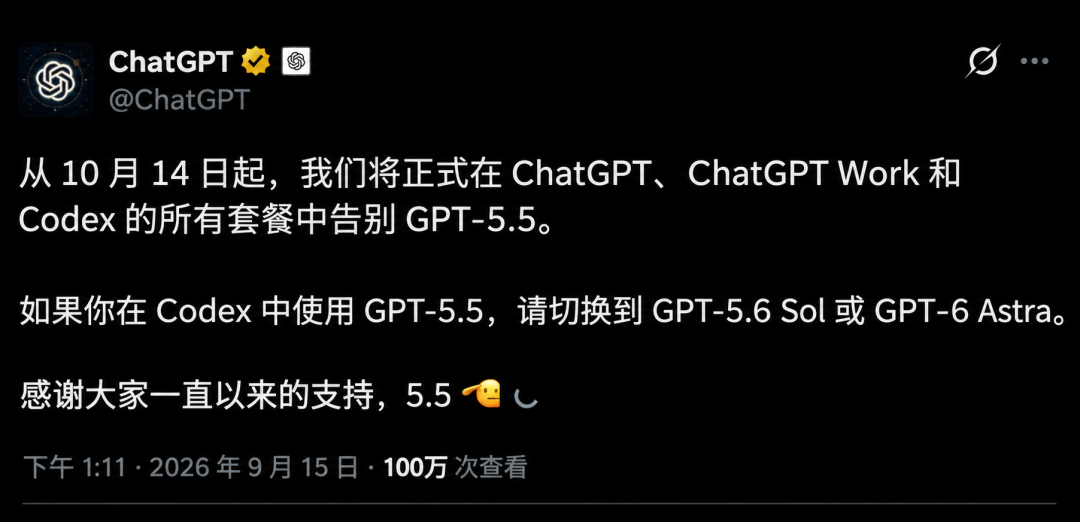
From its high-profile debut in April this year, which was hailed as "a true productivity intelligence designed to do dirty work," to its countdown to its exit now, the life cycle of GPT-5.5 has only lasted less than half a year, and everything seems like yesterday.

Sudden "Zhan Li Jue": the entire package will be canceled without distinction
In the past, model iterations focused on "alternation of old and new, and natural transition," but this time the farewell to GPT-5.5 is more like a vigorous "forced relocation."
According to the official announcement from ChatGPT,
GPT-5.5 will be completely deleted from the service list on October 14, 2026
.Pay attention to the official wording and scope:
Not just the free version and the Plus version: even the enterprise version of ChatGPT Work with a high unit price is no exception;
The programming base Codex will be removed simultaneously: the GPT-5.5 engine, which countless engineers directly access the IDE for code completion and reconstruction, will be completely removed;
There are no legacy reserved channels: This means that on October 14th, whether you are opening a long unclosed conversation on the web page or running an Agent pipeline with 5.5 mounted in the background, as soon as the time is up, the supply will be out of service.
Back when OpenAI launched GPT-5.5, OpenAI positioned it as a new intelligence.
It is very easy to use. You don’t need to watch every step or give instructions repeatedly to get the job done. Moreover, it saves tokens, responds quickly, and can run on a large scale.

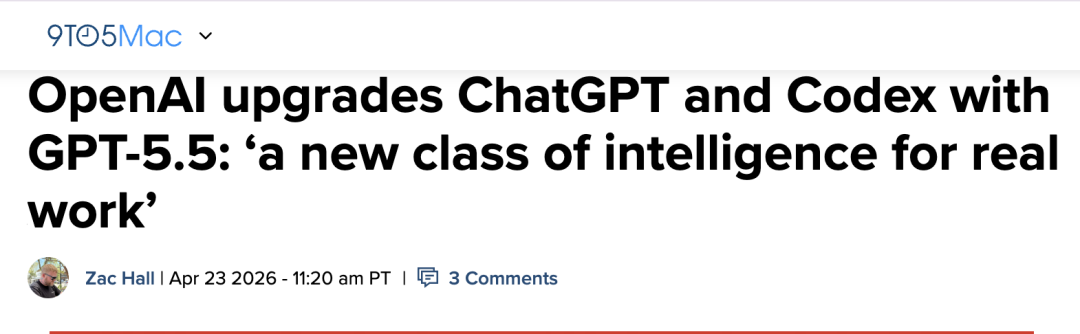
Foreign technology media 9to5Mac once used a large page to praise it as
"a new generation of intelligent agents for real work"
.
At that time, everyone was still sighing that AI could finally act as a reliable worker in complex long text logic, cross-table data analysis and strict code architecture.
However, in less than six months, this "cyber honeymoon period" came to an abrupt end.
On social media, the official comment section instantly exploded.
Some people even thought that the $200 subscription package that made their wallets tremble was about to be cancelled. After a closer look, they realized that the death knell of 5.5 was ringing:

One day for AI and one year for human beings.
In the current AI track, six months is enough to turn a cutting-edge model from an "epoch-making hero" into a "computing power liability."
Two official guiding cards: Sol or Astra?
Now that offline is a foregone conclusion, the most realistic question facing all users is:
Whose name should I call when work starts tomorrow?
The official gave a clear migration route in the announcement:
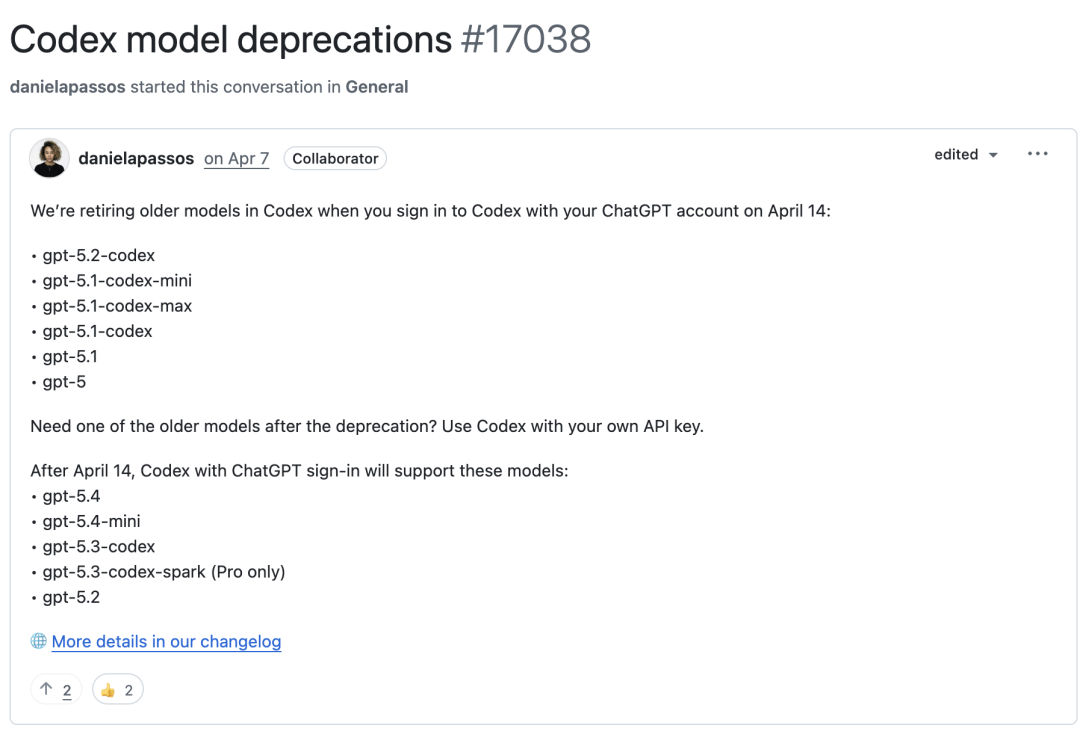
In Codex and ChatGPT, please switch to GPT-5.6 Sol or GPT-6 Astra.
What is the difference between these two cards? How to choose between workers and developers?
We combine the community's front-line measurements and technical architecture to dismantle the quality of these two "successors":
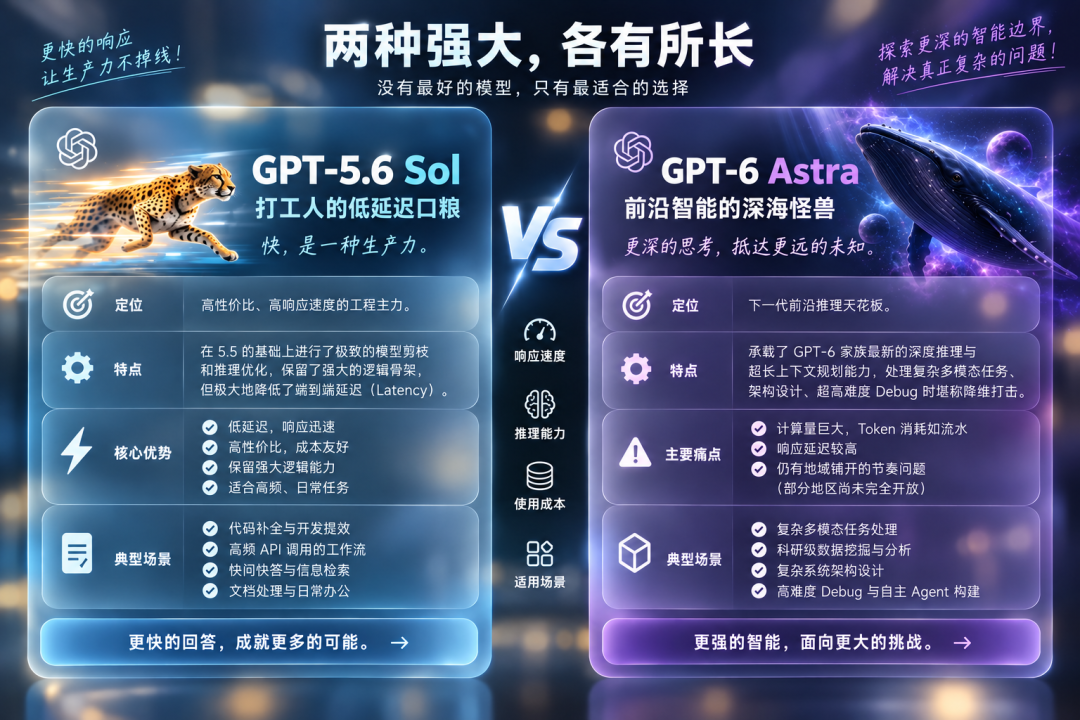
It is obvious that OpenAI's product matrix is undergoing an unprecedented "downsizing and differentiation":
Either use the extremely light and extremely fast Sol to solve daily productivity, or use the overweight and ultra-strong Astra to solve hard core problems.
Sandwiched in the middle, 5.5, which no longer has an advantage in energy consumption ratio and computing power cost-effectiveness, has naturally become the target of elimination.
The nightmare of programmers and architects: "My Agent circuit collapsed overnight"
For light chat users, changing models is nothing more than selecting an icon in a drop-down menu. Even if the system switches quietly, many people may not notice the subtle difference.
But for
engineers, automated agent developers and enterprise system architects who deeply integrate GPT-5.5 into the production environment
To me, this is nothing short of an earthquake.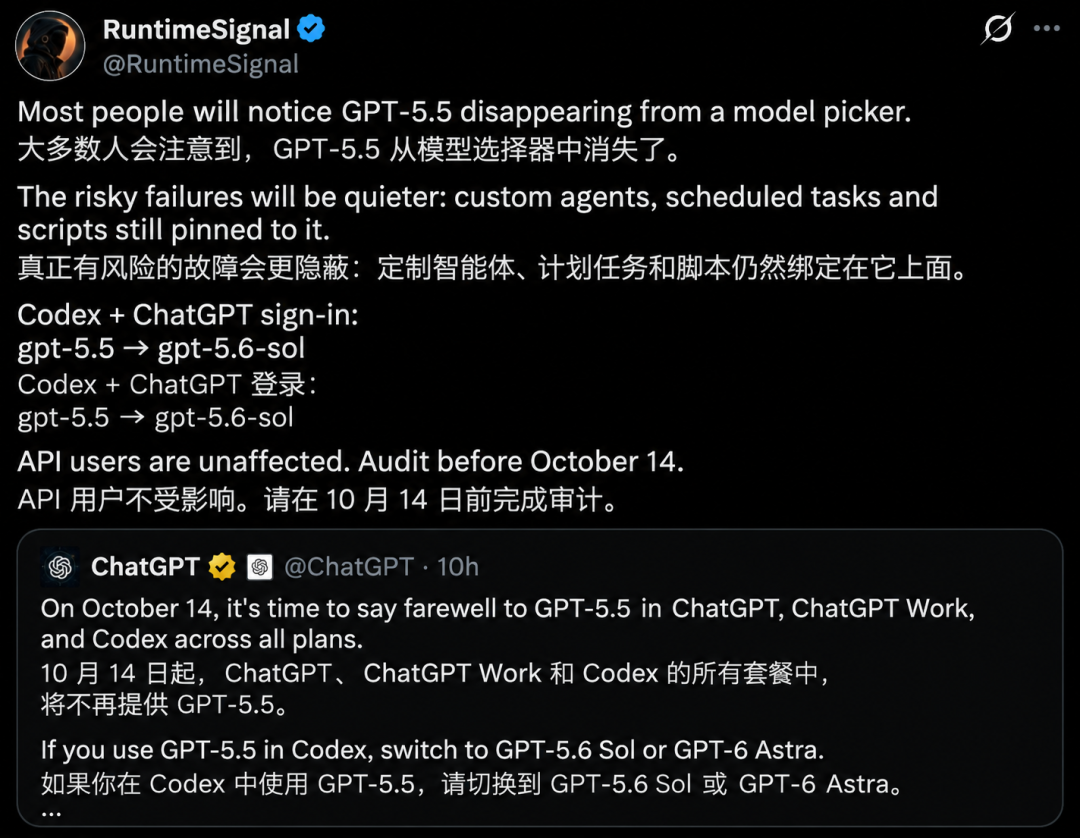
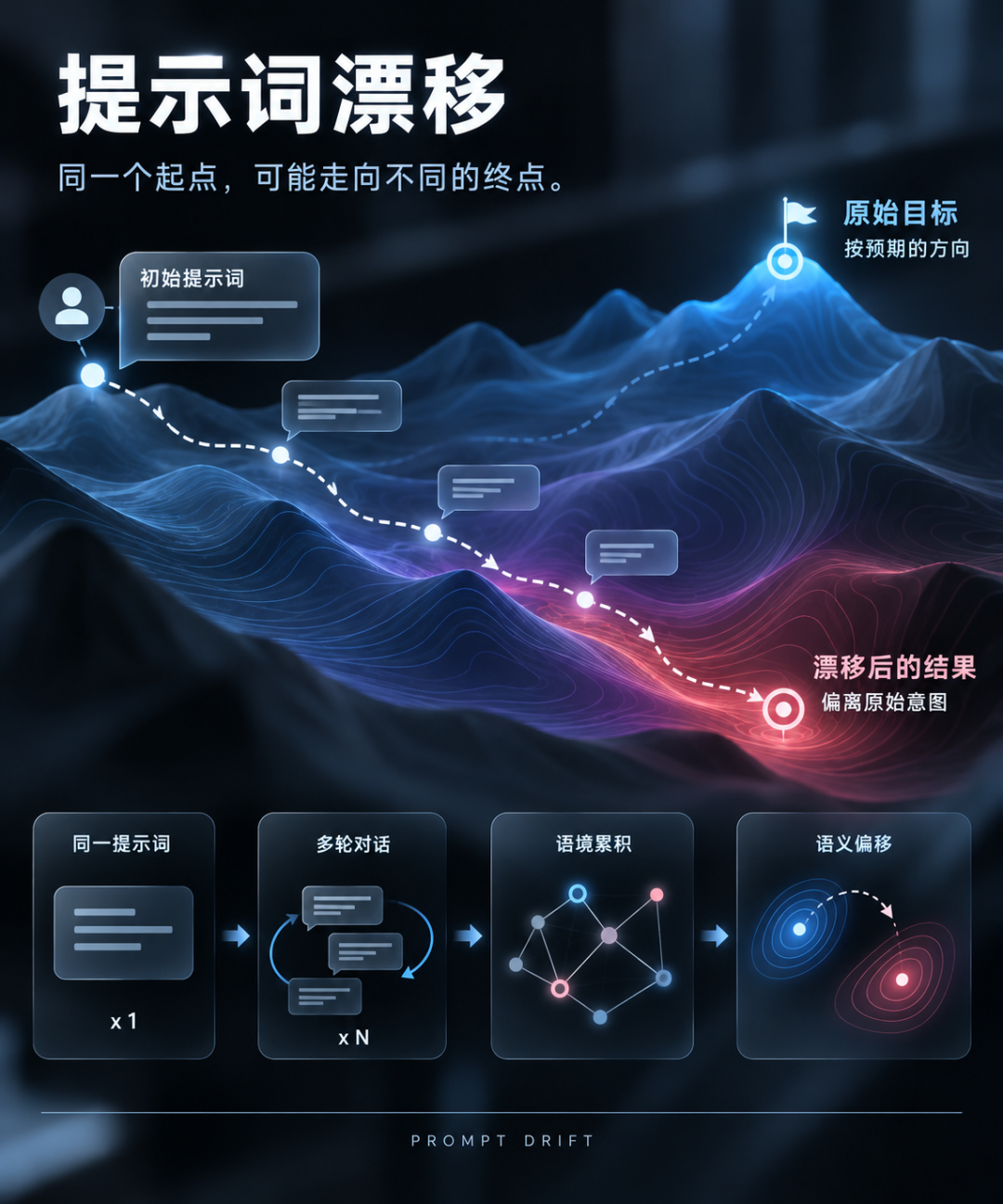
Catastrophic Prompt Drift
Senior AI developers all know that Prompt Engineering has extremely strong "model specificity".
If you have polished the System Prompt thousands of times on GPT-5.5 and debugged it to accurately execute JSON output, and then switch it to 5.6 Sol or 6 Astra, there is a high probability that there will be behavioral deviations.
Does the temperature coefficient (Temperature) need to be readjusted?
Will few-shot examples (Few-Shot) lead to instruction overfitting under the new model?
Will the boundary constraints of structured output create illusions in the new model?
All this means that developers have to
"re-run all Eval Pipelines (evaluation pipelines)"
.
Agent Fallback circuit breaker logic is broken
An architect who deploys autonomous agents in production environments posted:
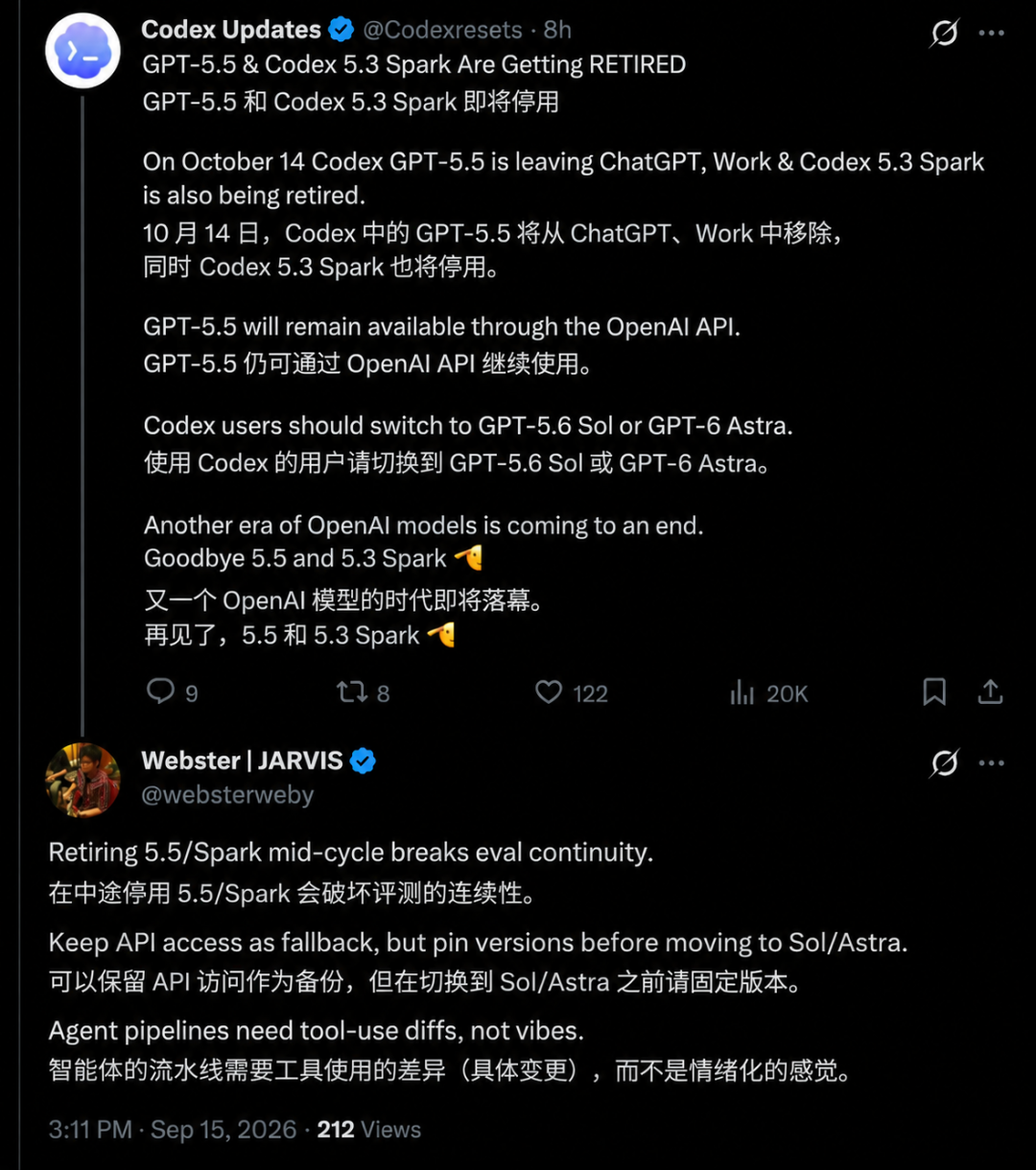
Taking the core model offline directly without buffering may directly crush the Agent fallback loops overnight.
In complex industrial-grade Agent systems, a cascade calling strategy is often configured: the main force is to run large models. If it times out or triggers current limiting, it will automatically switch to GPT-5.5 as a guaranteed downgrade model.
Now that the base is empty, if the code is not manually modified in time to reconstruct the routing, once October 14th comes, the online business will face a large area of error reporting and circuit breaker.
Bottom line and cost anxiety
With the leap in model capabilities, users' wallets and quota mechanisms are also experiencing extreme pressure.
Some subscribers complained that this was simply a disguised price increase:

The capabilities of large models are getting stronger and stronger, and more and more "thinking tokens" are occupied by a single inference. At this time, users are forced to make the leap from small and durable old models to new generation models, which not only brings about an upgrade in computing power, but also increases the cost of real money.

In this discussion about the rollout of GPT-5.5, in addition to complaints about technical adaptation, there is another voice that resonates widely.
That's choice.
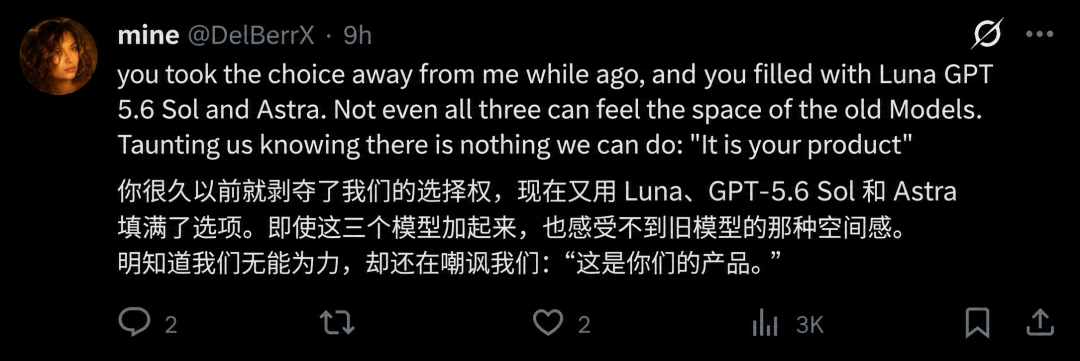
For some users, the consistency and certainty of the system are far more valuable than blindly chasing the latest model.
This sentence hits the most secret pain point in the entire AI implementation industry:
What we need is the stability of the tools, not the ever-changing uncertainty.
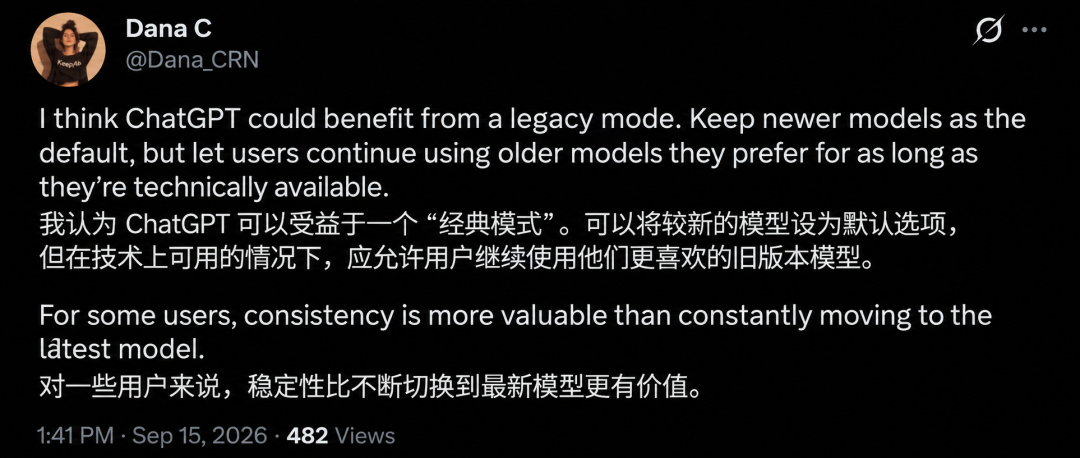
In the traditional software industry, even if a version is outdated, as long as you don’t upgrade it, it can still run quietly locally for five or ten years. It took more than ten years for Windows XP to be retired, and the CentOS upgrade triggered a global operation and maintenance earthquake.
But in the era of large models, software runs in a "black box" in the cloud, and control of the life cycle is completely transferred to the service provider.
Once the AI's memory is cleared,
Will there be a clear prompt when switching models for existing long dialogues? This is a problem.As a netizen said: "The same chat window may have undergone considerable changes, but you are completely invisible."

Many users once again mentioned the passivity and discomfort they felt when GPT-4o was forced to adjust earlier. Every forced demolition is a brutal interruption to user operating habits and workflow stability.
When "certainty" becomes a scarce commodity, developers and workers have to fall into a permanent
upgrade anxiety
: You spent three months building an automated business flow, and it finally ran smoothly today, but it may only take an official tweet from OpenAI to completely fail in a few weeks.The cold thinking behind the rush: Large models have officially entered the "monthly disposal era"
Looking beyond specific technical worries and looking at the macro perspective of the entire AI industry, the "abortion" of GPT-5.5 actually reflects the cruel reality faced by leading AI manufacturers.
The "disconnection" of computing power islands and infrastructure
Supporting hundreds of billions and trillions of parameter models to run concurrently on the cloud consumes a huge amount of electricity and computing power every second.

Maintaining an intermediate transition model (such as 5.5) means that dedicated memory slicing, scheduling middleware and engineering operation and maintenance teams must be retained.
In the context of the mature GPT-6 family and 5.6 series, OpenAI must "clean up" the computing power pool and allocate the most expensive GPU clusters to next-generation architectures with more strategic value.
The old model was eliminated not because we didn’t like it, but because the server room really couldn’t fit in it.
From "annual update" to "monthly disposal", the advent of AI consumerism
Once upon a time, we were used to the long and mysterious wait between GPT-3 and GPT-4.
Now, from 5.3 Spark, to 5.5, to 5.6 Sol, 5.6 Luna, and GPT-6 Astra, the naming suffixes of the models have become as dazzling as car displacement and mobile phone chips.
This marks that the large model has completely changed from "cutting-edge laboratory exploration" to "fast-moving consumer goods manufacturing".
GPT-5.5 with a half-year life cycle will not be the last short-lived ghost, and future version changes will only be faster and more ruthless.
The "shelf life" of AI models is rapidly shortening by weeks.
In this era, the most cyberpunk thing is: you are still writing a eulogy for the AI that saved your life half a year ago, while the newly created gods on the production line have already crowded your drop-down menu.
Comments