
Abstract:
A new study shows that an ancient volcanic structure buried on the far side of the moon may provide one of the strongest evidence yet for the long-standing controversy that "the moon had a global magnetic field generated from its own interior when it was young."
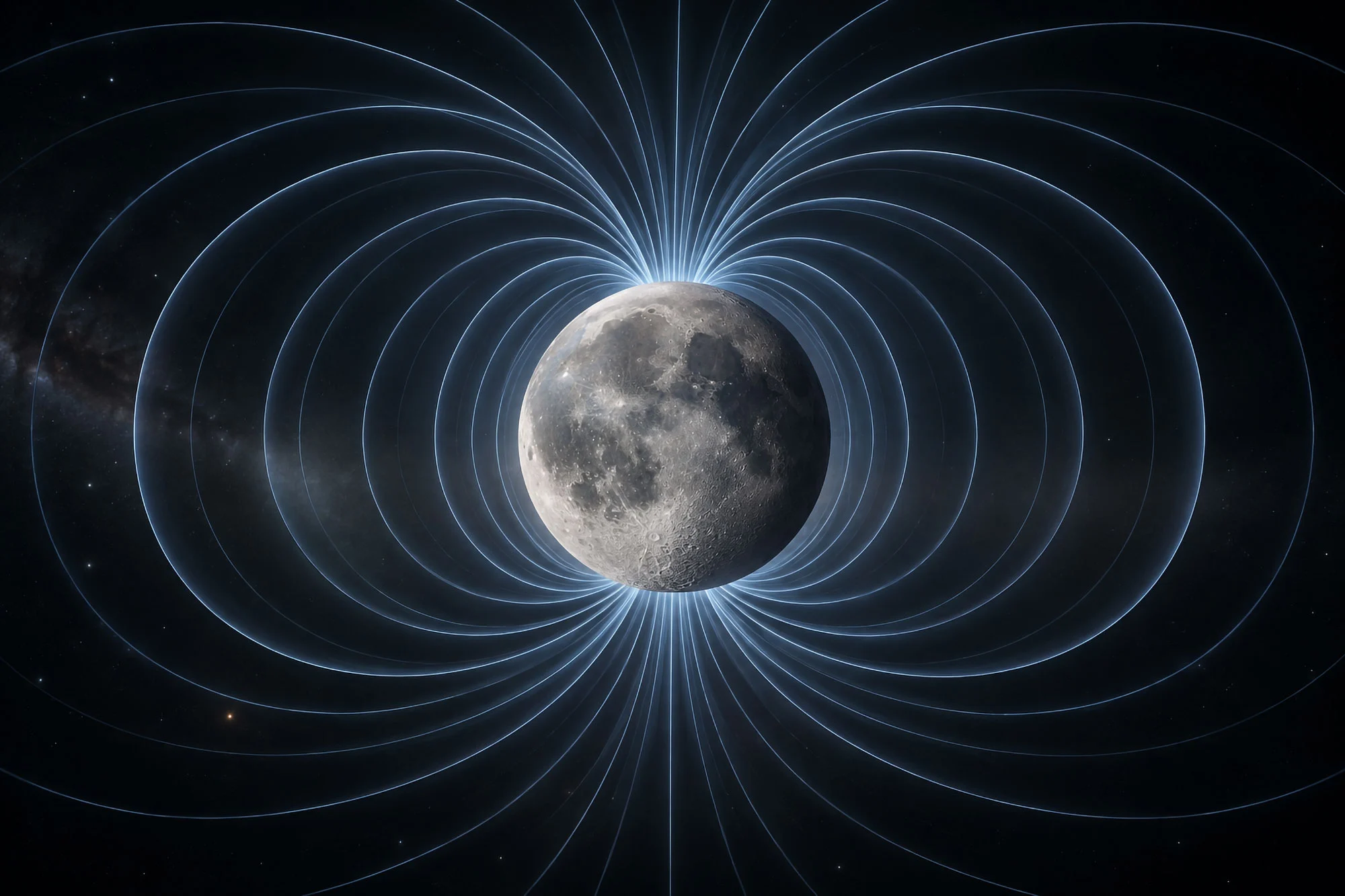
A research team from ETH Zurich combined gravity data obtained by NASA's GRAIL mission and magnetic field measurements collected by the Lunar Prospector and Japan's Kaguya probe to discover a high-density, strongly magnetized rock mass in the Der Waal region on the far side of the moon. Researchers estimate that the underground structure is about 60 kilometers wide and extends about 9 kilometers underground.
Today's moon no longer has a global magnetic field, but for decades the scientific community has been discussing whether the moon's interior once had a core-driven dynamo mechanism like the Earth's, creating a global magnetic field. Previous studies on lunar rock samples brought back by the Apollo missions have been inconsistent. Some evidence suggests that the moon had a strong magnetic field in its early days, while other studies are skeptical.
The research team believes that the underground structure in the Dewaal area is likely to be a magma body that rose up from the interior of the moon about 4.2 billion years ago and eventually cooled and solidified. Because scientists were able to estimate the amount of iron in these rocks, they could also work out the minimum magnetic field strength that would have caused the rocks to become magnetic as they cooled.
The researchers said that calculation results showed that the strength of the moon's magnetic field at that time was very likely to exceed 10 microtesla. For comparison, the average magnetic field strength at the Earth's surface today is about 50 microtesla.
The research team also evaluated another possibility, that is, the impact of a large asteroid or meteorite caused the magnetization of rocks. However, the De Waal region is outside the area previously thought to be responsible for impact magnetization, so researchers are more likely to believe that these magnetization features come from a longer-lasting magnetic field generated within the moon, rather than a one-time impact event.
This means that the associated magnetic field almost certainly originates from a long-standing dynamo mechanism within the moon's core, the researchers noted. The discovery further supports the idea that the moon once had an internal magnetic field.
It is worth noting that there is also a special surface structure called "lunar spiral pattern" in the Dewaal area. These bright, curved surface patterns are often associated with localized magnetic anomalies. One explanation proposed by scientists is that the horizontally distributed magnetic field can partially deflect the solar wind, thereby slowing down the long-term weathering effect of the solar wind on the lunar soil, allowing the relevant areas to maintain higher brightness.
Researchers said that this type of phenomenon is of great significance for future lunar landing activities. Local magnetic field lines may provide astronauts with a degree of protection from the solar wind, while lunar swirls are expected to help scientists identify these potential areas of protection.
This study further strengthens the evidence base for the existence of an internal magnetic field dynamo in the early Moon. However, a new puzzle emerged: How on earth the moon's relatively small core generates such a powerful magnetic field. Researchers believe that the current scientific community's concern is gradually changing from "whether the moon once had a generator mechanism" to "how does this mechanism work?"
The research team also pointed out that the method of combining orbital gravity data with magnetic field data is expected to be used to study the magnetic field evolution history of other celestial bodies in the future. Mars is a potential research target, but the accuracy of relevant detection data at this stage is not enough to carry out detailed analysis similar to that of the moon.
The research results have been published in the journal Science Advances. The study believes that the Deval magnetic anomaly is most likely to originate from deep magma activity, and provides new key clues for revealing the early internal evolution and magnetic field history of the moon.
Comments