
Abstract:
Caiwen recently visited a number of local express delivery stations in Hangzhou. In the afternoon, residents came in and out from time to time, reporting their mobile phone numbers to pick up packages. A staff member of the post station told Caiwen while scanning the code to put it into storage:
"After online shopping, express delivery is placed at the post station by default. Unless the merchant uses SF Express or JD.com, the courier will not take the initiative to deliver the goods to your door."
When Caiwen asked how to get courier delivered to your door, the staff didn't even look up: "You have to find the corresponding courier company to find out how to deliver it to your door. We are only responsible for warehousing."
Such scenes are not uncommon across the country. Recently, a number of terms related to express delivery have frequently appeared in hot searches on the Internet. Some consumers complained that express delivery companies were unable to deliver goods to their doorsteps, but were maliciously retaliated by couriers.
There seems to be a tinderbox between consumers and couriers. What was originally a normal request for rights protection has become a spark that can easily ignite the tinderbox.
In fact, relevant policies have long stipulated that express delivery companies cannot place them at delivery stations without the permission of consumers. However, several years after the establishment of the regulations, the problem of door-to-door express delivery has not been solved, and there is even a trend of further complication.
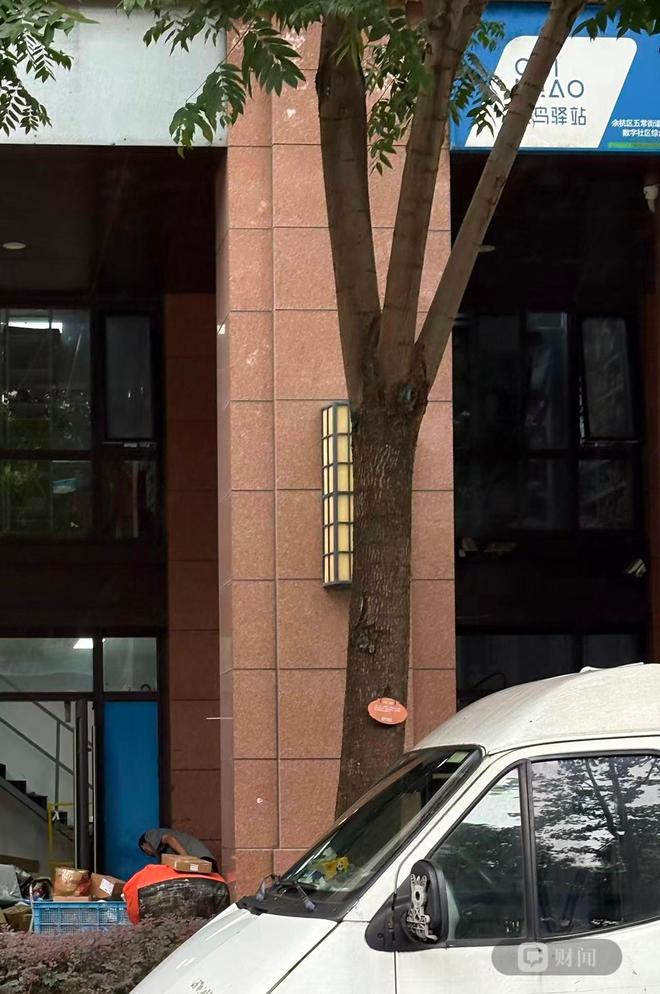
At a rookie inn in Hangzhou, staff are sorting. Photo by Liu Yanshuang, Financial News
Conflicts caused by door-to-door delivery frequently appear in the news
Recently, many incidents related to door-to-door express delivery have become hot topics on the Internet, and some have even become social security cases.
According to a Dafeng News report on August 16, a woman purchased large-ticket items on an e-commerce platform and noted that they would be delivered to her door. However, the STO courier responsible for the delivery failed to fulfill the contract and directly stored the courier at the post station. After the woman communicated with the courier on the phone, the courier maliciously retaliated by spreading her mobile phone number to a dating group with a non-existent demand for marriage.
Previously in July, Southern Metropolis Daily reported that a woman from Guangdong clearly stated "delivery to your door" on the postal EMS express. However, the courier Zhou was dissatisfied when he saw the note while sorting, and wrote the insulting text "Do you want it delivered to your bed" on the receipt?
On August 11, the entry “Couriers say door-to-door delivery is getting more and more expensive” became a hot search on Weibo. According to Foshan News, citizens said that most couriers now have to take the initiative to call before they can be delivered to their doorsteps. The couriers interviewed said that the average daily delivery volume now exceeds 600, and there is simply no way to finish them.
It is worth noting that on July 1 this year, the "Guangdong Provincial Express Delivery Regulations" issued by Guangdong Province have just come into effect. The regulations make it clear that express delivery operators shall deliver express parcels to the agreed receiving address, recipient or recipient designated by the recipient. They shall not refuse delivery for any reason, nor may they confirm receipt of express delivery or charge additional fees. When delivering to express terminal service facilities such as smart express boxes and express service stations, the consent of the recipient is required.
In addition, Article 28 of the "Express Delivery Market Management Measures" issued as early as 2024 clearly stipulates that companies operating express delivery services are not allowed to confirm receipt of express shipments without the user's consent, and are not allowed to deliver express shipments to smart express boxes, express service stations and other express terminal service facilities without authorization.
But judging from the results,
Despite the government's repeated introduction of relevant regulations, door-to-door express delivery is still a difficult problem that has not yet been fully implemented.
There is no uniform standard for door-to-door delivery
Publishing the post has become the "default item"
Caiwen also recently visited a number of local express delivery stations in Hangzhou. Many station staff made it clear to Caiwen that express delivery sent after online shopping is placed at the inn by default. Unless the merchant uses SF Express or JD.com, the courier will not take the initiative to deliver the goods to the door.
Caiwen tried to understand how to deliver goods to your doorstep, and found that this has become a question that is difficult to answer uniformly.
Most outlets stated that consumers have to find the corresponding courier company for consultation on how to come to their door, and the post station is only responsible for express delivery management.
As a consumer, Caiwen contacted a Jitu Express delivery person at a Tuxi Station. The other party said that the delivery station is now the default. If consumers want to have the goods delivered to their door, they can report the delivery address to the delivery person. The next time the address arrives, the delivery person will "deliver it."
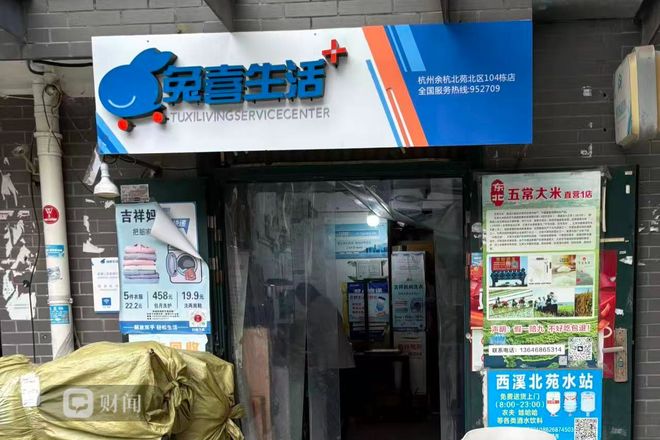
Industry insiders believe that the launch of the post station brand by express delivery companies is a sign that they have begun to pay attention to the role of post stations
Caiwen also discovered during the visit that the delivery station is responsible for delivery. A YTO courier told Caiwen that the post station is responsible for door-to-door delivery in the area he is responsible for, and he is only responsible for placing the express delivery at the post station. Caiwen contacted the person in charge of the post station, but the other party said that the express delivery delivered by the post station was "door-to-door delivery" and other express delivery was refused to be delivered to the door.
According to the station staff, there are generally two types of door-to-door delivery. One is products that are clearly marked "door-to-door" by Pinduoduo, and the other is products purchased by Taobao 88vip members.
For these two types of express delivery, merchants pay to subsidize the cost of door-to-door delivery for couriers.
Some insiders told Caiwen that the complex rules behind door-to-door delivery are related to different cooperation agreements between express delivery companies and express delivery station managers. At present, many post station managers may also be couriers for multiple express delivery companies, and naturally bear the obligation of door-to-door delivery. However, on the whole, express delivery companies are unwilling to deliver goods to the door. Trying to avoid door-to-door delivery through different means is the current meaning of the existence of express delivery stations.
Inns and express companies are closely related
Song Tao (pseudonym) has been working in the express delivery industry for more than 10 years and now owns multiple express delivery stations. He told Caiwen that the early emergence of express delivery stations was to solve the problem of lost items caused by irregular delivery of express delivery. When consumers are not at home and cannot deliver express delivery to consumers, simply dropping the express delivery at the user's door will attract many complaints.
Alibaba e-commerce represented by Taobao and Tmall does not want to see these complaints affect its business, so Cainiao Post came into being. By standardizing the management of these express delivery, allowing users in a community to go to the post to receive express delivery can solve many unnecessary troubles. In this case, the protagonist of the post station operation is the e-commerce platform.
However, with the rise of other e-commerce platforms such as Pinduoduo and Douyin, the number of express delivery companies need to handle is increasing. Coupled with the continuous price war between express delivery companies, the terminal delivery fee is getting lower and lower. How to deal with these large quantities of express delivery but low single-piece delivery fees has become an important problem for franchised express delivery companies.
Many people in the express delivery industry told Caiwen that franchised express delivery companies that mainly engage in low-price e-commerce business have continued to reduce terminal delivery fees. Now they have generally fallen below 1 yuan, or even to about 0.8 yuan. It is almost difficult to recruit couriers at this price, because food delivery jobs of almost the same nature are obviously more cost-effective. Therefore, express delivery companies have set their sights on express delivery stations, and avoid end-of-line delivery by placing a large number of express deliveries at the stations by default.
In this process, the operating protagonist of the station has also transitioned from an e-commerce platform to a courier company.
Song Tao told Caiwen that express delivery companies have become the protagonists of post station operations mainly in two aspects: First, many express delivery companies have begun to build their own post station brands, such as Yuantong’s Mama Post, Yunda’s Yunda Express Supermarket, Zhongtong’s Tuxi Post, etc. Express companies even set assessment indicators for the number of post stations opened in a city. The second is that express delivery companies have begun to let their couriers or related persons set up post stations in the contracting area and sign exclusive delivery agreements. This has resulted in a situation where one person is both the owner of the post station and the courier of the express company.
"Express delivery companies attach great importance to the stability of post stations. If a post station in an area is paralyzed, a large number of express delivery will be "forced" to deliver goods to your door. This is a cost that express companies cannot afford,"
Song Tao said, "This tendency makes express delivery stations play a role similar to that of a "gatekeeper", whose role is to "pacify" consumers in the area as much as possible. If the delivery station fails to do this job well, leading to a large number of complaints in the area, requiring express companies not to place delivery stations and must deliver door-to-door delivery, then the express company is likely to terminate the contract with the delivery station operator."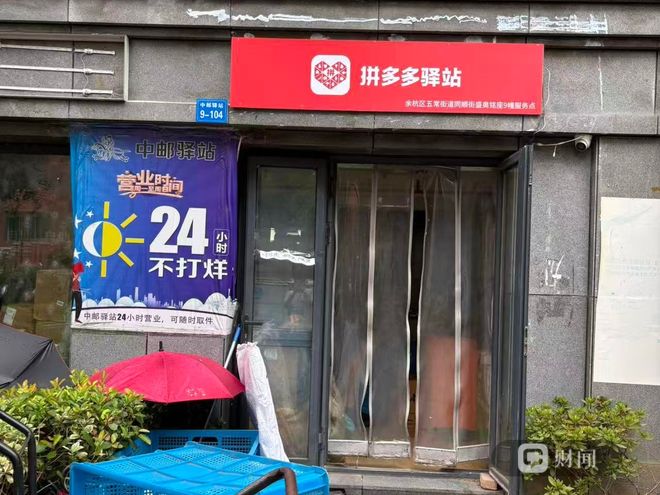
A Pinduoduo Station in downtown Hangzhou. Photo by Caiwen Liu Yanshuang
"If there is a complaint, it will be sent, if there is no complaint, it will not be sent"
Caiwen learned that
This kind of business method in which post stations and express delivery companies are bound to each other to avoid door-to-door delivery also creates hidden dangers for conflicts between couriers and consumers.
Lin Feng (pseudonym) has been engaged in the express delivery industry in Shanghai for many years. From the beginning of operating a single post station, he gradually developed into an express delivery franchisee.
He told Caiwen that when he started operating the post station in 2019, it was just when Cainiao Post was just emerging. At that time, running the post station was very easy. All he had to do was to put it into storage, and there was no need to send customers a reminder text message that the express delivery had been put into storage. However, as the identity of the post station operator changes, and as the link between the post station and the express delivery company becomes deeper and deeper, the express delivery station has more and more requirements for workers. They not only need to complete orderly warehousing, but also need to respond to customer complaints.
“If you complain, you will be fined. This is the source of conflicts between many consumers and couriers and delivery stations.”
Lin Feng told Caiwen, "At present, express delivery companies impose a lot of fines on front-line couriers and post stations. Fines have become a must-have monthly expense for express delivery practitioners. In actual operations, as long as consumers do not complain about door-to-door delivery to the express company, a door-to-door delivery work order will be sent to the post station. At the same time, the fine will be generated immediately and you will not be given the opportunity to appeal."According to Caiwen, there is a common unspoken rule in express delivery stations:
If someone complains about the express delivery at the inn, it will be delivered to the door. If no one complains, it will not be delivered to the door.
In reality, some customers are very obsessed with door-to-door delivery. As long as a courier is placed at the post station without permission, they will lodge a complaint. In the face of these customers, express delivery companies and post stations have formed a mature response model: forming a "white list" for these "special customers" in the management area. As long as customers in the white list express express delivery to the post station, the post station will take the initiative to deliver the goods to your door.
Lin Feng believes that the existence of post stations and the express lockers derived from them are still necessary, because from the actual operation point of view, most consumers can still accept the self-pickup method of express delivery. Of course, consumers who complain cannot be blamed. After all, consumers have paid and are not obligated to bear the loss of service quality.
Can differentiated pricing become a breakthrough?
“Some consumers have also asked me why SF Express and JD.com can deliver door-to-door delivery, but these two companies are mainly responsible for high-priced express delivery. The delivery fee of the courier is significantly higher than that of ordinary franchised express delivery companies. At the same time, the delivery fee is high, and the number of express delivery that the courier needs to deliver is far less than that of JD.com. "Union-made express delivery", Lin Feng told Caiwen, "I think the key is to solve the current core problem of low delivery fees and regulate the phenomenon of arbitrary fines by express delivery companies. Otherwise, it will be difficult to find a good solution to the conflict between consumers and couriers for door-to-door delivery."
Express logistics expert Zhao Xiaomin said in an interview with Caiwen that the difficulty of door-to-door express delivery is caused by long-term low-quality competition in the domestic express delivery industry. In the past decade or so, the rapid development of e-commerce business has brought about a surge in express delivery business volume. However, the business model of express delivery companies has never kept up with market development and customer needs. They have long competed by "exchanging price for volume". As a result, once supervision and consumers have higher requirements, the express delivery company's distribution system, outlet carrying capacity, and the relationship between franchisees and headquarters will all become unbalanced. In the final analysis,
it is now difficult for the express delivery terminal service mechanism to meet customer requirements.
Zhao Xiaomin believes that under the existing franchise express delivery ecosystem, taking into account the existing average daily business volume of couriers, it is difficult to complete the delivery quota without being fined. It is difficult to confirm by phone one by one. Putting a large number of packages in terminal infrastructure such as post stations and express cabinets is the only solution for the industry after comprehensive survival and efficiency.
He suggested that
we can consider letting express delivery companies and e-commerce companies negotiate to form differentiated pricing. Door-to-door delivery is one price system, and ordinary delivery is another price system.
However, after differentiated pricing is formed, the assessment mechanism and payment mechanism for couriers must be followed up and reformed, so that couriers who are willing to provide door-to-door services can receive corresponding rewards instead of relying on fines.Zhao Xiaomin further stated to Caiwen,
In the long term, the future development trend of the industry will be whether customers' personalized delivery requirements can be more accurately met. Whoever can complete the construction of this system first will form a competitive advantage,
Then rely on market forces to eliminate outdated companies in a series of mergers, acquisitions and reorganizations, and allow companies that have experienced market voting to take on more business. Only in this way can we ensure both economic and social benefits.
Comments