
Abstract:
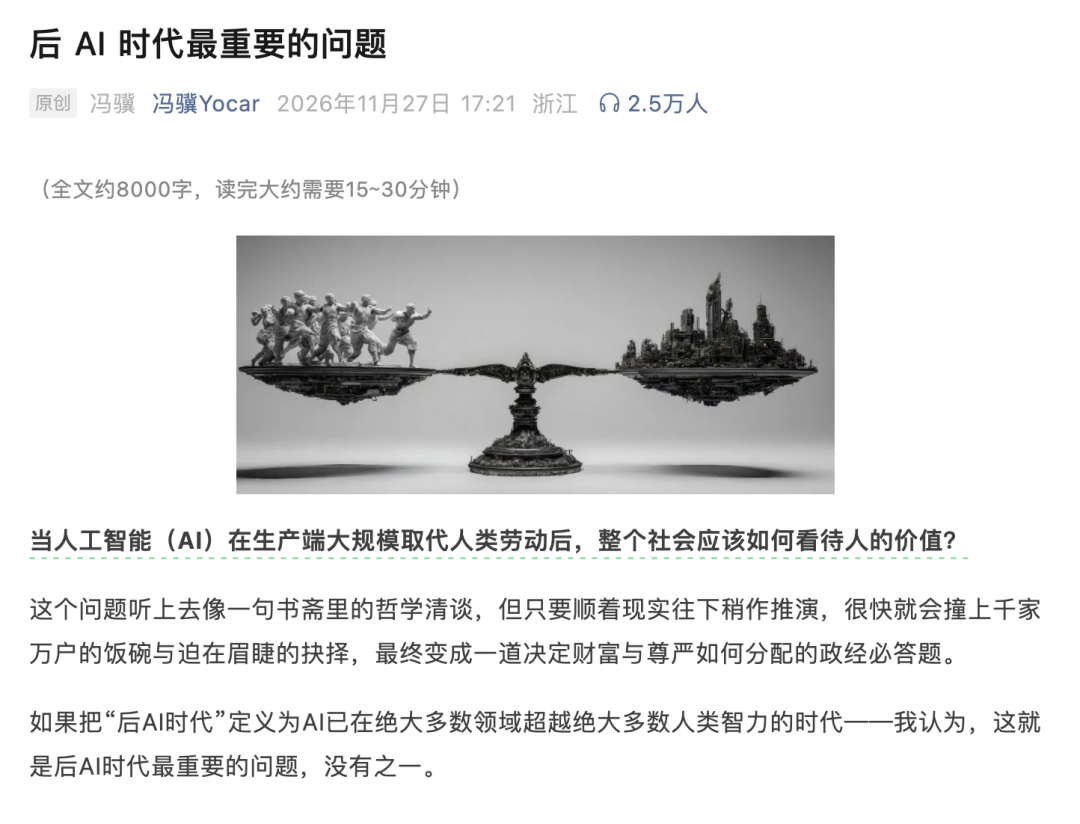
Yesterday I read Feng Ji's long article "The Most Important Issue in the Post-AI Era". He mentioned the moment when he sat down dizzy and paralyzed in his chair. It is estimated that many people including me have experienced it this year: mathematics is solved with AI, and games are made with AI. If one day there are no more jobs that require people, what should people do?
But another group of people suddenly jumped out of my mind - those who are at the door of the "post-AI era" and have never used AI before.
So there are still people like this?
I came across a post a while ago. The poster said that he met a girl in the film industry and had never used ChatGPT. She is worried that once she starts using AI tools, she will lose her ability to think. She hates the AI answers that pop up automatically in Google search results. She finds them uninvited and annoying.
You may feel that this girl is a little out of place. ChatGPT has more than 800 million weekly active users around the world, and Claude, Gemini, and Copilot each have large user bases.
In the technology industry I work in, "What model do you use?" and "Has your account been blocked?" have become ways of saying hello.
Having never used AI is just like saying you didn’t have WeChat fifteen years ago, or saying you didn’t use email twenty years ago, it will attract a slightly puzzled look. In the workplace, there is a high probability that you will be looked down upon and eliminated.
However, the ubiquitous "efficiency improvement" and "value creation" narratives in the technology circle simply do not hold true for some people, or in other words, they have enough reasons to doubt whether it holds true.
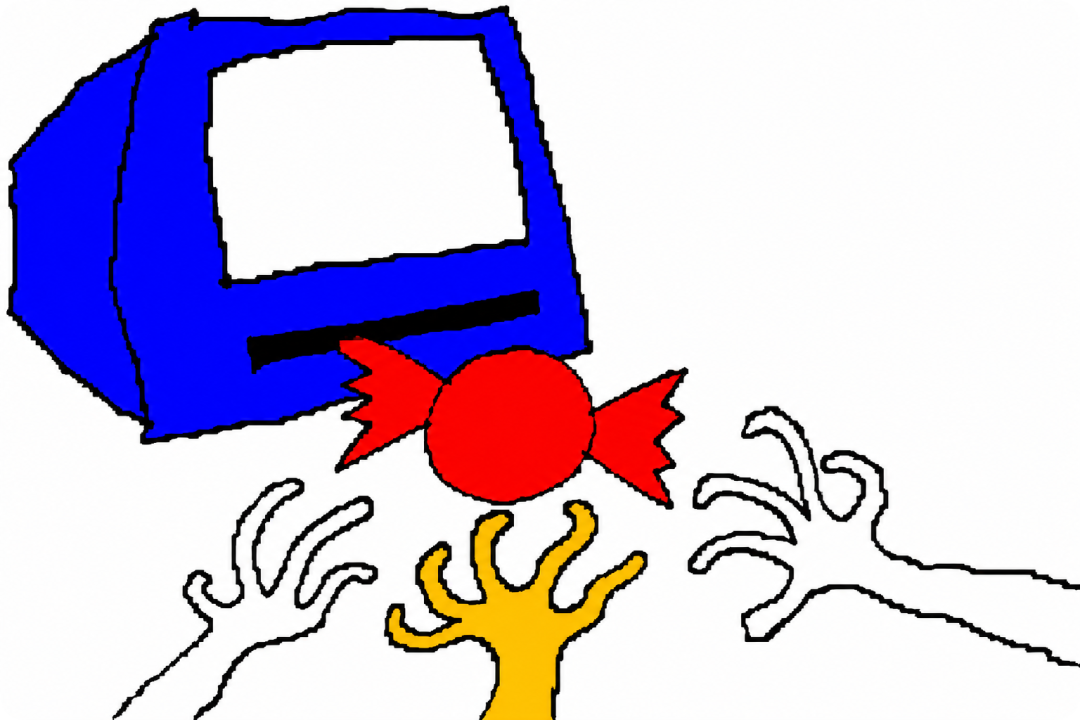
Feng Ji said that every time you feed the AI, it will immediately give you an efficiency candy. But "when the sugar is enough, the sweetness will become compulsive." When peers rely on it to double their efficiency and cut their quotations in half, the optimists are stepping on the accelerator, while the pessimists are stepping on the accelerator harder than the optimists in order to protect themselves.
I feel the same way.
Burning a lot of Tokens may not necessarily allow you to create greater value, but it may produce more dopamine than a skit on red fruit, making you unable to extricate yourself.
It is precisely in this coercion of the whole world rushing to eat candy, are those who do not reach out, are they stubborn or sober?
Helen Coffey, a reporter for the British "Independent", wrote an article saying that she is a
"ChatGPT virgin"
: Never opened ChatGPT, Claude, Gemini or any other generative AI, not even sure where exactly these tools are on the internet.She couldn't explain why, but she felt unexpectedly comfortable.
Another writer who published an article in "Writing Cooperative" said that he was not deliberately confrontational, nor was he proud of it, but he just missed the initial window period for early adopters. Later, the pace became faster and faster, and colleagues, children, and even friends who were not very technical savvy began to use it, but I still didn't.
Slowly, the focus of the discussion shifted from "is it useful or not" to "will AI destroy humanity?" She said that she neither felt smart nor determined, but simply felt "old".
As content creators, we have also noticed research findings:
The widespread use of AI has indeed improved individual creative output, but on a larger scale, it has compressed the diversity of overall creation.
Everyone feels like they are "creating" when using AI,
but the gains brought by AI at the individual level come at the expense of the loss of diversity at the group level
——When tens of millions of people call the same probability model, human expression seems to be skyrocketing, but in fact it is collapsing towards the same mean.Not to mention, as Feng Ji said, "There is indeed equality in creation tools, but there is no equality in the distribution entrance, there is no equality in the distribution of computing power, and there is no equality in the way of distributing money."
For the vast majority of people who are proficient in using tools, every micro-operation on the screen may become a contribution of free corpus to the system that is about to replace them.
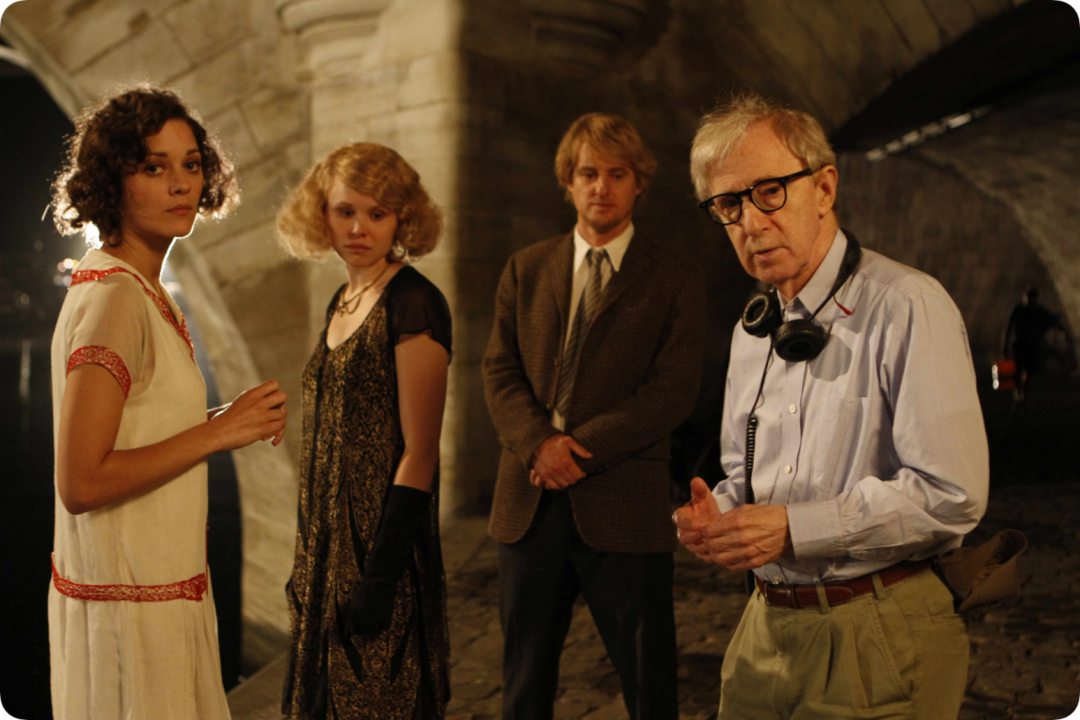
A study conducted by New York University on 25 professional writers with an average of 17 years of writing experience found that some writers who are resistant to AI regard AI as a competitor and actively adopt "confrontational strategies." They deliberately strengthen their human attributes and focus on developing local narratives, individual life experiences, and specific emotional textures that are difficult for AI to replicate.
"AI confrontation as a craft" also requires skills. You need to clearly know what you are competing with and where your irreplaceability lies. A screenwriter interviewed said:
"If I let AI do my job, I will feel painful inside."
We continue to introduce tools into our lives, and the tools become more and more powerful. The narrative of "rejection or falling behind means loss" has been repackaged in the AI era and turned into "people who cannot use AI will be replaced by people who can use AI", which is circulated on social media in various versions.
This statement mixes real career anxiety and habitual optimism in the technical circle. Although it describes only a very partial reality, it is cited everywhere as a universal rule.
When "intelligence detached itself from the body for the first time in history and changed from a labor factor to a capital factor." Obviously, capital can directly use electricity bills to wholesale intelligence, but in the end, it has become us to review whether we have not learned fast enough, followed closely enough, and have to jump into the sea first even if we can't swim.
This is indeed a very divided era.
The Riemann Hypothesis is a problem that the top minds in the past 150 years have devoted their lives to. Now it was "proven" by a 34-year-old mathematician with Claude in about six weeks.
Anthropic co-founder Jack Clark said in a blog today that we have officially entered the singularity. The speed of AI research in science is so fast that humans need to open a new discipline of "machine hermeneutics" to understand what AI has discovered.
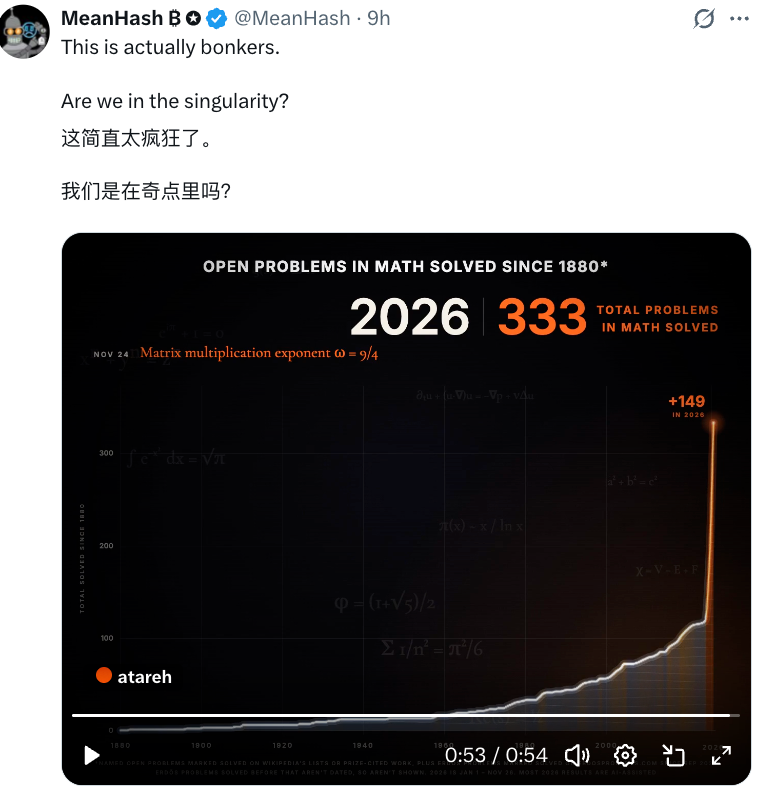
Take this year’s AI mathematics papers as an example. The time we spend understanding them may be dozens or hundreds of times longer than the time it takes for machines to write them.
So there is an atmosphere around us.
It seems that if we don’t embrace AI, we will become another form of illiteracy
.But even the Holy Grail of Mathematics, which the best minds of mankind have spent their entire lives trying to achieve, can be loosened in six weeks. How much stronger is the professional defense line built by ordinary people by memorizing a few more prompt words than a sandcastle on the beach?
I myself am often a bit split. On the one hand, I think it's cool, but at the same time, it's a bit empty.
This feeling of emptiness is probably because, as Feng Ji said, we are too accustomed to
"a person's sense of security and dignity is tightly tied to his indispensability in the production chain."
In fact, people outside the grand narrative of AI are also living well.
Some people say they are "not interested", which does not mean they are ignorant or backward, it just means that this tool does not yet constitute a sufficiently convincing reason for their current lives. Those who have never opened a dialog box have not caught up with the future, they just refuse to let the future take over their present in advance.
Feng Ji believes that
the true freedom in the post-AI era should include "the freedom of not having to prove to others that one is "useful""
——Being at peace and content with being a happy ordinary person who is useless according to the old standards, without any meritocracy ruler pointing fingers.Indeed, being able to say "not interested" in the efficiency carnival sweeping the world, without having to prove to any algorithm that one is still "useful", may be the most honorable freedom for a human being in the future.
Comments