
Abstract:
India is preparing to invest US$25 billion in local deep technology start-ups, hoping to catch up with the United States and China in global technology competition and reduce its dependence on foreign cutting-edge technologies. Rajat Tandon, president of the Indian Venture Capital and Alternative Capital Association, told the media that India has invested a total of US$11.6 billion in deep technology over the past ten years; now, the Indian government has committed to investing US$11 billion through the Research and Development Infrastructure Fund, with matching funds from venture capital and private equity fund managers. In addition, approximately US$3 billion to US$4 billion will be added, bringing the total available funds for deep technology investment to US$25 billion.
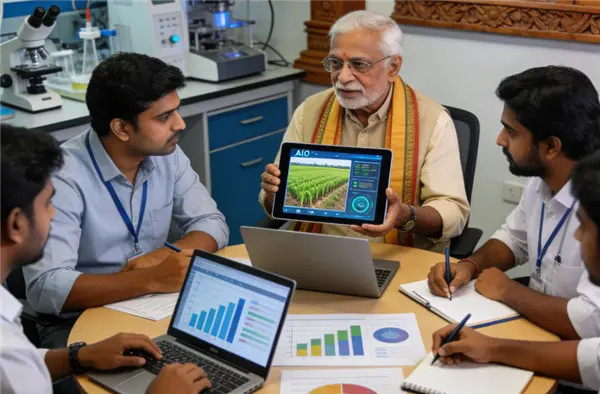
Deep technology usually covers areas such as artificial intelligence, semiconductors, advanced manufacturing, drones and aerospace technology. Industry insiders believe that in the context of rising geopolitical tensions, cutting-edge technology has become increasingly important to various countries, and the Indian government has therefore increased related investments. China and the United States are currently leading the artificial intelligence race, but India has doubts about Chinese technology products, and U.S. restrictions on technology exports also make it difficult for India to regard it as a stable and reliable source.
Anandamoy Roychowdhury, managing director of Crane Venture Partners, said that U.S. tariffs will actually help promote the development of India's deep technology sector because India is worried that important technologies may be cut off from supply at any time, so it needs to cultivate local companies. Concerns were further heightened in June this year when artificial intelligence company Anthropic disabled foreigners' access to its new models, Fable 5 and Mythos 5, after the U.S. government issued an export control directive.
At the Asia SuperReturn Investment Conference, many start-up investors said that Indian deep technology companies are still in the early stages of development, but the quality of local talents and ideas is outstanding, and the ecosystem is expected to eventually nurture globally competitive companies. Shweta Rajpal Kohli, President and CEO of Startup Policy Forum, said that innovation in India's deep technology field is accelerating significantly, and some companies have moved from the prototype stage to actual commercialization. This year, atmosphere programming startup Emergent, aerospace company Skyroot and India's full-stack sovereign artificial intelligence company Sarvam have become unicorn companies after their latest round of financing exceeded $1 billion in valuation.
Roy Chaudhry described himself as "like a kid walking into a candy store" when looking for deep technology investment projects in India, and revealed that about 80% of his US$150 million Asia-Pacific fund is currently focused on investing in India. A report released by the Indian Venture Capital and Alternative Capital Association in August showed that among the 100 domestic funds surveyed by the organization, about 90% were investing in deep technology start-ups, and 37% of the funds held shares in 11 to 20 such companies.
The report also shows that the financing volume of India's deep technology industry in 2025 will be close to US$3 billion, a record high, although the overall financing volume of Indian start-ups has declined during the same period. However, compared with the United States, India still has a huge funding gap: the financing amount of the deep technology industry in the United States reached 136 billion US dollars. Due to the long R&D cycle and heavy investment, Indian start-ups especially lack local capital to support their expansion.
Tanden pointed out that only about 2% of investors in India are currently able to write checks of more than $10 million. He believes that high net worth individuals and family offices need to increase investment to provide the required funds for the development of India's deep technology industry. While local venture capital and private equity investors are confident that India will eventually emerge as a global leader in deep tech, they have yet to give a clear timeline.
Comments