
Abstract:
The International Energy Agency issued a warning: Global data center electricity consumption may double by 2030, which will put tremendous pressure on the power grid and may also slow down the implementation of new projects. The IEA says annual electricity consumption by data centers could reach about 1,000 terawatt hours in 2030. The report also mentioned that factors such as tight supply chains, local opposition, and insufficient power grid capacity may delay the construction of data centers.
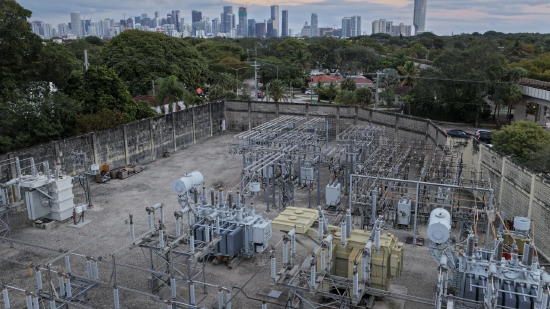
January 14, 2026 High-voltage transmission lines pass through a substation from an aerial view in Miami, Florida, Japan, Japan.
This warning comes from the IEA's World Energy Outlook 2026 Stated Policy Scenarios report. The predictions under this scenario are based on policy measures that have been proposed by various countries but have not yet been formally implemented.
The IEA mentioned that Texas, Virginia, Finland and the United Kingdom all have a large number of data center projects to be built. The total installed capacity of data centers to be connected to the grid in many regions has exceeded the current local power consumption peak.
The IEA said that if the power grid is not upgraded, the congestion problem of the power network will intensify and the reliability of power supply will decrease.
The waiting period for new projects to be connected to the grid will be lengthened; when the grid is unable to meet power demand, some power generation facilities will even be forced to operate at reduced power.
IEA predicts that global peak electricity consumption will increase by 40%-50% before 2035. In the stated policy scenario, 26 million kilometers of new transmission lines will be built by 2035, while about 16 million kilometers of older lines will need to be replaced or refurbished. The agency stated that the supply of copper, cables, and transformers is already in a tight state.
Power grid investment may rise by 75%
Current Policy Scenario
Based on the energy policies and regulations now in force in each country, the scenario predicts a 75% increase in investment in the grid sector over the next ten years. The IEA evaluates the power network as “one of the most important energy investment directions in the next decade.”This scenario predicts that the growth rate of renewable energy generation in the next decade will be 85% higher than in the past decade; photovoltaics will become the world's largest source of electricity in the late 2030s.
In the IEA baseline scenario, electricity's share of global final energy consumption will increase from 23% currently to close to 30% in 2035.
Energy security makes transformation more urgent
The IEA said that the energy crisis in 2026 may accelerate the electrification process, and countries hope to reduce their dependence on oil and gas imports. Electrification can reduce exposure to imported fuels, but it also means that a reliable grid is increasingly strategically critical.
Before the outbreak of the Iran War, an average of 20 million barrels of crude oil and petroleum products passed through the Strait of Hormuz every day in 2025, accounting for approximately 25% of global seaborne oil trade; nearly 20% of the world's liquefied natural gas trade also passed through the Strait.
IEA Administrator Fatih Birol said: "The pressures caused by the current crisis cannot obscure the key choices that will determine energy security, sustainable development and economic prosperity for decades to come."
Comments