
Abstract:
U.S. unmanned boat companies Saildrone and Lockheed Martin recently announced that their Saildrone Surveyor unmanned surface vessel (USV) completed a live-fire demonstration during the "Rim of the Pacific 2026" joint military exercise (RIMPAC 2026) and successfully launched two Joint Air-to-Ground Missiles (JAGM). This unmanned boat, which looks like a large robot sailboard, is being explored for long-range reconnaissance, electronic warfare, search and rescue, and strike missions.
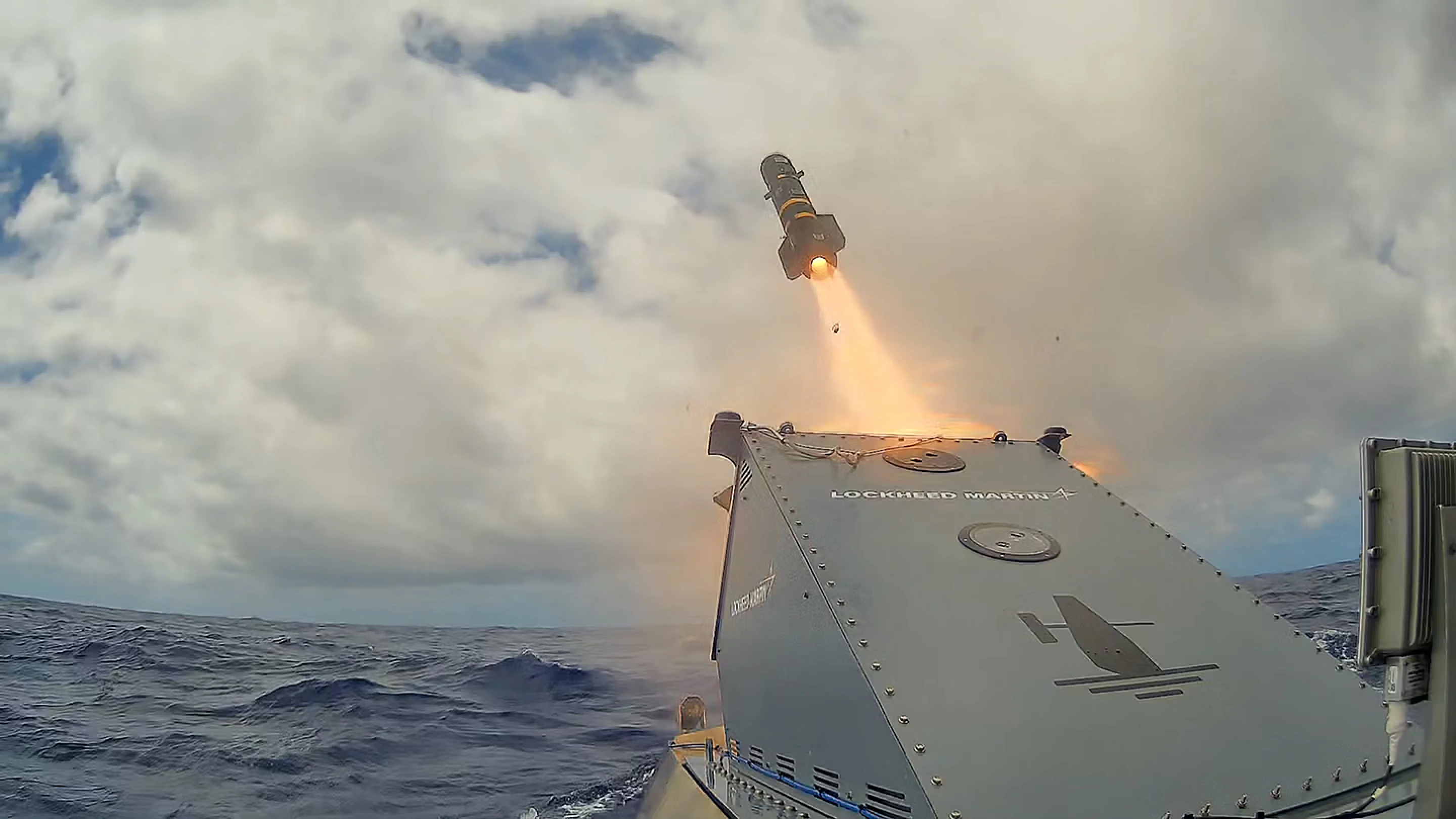
The boat is about 20 meters long, uses a rigid sail to provide main power, and is equipped with an auxiliary diesel engine. With this power combination, the platform can carry a variety of mission payloads and can be continuously deployed autonomously at sea for more than 180 days. Its long-term retention capability is regarded as an important foundation for building long-range unmanned reconnaissance and strike forces, and also helps enable unmanned platforms to continue to perform tasks in wider sea areas.
The test was held off the coast of Hawaii as part of the U.S. Navy's Fleet Experimentation Program (FLEX). During the exercise, Surveyor was equipped with a JAGM twin launcher provided by Lockheed Martin and used collaborative sensor data provided by the USS Theodore Roosevelt (CVN-71) aircraft carrier strike group to continuously launch two missiles at a target that simulated a high-speed surface craft.
In addition to actual missile launches, Surveyor also collaborated with an MH-60S helicopter to detect, classify and identify simulated radar threats. This shows that unmanned surface platforms can not only serve as remote sensor nodes, but can also be connected to the same combat network as manned ships, shipborne aviation and other forces to undertake some tasks in distributed maritime operations.
Currently, the military field is accelerating the integration of land, sea, air and even future space unmanned systems, while seeking to shorten the development and production cycle of new equipment. The core idea is to establish a hybrid power system with manned and unmanned collaboration: people are responsible for high-level decision-making and high-skilled positions, while unmanned platforms take over repetitive tasks and enter higher-risk areas to perform tasks.
In this system, unmanned boats with long endurance, autonomous navigation and modular payload capabilities can also serve as "force multipliers" to expand coverage through large-scale interconnected formations. A single platform that can remain stationed for months without external resupply would provide more flexible deployment options for continuous surveillance, electronic warfare support, and long-range strike.
Paul Lemo, vice president and general manager of Lockheed Martin's sensors, effectors and mission systems business, said that the company is working with Saildrone to use industrial capabilities to promote autonomous platforms with containerized mission modules into defense applications; Lockheed Martin will continue to invest in the research and development of new capabilities in advance to speed up the deployment of key defense technologies and reduce application risks.
Comments