
Abstract:
On Wednesday (18th) local time,
Moody's lowered Nvidia's credit rating outlook from "positive" to "stable",
The reasons were the resignation of longtime CEO Jen-Hsun Huang and the company's "lack of a formal succession plan." Moody's pointed out that although the agency believes that Nvidia's market leadership and financial position remain very strong,there is little room for improvement in Nvidia's credit rating in the next 12 to 18 months.
Raj Joshi, senior vice president of Moody's Ratings, said Huang's departure "creates uncertainty about the company's business strategy and financial policies," although Nvidia's market leadership and financial position remain "extremely strong."
He further stated in the report, "This may have an impact on the company's growth strategy, which relies on its vast network of relationships in the artificial intelligence ecosystem."
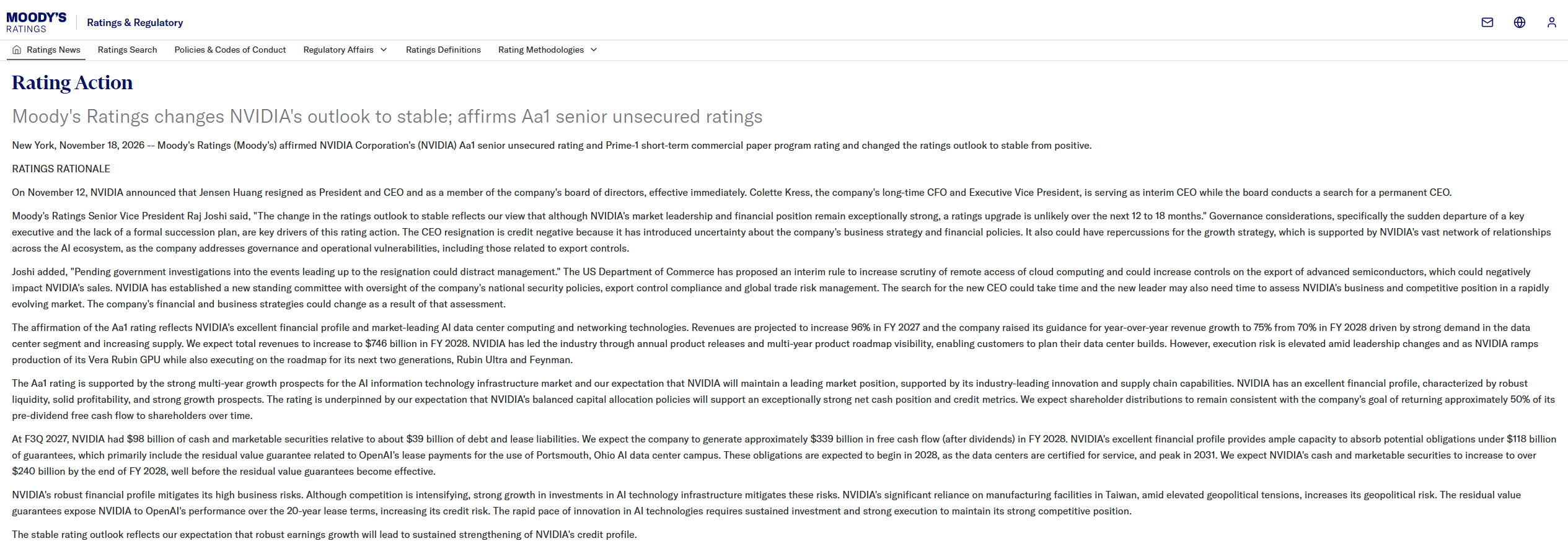
Joshi also mentioned that "the government's investigation into the events leading to this resignation is still ongoing, which may distract management."
In addition, he added that the U.S. Commerce Department has proposed a temporary rule to increase scrutiny of remote access to cloud computing and may strengthen controls on advanced semiconductor exports, which may have a negative impact on Nvidia's sales. Nvidia has established a new standing committee to oversee the company’s national security policies, export control compliance and global trade risk management.
Moody's stressed that the search for a new CEO may take some time, and that the new leader may also need time to evaluate Nvidia's business and competitive position in a rapidly changing market. The company's financial and business strategies may change as a result.
At the same time, the reaction of the bond market was relatively mild. Nvidia's five-year credit default swap (CDS) reported 121 basis points on Wednesday, down about 20 basis points from a week ago. Traders believe that Huang Renxun's departure may limit the company's debt scale, thereby alleviating credit pressure to a certain extent.
Finally,
Moody's affirmed Nvidia's Aa1 senior unsecured bond rating (the second highest rating in Moody's rating system) and Prime-1 short-term commercial paper program rating.
Moody's reported that the Aa1 rating is based on the strong multi-year growth prospects of the artificial intelligence information technology infrastructure market and its expectation that Nvidia will continue to maintain its market leadership position with its industry-leading innovation capabilities and supply chain strength.
"NVIDIA has an excellent financial profile, with ample liquidity, solid profitability, and strong growth prospects. The rating is also based on our expectation that NVIDIA's balanced capital allocation policy will support its extremely strong net cash position and credit metrics. We expect shareholder dividends to be consistent with the company's long-term goal of returning approximately 50% of pre-dividend free cash flow to shareholders." The report added.
Comments