
Abstract:
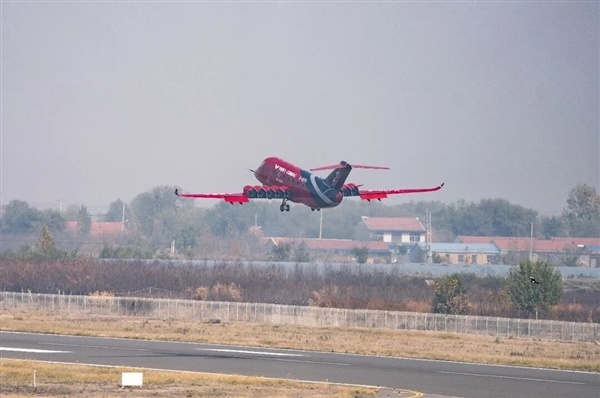
The 10-ton electric commercial aircraft CE-25A recently completed its first manned intelligent flight in Binzhou, Shandong. Both sides of the wings are equipped with 10 distributed electric ducted propulsion motor systems self-developed by the Institute of Electrical Engineering of the Chinese Academy of Sciences. The total system power is 2MW, providing all power for the world's largest manned pure electric passenger aircraft.
The CE-25A, developed by COMAC, is its first electric commercial aircraft and is mainly targeted at intercity commercial flight scenarios.
Pure electric aviation places extremely high requirements on the power-to-weight ratio of the power system. There is a natural conflict between air cooling and high power density electric propulsion. High heat flux density electromagnetic load is paired with low heat capacity air cooling medium. Conventional solutions are difficult to dissipate heat accumulation under high power conditions in a compact space, and can easily cause the temperature rise of key components to exceed the limit.
Looking around the world, the continuous operating power of international mainstream air-cooled electric propulsion mature products such as France's Safran ENGINEUS100B is mostly within 100kW. High-power, high power-to-weight ratio aviation-grade pure air-cooled electric drives have long been a blank in the industry.
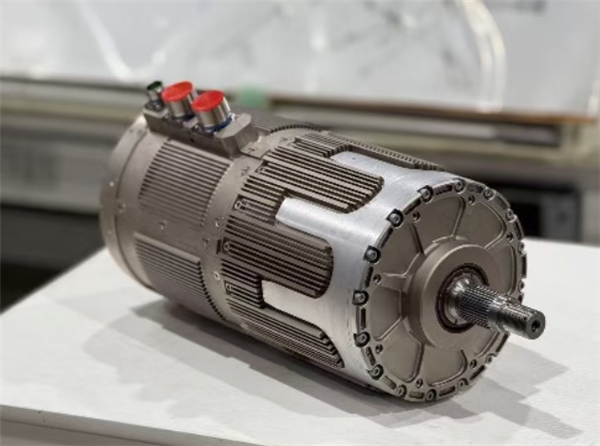
Facing the strict constraints of the Civil Aviation Administration of China's CCAR-25 transport aircraft airworthiness standards, the Institute of Electrical Engineering's High Power Density Electric Drive and Electric Vehicle Technology Research Department established a technical route based on ducted flow field forced air cooling, innovatively adopted a deeply integrated motor-converter configuration, and broke through four key technologies: large-scale automatic optimization design of motors based on bionics, wide bandgap semiconductor parallel power integration, variable cross-section gradient array cooling fin design, and multi-source near-field electromagnetic interference suppression in a highly compact sealed cavity.
The above achievements have broadened the performance envelope of the air-cooling system, greatly improved flight safety, and solved the two major pain points of the liquid cooling solution’s complicated accessories and heavy weight, which are difficult to obtain airworthiness certification and limited range.
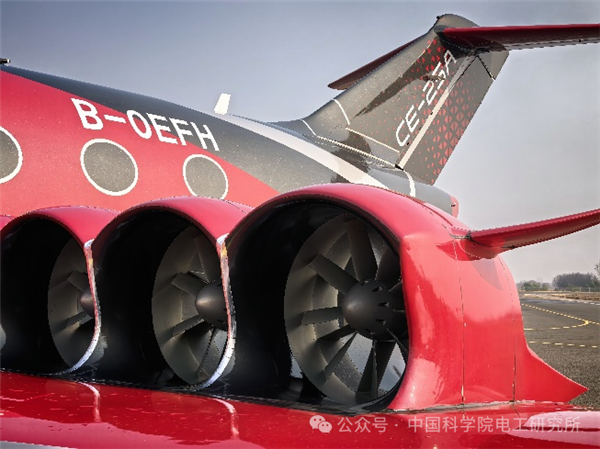
The air-cooled propulsion motor system supporting this time was all designed by the Electrician Institute and manufactured by Xiangtan Electric Co., Ltd. It is currently the world's largest airborne distributed propulsion motor system.
The energy efficiency of the system's flight profile can reach 94.5%, and the power-to-weight ratio is 4.34kW/kg, which is 79.3% higher than the 2.42kW/kg of French Safran's benchmark product that has received airworthiness certification from the European Aviation Safety Agency.
Comments