
Abstract:
A research team at North Carolina State University in the United States recently developed a new type of soft robot. The robot can jump continuously when illuminated by infrared light without the need for human intervention or readjustment. The researchers said that this achievement demonstrates a new autonomous movement mechanism of soft robots and provides new ideas for the design of future self-driving robots.
This robot is shaped like a water drop and was named "Ring Jumper" by the research team. Unlike many robots that require batteries, motors, or complex control systems, it relies solely on external infrared light for power. Once illuminated, the robot can continue to perform cyclic actions and switch between different movement modes such as forward, jumping and even vertical flight.
The core principle of the robot is to use torsional deformation to store elastic potential energy and release it instantly when it reaches a critical point, according to the researchers. Since the structure itself has the ability to automatically recover, there is no need to reset after each jump, but it can return to the initial state and start the next round of action. The entire process can be repeated as long as the infrared light continues to exist.
Structurally, the robot is mainly composed of a drop-shaped ring made of liquid crystal elastomer material, connected to a slender V-shaped aluminum structure at one end. When infrared light hits the surface of the material, the liquid crystal elastomer shrinks, causing the entire structure to rotate.
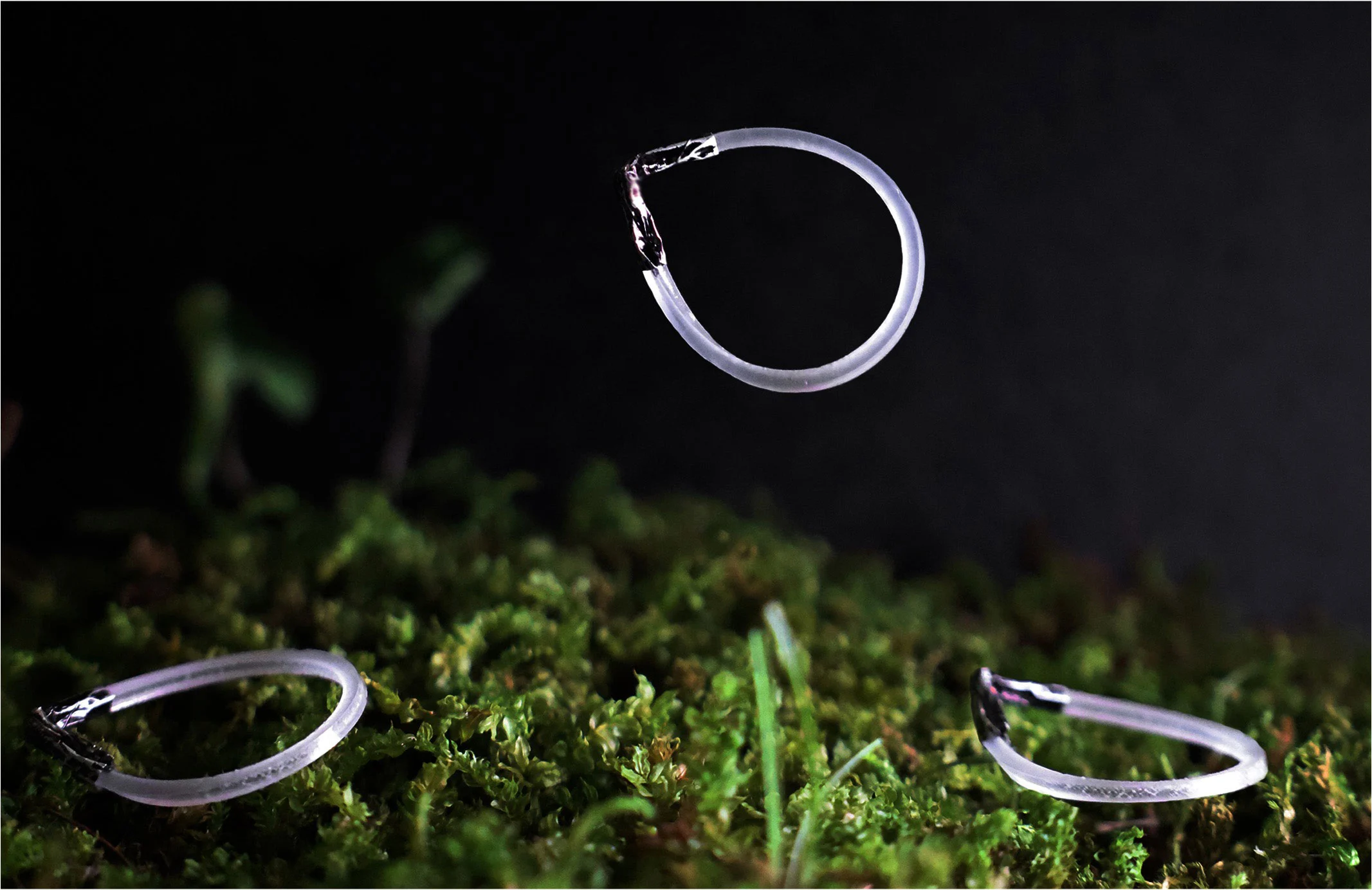
Without additional design, this structure usually just scrolls in place. However, the V-shaped aluminum parts installed at the ends prevent this process, causing the belt to continuously accumulate torsional deformation. As the torsional load continues to increase, the elastic potential energy stored in the material becomes larger and larger. When a certain critical point is reached, the energy is suddenly released, and the V-shaped structure quickly ejects downwards and hits the ground, thus ejecting the entire robot into the air.
After completing a jump, the robot will return to its original form and then start the energy storage and release cycle again, forming a continuous autonomous jumping behavior.
The research team found that simply changing the angle of the V-shaped structure can significantly change the way the robot moves. When the included angle is about 120 degrees, the robot mainly moves forward slowly in a crawling manner; when the included angle shrinks to 90 degrees, the robot jumps forward; and when the included angle further reduces to about 50 degrees, the robot can jump almost vertically into the air.
The researchers said this means that the same robot can be switched between different motion modes by adjusting a simple geometric parameter without changing the driving principle or adding additional control systems.
In addition to adjusting the included angle, the team also found that the position of the robot's center of gravity also affects motion performance. Experiments show that by adding a small amount of counterweight to the rounder end of the drop-shaped structure, the robot can achieve a longer jumping distance and a more stable forward trajectory. Researchers liken this phenomenon to a swimmer leaning forward when setting off to gain greater propulsion.
During the experiment, the research team also observed that infrared light intensity is crucial to sports performance. If the light intensity is insufficient, the robot cannot accumulate enough energy to complete the jump; but if the light intensity is too strong, the jumping process may become unstable and the direction may even be unpredictable. Therefore, proper control of light intensity is an important condition for achieving stable and continuous motion.
Researchers believe that this kind of soft robot that can self-reset, continue to move and has a simple structure is expected to be used in the fields of complex environment exploration, narrow space inspection, and new self-driven soft robot research in the future. Because it does not require a complex electronic control system and can complete autonomous movement solely relying on material properties and external light sources, it also provides a new development direction for future low-cost, lightweight robot design.
Comments