
Abstract:
With the rapid development of artificial intelligence technology, the number of data centers around the world continues to increase, providing computing power for chatbots, cloud computing, video services and various online applications. However,
a new study found that about a quarter of the world's data centers are located in areas with an imbalance between water supply and demand. For at least one month every year, local water demand exceeds available water resources. If global temperatures continue to rise in the future, this proportion may further increase to one-third.
Researchers warn that data centers are not built in isolated areas without other water users, and the water required for their cooling systems may compete with local residents, agriculture and manufacturing for the same water source.
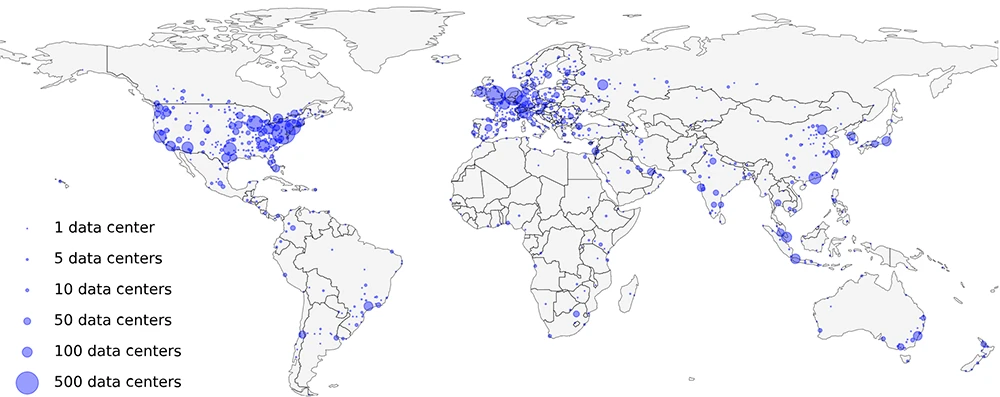
This research was published in Environmental Science and Technology, a journal of the American Chemical Society, and the relevant research results were announced through a press release issued by the American Chemical Society on October 19, 2026. The research team established a global data center distribution map and compared the location of facilities with the water needs of local water supply, urban water, agricultural irrigation, manufacturing and power generation to assess the water pressure faced by existing data centers.
The researchers analyzed a total of 9,347 operating data centers around the world. The results show that about 25% of them are located in areas where there is a gap between water supply and demand for at least one month every year, and about 6% of data centers are located in areas that face water stress for most of the year.
Lorenzo Rosa, the lead author of the study and a researcher at the Carnegie Institution for Science in the United States, pointed out that data centers are not built in open areas with no other needs, but are directly superimposed on the water resources that cities and farmland originally rely on. As data centers expand in size, their water needs may further exacerbate existing local water supply pressures.
Why do data centers require large amounts of water? The key reason is that servers generate a lot of heat when running. To prevent processors, memory, and other hardware from overheating, which could degrade performance or even malfunction, data centers must continue to dissipate heat. Some facilities use cooling towers and evaporative cooling systems to remove heat through evaporation of water; others use different forms of liquid cooling or air cooling technology.
For facilities using evaporative cooling, part of the water will directly evaporate during the heat dissipation process and cannot immediately return to the local water supply system. Data centers may also reduce water use through other cooling methods, but specific needs depend on server density, cooling technology, climate conditions, and operating loads.
Unlike electricity, water resources generally cannot be flexibly deployed through long-distance transmission networks. Data centers require water supplies from nearby rivers, lakes, reservoirs, or underground aquifers, which surrounding communities, farms, and industrial facilities also rely on. Even if a data center has enough funding, that doesn't mean the region can provide unlimited additional water.
The research team noted in particular that data center energy consumption has been heavily measured in the past because electricity use can often be measured and recorded through electricity meters. In contrast, the statistical methods for data center water use in different regions are not uniform, and some regions even lack complete data. Therefore, the researchers hope that by building a global water stress map, they can help governments and companies more clearly identify the water risks that data center expansion may bring.
In terms of global data center distribution, the United States occupies a considerable proportion, accounting for 39% of the total research statistics. This means that the United States is not only one of the countries with the highest concentration of data centers in the world, but also an important region where data center water pressure may further increase in the future.
The study found that in the United States, about 21% of data centers are located in water-stressed areas. There are a large number of data center clusters in the eastern United States, and many of these areas currently have relatively low water stress; however, in parts of the western and southern United States, the gap between water supply and demand may last for several months, and individual areas may even face pressure for most of the year.
There are obvious regional differences in the situation in Europe. Data centers are mainly concentrated in Northern and Central Europe, which generally face relatively less water stress. However, water stress is more acute in some areas of southern European countries such as Spain, Italy and Greece, and some areas may experience a gap between water supply and demand for more than six months each year.
Canada is not entirely unaffected. Research shows that about 35% of data centers in Canada face water shortages for at least one month each year. Although Canada is generally rich in water resources, the distribution of water resources is not uniform. The local water supply conditions in areas where population, industrial facilities and data centers are concentrated may be significantly different from the national average.
The researchers also analyzed the top water use sectors surrounding data centers to determine which industries these facilities might compete with. Globally, about 41% of data centers are located in areas where urban and municipal water use dominates, and about 28% are in areas where agricultural irrigation water dominates.
In addition, about 18% of the data center areas are located in areas where manufacturing water demand is the main demand, and about 8% overlap with the water demand of the power generation industry. The remainder is mainly involved in activities such as livestock farming and mining.
These data show that the water resources problems caused by the expansion of data centers are not simply industrial water problems, but comprehensive challenges involving urban water supply, agricultural production, energy supply and ecosystems.
When data centers overlap with urban water needs, residents, public services and commercial activities may face more intense competition for water resources. In areas where agriculture is dominant, additional industrial water needs may conflict with irrigation water. As for whether water stress will eventually lead to water restrictions for residents, reduced crop yields, or limited data center operations, it is not yet possible to draw firm conclusions based on this study alone.
To assess the possible impacts of climate change, researchers also used multiple global climate models to analyze the water conditions in areas where existing data centers are located when the global average temperature is 3 degrees Celsius higher than in 1900. This scenario represents possible climate conditions about 10 to 40 years in the future and does not mean that the study predicts that global temperatures will definitely reach this level in a specific year.
Model results show that under this future climate scenario, about 33% of the world's current data centers may be located in areas where water demand exceeds supply. In other words, if climate conditions develop in the direction set by the study, the proportion of data centers facing water stress could increase from one-quarter today to one-third.
The United States is expected to be particularly affected. Since 39% of the world's data centers are located in the United States, a considerable part of the new water pressure in the future will also be concentrated in this country. The researchers believe that this result highlights the importance of data center location selection: when deciding where to build, companies cannot only consider land prices, power supply, network connections and tax incentives, but also need to evaluate the long-term sustainability of local water resources.
It should be noted that this study analyzes the water resources risks faced by data centers currently in operation under different hydrological and climatic conditions, and is not a prediction of the number of future data centers or specific construction locations. It also does not prove that all data centers located in water-stressed areas will experience water supply outages, nor does it directly quantify how much actual damage these facilities have caused to surrounding residents.
The researchers emphasized that the gap between water supply and demand will not necessarily force data centers to cease operations, because enterprises may maintain operations by purchasing water rights, building water storage facilities, using alternative water sources, or adjusting cooling methods. However, whether these measures can actually reduce overall local water stress depends on the specific water supply system, regulatory rules and the needs of other water users.
The research team believes that long-term planning of data centers needs to pay more attention to local water management and infrastructure conditions. For areas with relatively sufficient water resources, it may be easier for new data centers to obtain stable water supply; while for areas that are already prone to drought, insufficient groundwater recharge, or have high agricultural water demand, the construction of new large-scale facilities needs to be more cautious.
Companies can also reduce their reliance on fresh water by adopting efficient cooling systems, increasing water recycling rates, using recycled water that meets requirements, and adjusting operations based on seasonal water conditions. However, there is no one-size-fits-all answer to these technical solutions that applies to all data centers. Different climate conditions, server loads and infrastructure design will affect the actual water savings achieved by various cooling technologies.
As artificial intelligence models become more and more complex, the computing resources required to train and run the models continue to grow, and the energy and water consumption of data centers has gradually become an environmental issue that cannot be ignored in the expansion of the technology industry. While AI services themselves are delivered in digital form, the servers, cooling equipment, and power systems that underpin them all rely on real-world natural resources.
This study does not assert that the development of artificial intelligence will inevitably lead to global water shortages, but points out that the geographical location of data centers will affect their environmental costs. If data centers of the same size are built in areas with sufficient water resources and those with long-term water shortages, the potential pressure on local society may be completely different.
Researchers believe that future data center site selection and governance need to incorporate water resources constraints into long-term decisions, rather than focusing solely on computing power, energy prices and network latency. Only by taking into account the water needs of local residents, agriculture, industry and ecosystems can we more accurately judge whether data center expansion is sustainable in the long term.
As the number of data centers around the world continues to increase, water management may gradually become a key factor in the construction of artificial intelligence infrastructure. The global distribution differences revealed by the study mean that the future competition for data centers will not only be a competition for computing power, chips and electricity, but will also be increasingly affected by water conditions and local governance capabilities.
Comments