
Abstract:
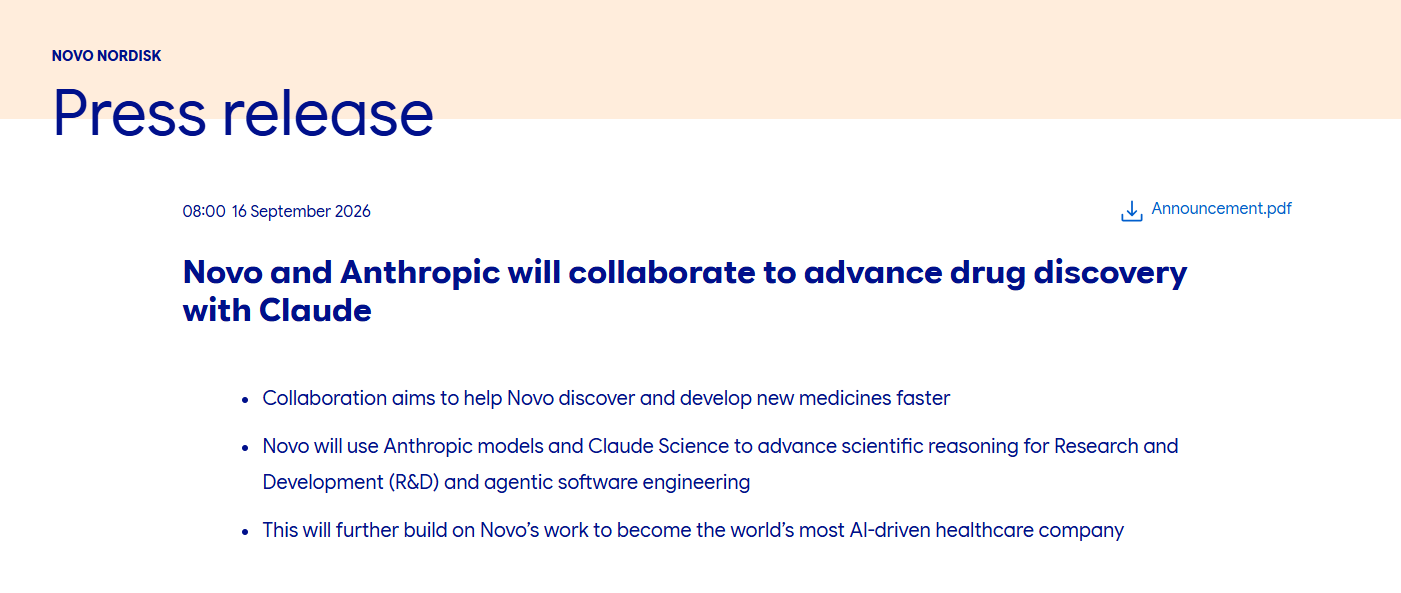
Danish pharmaceutical giant Novo Nordisk will cooperate with artificial intelligence company Anthropic to use AI tools to advance drug research and development. Novo Nordisk said on Wednesday local time that it will use Claude Science, Anthropic's platform for scientific research, to accelerate the discovery and development of new drugs and focus on solving scientific problems that both parties believe can have the greatest practical impact.
Novo Nordisk is the maker of diabetes and weight-loss drugs Ozempic and Wegovy. This cooperation is another recent example of large pharmaceutical companies investing in the field of AI. Many large pharmaceutical companies, including Eli Lilly, Merck, and Roche, are betting heavily on AI, hoping to use this technology to discover and produce drugs faster.
Novo Nordisk CEO Mike Doustdar said: "AI can help us improve R&D efficiency and shorten the time from scientific research to product launch. But in addition, AI tools can also bring new scientific research opportunities and help us better reason and understand human biology and drug action mechanisms."
AI is expected to help drug developers solve some of the toughest problems in biology and use its powerful analytical capabilities to find new ways to treat major diseases. But while drug companies are investing heavily, those bets have so far not translated into tangible results.
At present, although some drug candidates discovered with the help of AI have entered the human clinical trial stage, AI has not yet contributed to any approved drug.
Some industry insiders say that so far, the greatest direct benefits that AI has brought to the pharmaceutical industry are mainly reflected in the automated processing of daily tasks, such as integrating and summarizing scientific research materials, analyzing massive data, and designing human clinical studies.
Ipsen CEO David Lowe said last month: "AI can play a role on both ends at the same time. On the one hand, it can help companies increase sales, improve efficiency, and find more patients; on the other hand, it can also help companies improve operational efficiency, thereby completing more work with fewer resources."
Pharmaceutical companies have also found AI useful in selecting patients who are eligible to participate in drug clinical trials.
Bill Coyle, managing director of ZS Europe, a global consulting and technology company, said that for some rare diseases driven by genetic factors, AI is particularly helpful in identifying potential patients from large-scale electronic health records.
Novo Nordisk has cooperated with a number of companies, hoping to use AI to speed up the discovery and development of new drugs. Earlier this year, the Danish drugmaker announced it would partner with ChatGPT developer OpenAI and establish an AI innovation center with Amazon Cloud Services.
Novo Nordisk said that in its collaboration with Anthropic, the company will test Claude Science to help solve problems in scientific research. In addition, Novo Nordisk also plans to use Anthropic's model to further enhance its AI-driven software development capabilities.
Dario Amodei, co-founder and CEO of Anthropic, said: "As AI capabilities continue to improve, it is possible to compress biological and medical breakthroughs that would have taken a century to occur within a decade. We can shorten R&D cycles, improve R&D results, and discover drugs and treatments that can significantly improve human lives. This is exactly what we hope to achieve in our partnership with Novo Nordisk."
The two parties also stated that this cooperation has incorporated strict data governance and manual supervision mechanisms from the beginning of the design to ensure that AI is used responsibly and in compliance with Novo Nordisk's ethics and compliance standards.
Comments