
Abstract:
A question in the world history subject of South Korea's college entrance examination this year caused huge controversy across the country. The error rate of candidates' answers to this question exceeded 90%, almost failing the vast majority of candidates. Many students who have completed the exam collectively questioned the misleading bias of the question setting itself. Many people even uploaded the test results, saying that the answers given by the mainstream artificial intelligence models on the market are different from the official standard answers released by the Korean Educational Curriculum Evaluation Institute. It is generally believed that there is a problem with the question stem guidance itself.
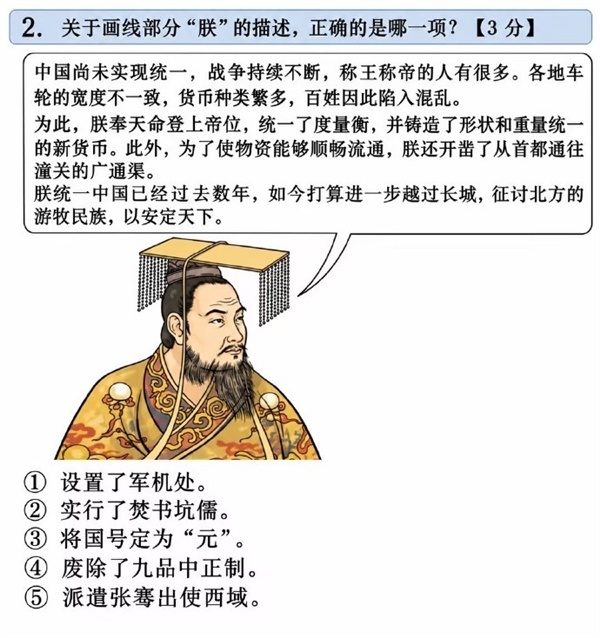
This controversial question caused an uproar. The question stem describes a series of policies implemented by a certain ancient Chinese emperor. The examinee is required to choose the correct statement from the given options that exactly matches the content described in the question stem. The question stem also specifically gives detailed hints such as unifying currency and weights and measures, and leading an army to conquer the northern nomadic tribes.
When the vast majority of candidates saw the iconic information about the unification of weights and measures and the attack on nomadic tribes in the first half of the question, they subconsciously determined that the Chinese emperor described in the question stem was Qin Shihuang.
Follow-up statistics show that 87.7% of the candidates directly chose the option corresponding to burning books and humiliating Confucians, which was almost the common choice of the vast majority of people.
Unexpectedly, the official correct answer announced by the Korea Educational Evaluation Service was the option corresponding to the abolition of the nine-grade system. The final error rate of candidates for the entire question was as high as 92.6%, and the proportion of students who chose the correct option was less than one-tenth.
Afterwards, many people reviewed and found that the most critical clue to determine the correct answer was hidden in the most inconspicuous position of the question, which was the five words mentioned in the construction of the Guangtong Canal. The Guangtong Canal was the Guanzhong water transport canal ordered by Emperor Wen of the Sui Dynasty Yang Jian to preside over the construction. This was the core basis for determining that the figure was Emperor Wen of the Sui Dynasty and not the First Emperor of Qin.
This controversial question has also triggered widespread discussion in South Korea. Many people in the education sector have criticized the question maker for deliberately hiding core clues behind a large amount of strong interference information in order to deliberately improve the distinction of the test. This has deviated from the original intention of the history test to test common sense. Instead, it has become a word game that tests candidates' ability to dig out details, completely losing the original purpose of the test.
Comments