
Abstract:
On November 23, the large model API aggregation platform OpenRouter announced the latest week of model call data. In the week from November 16 to 22, the total number of global large model calls was 210 trillion Tokens, an increase of 8.25% compared to last week's 194 trillion. Among them, China's large model weekly token processing volume has surpassed that of the United States for the 30th consecutive week, ranking first in the world, and continues to lead the platform's model calling list. However, compared with last week, the number of calls to Chinese models has declined.
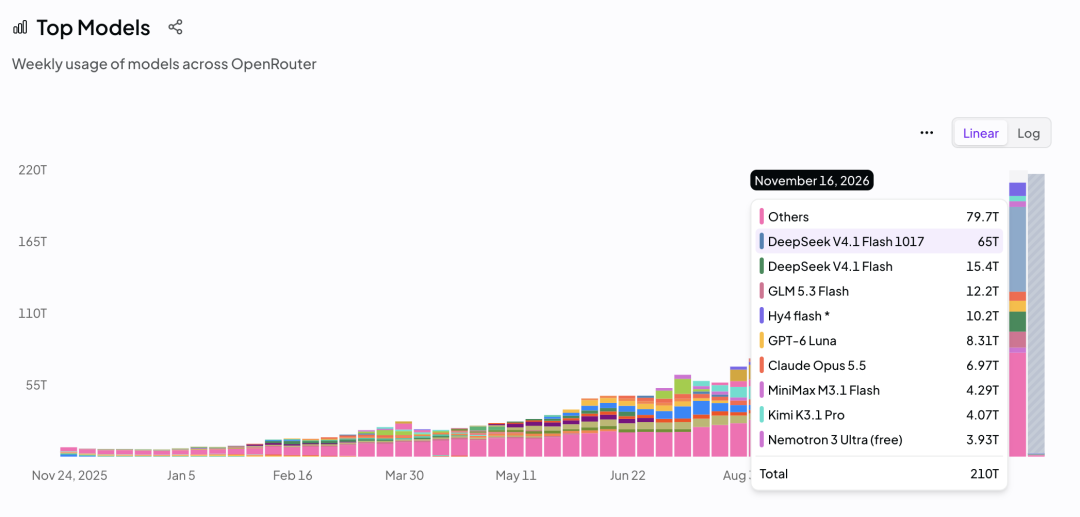
Among the top nine models in terms of call volume, Chinese large models accounted for 6 seats, with a total weekly call volume of 111.16 trillion Tokens, a month-on-month decrease of 6.67%; during the same period, American AI large models occupied 3 seats, with a total weekly call volume of 19.21 trillion Tokens, a month-on-month increase of 29.53%.
Specifically speaking of manufacturers, DeepSeek, Zhipu and Tencent took the top four spots on the list. DeepSeek's V4.1-Flash-1017 ranked first for five consecutive weeks, with a weekly call volume of 65 trillion Tokens, a month-on-month increase of 16%. DeepSeek V4.1 Flash ranked second, with weekly calls reaching 15.4 trillion Tokens, down 1% from the previous month.
GLM 5.3 Flash ranked third, with a weekly call volume of 12.2 trillion Tokens, a month-on-month increase of 3%; Tencent’s Hunyuan Hy4 flash launched on November 16 ranked fourth, with a weekly call volume of 10.2 trillion Tokens.
From a trend perspective, a change worthy of attention comes from MiniMax. The processing volume of M3.1 Flash, launched in October, increased by more than 461% month-on-month last week, reaching 4.29 trillion Tokens, ranking seventh. This means that more and more new domestic models are entering the scope of developers.
If you extend the time dimension of the list to one month, you can more clearly see which model has received more calls. The most eye-catching ones are the models launched by DeepSeek and Dark Side of the Moon last month.
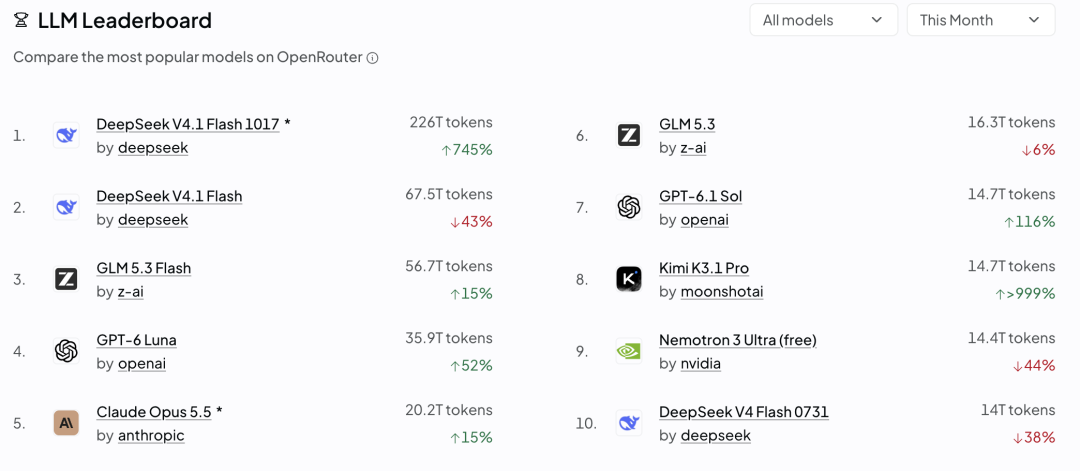
OpenRouter data shows that the Token processing volume of DeepSeek V4.1-Flash-1017 this month reached 226 trillion, an increase of more than 7 times, ranking first in the monthly list. The Kimi K3.1 Pro launched by Dark Side of the Moon in October has grown even faster. Its token processing volume increased by more than 999% this month, ranking eighth on the monthly list.
Overseas models are also growing. OpenAI's GPT-6.1 Sol's token processing volume increased by 116% this month, ranking seventh; GPT-6 Luna increased by 52%, ranking fourth in the monthly list.
However, OpenRouter data cannot be directly equated to global market share. The data here only counts traffic routed through the OpenRouter platform. Manufacturer's own APIs, cloud platforms, privatized deployments, and direct-to-consumer applications and web products are not included.
Looking over a long period of time, the growth trend of Chinese manufacturers is still obvious. In the week of November 24, 2025, the amount of tokens processed by OpenRouter was 7.18 trillion. Among the top nine large models with the most calls, 8 were overseas models. Among the Chinese models, only MiniMax M2 ranked among the top. The top one was Musk's xAI's Grok.
But as of last week, the number of model calls reached 210 trillion, an increase of more than 28 times in one year. As the overall market scale expands, domestic models have gradually transformed from a few participants on the list to a major contributor to head traffic.
Chinese models have won more call shares, but that does not mean they have made more money. Looking at another list on OpenRouter, the proportion of model expenditures on different tasks is still overwhelmingly ahead of overseas models. Chinese models still need to catch up in terms of commercialization.
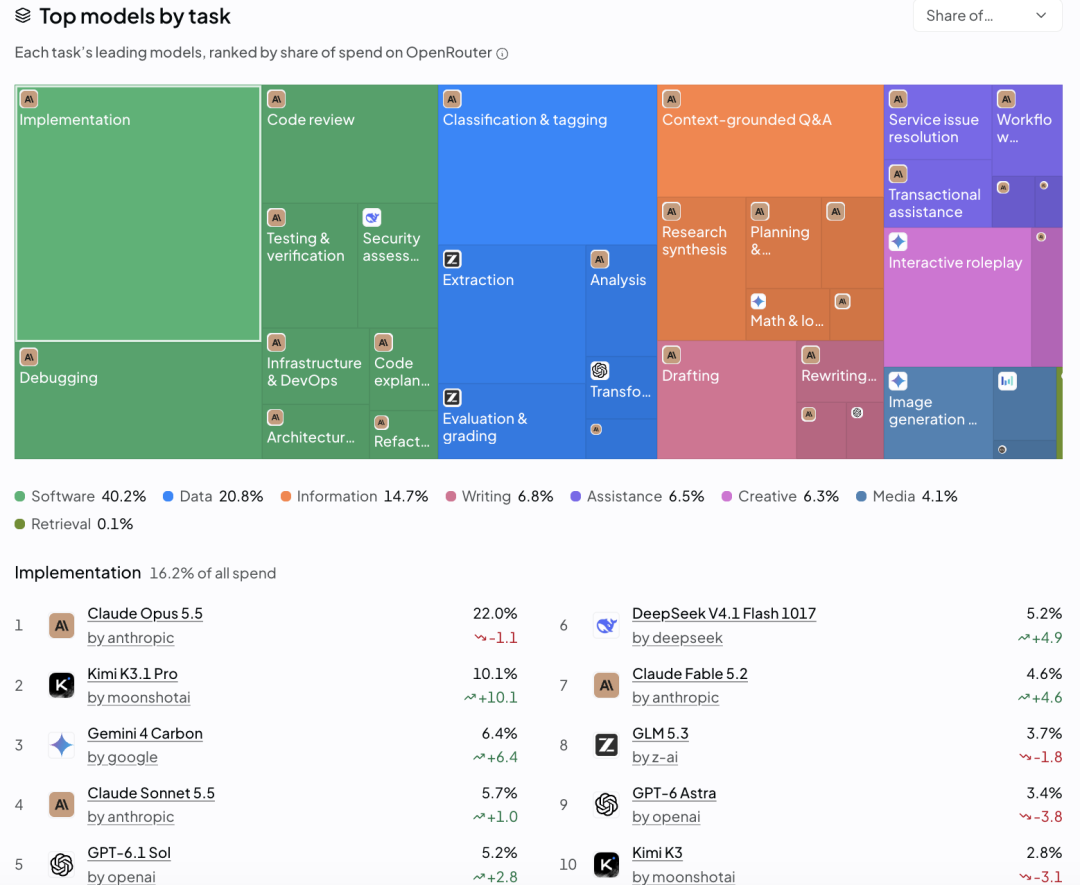
In the latest task expenditure data released by OpenRouter, software tasks (Software) are the largest consumption category, accounting for 40.2% of the total platform model expenditures; followed by data processing (Data), accounting for 20.8%; and information tasks (Information) accounting for 14.7%. Writing, auxiliary and creative tasks accounted for 6.8%, 6.5% and 6.3% respectively.
Judging from the figure, Anthropic’s Claude model takes the top share of most tasks.
Specifically, in the code implementation (Implementation) category under software tasks, this task expenditure accounts for 16.2% of the total platform expenditure. In the model expenditure ranking, overseas models occupy 6 seats and Chinese models occupy 4 seats. Among them, Anthropic's Claude Opus 5.5 ranked first, accounting for 22% of the expenditure on this type of task model; Dark Side of the Moon's Kimi K3.1 Pro rose to second, accounting for 10.1%; Google Gemini 4 Carbon ranked third, accounting for 6.4%. DeepSeek V4.1 Flash 1017 ranked sixth, accounting for 5.2%.
The Chinese model has entered the software development workflow of developers, but judging from the payment situation of high-value tasks, overseas manufacturers still have strong competitiveness. After China's big models gain traffic, they still have to pass the hurdle of making money.
Comments