
Abstract:
On November 9, local time, Anthropic released Claude Fable 5.2 and Claude Mythos 5.2. Both share the same underlying model. Fable is available to all users and has built-in cybersecurity and biosecurity protections; Mythos removes these restrictions and is only open to institutions that pass the Cyber or Life Sciences verification program.
After its release, everyone’s descriptions were almost the same: stronger and faster. Some developers also feel that the pricing is wrong at first glance. For coding, Fable 5.2 is not cost-effective. However, Anthropic itself said in the release documentation that for most coding and knowledge work, it is recommended that everyone "start with Claude Opus 5.5."
The most powerful models in history are constantly being updated, but there is not much time left to use them. Before reaching AGI, AI companies first hit the ceiling of commercialization.
The strongest continues to get stronger, has the prototype of the digital workforce emerged?
First let’s talk about what’s strong about it. FrontierCode 2.0 tests "whether open source project maintainers are willing to merge code written by models." At the highest computing power level, Fable 5.2 achieved 49.1%, while the previous generation Fable 5.1 achieved 32.4%.
The Remote Labor Index, which measures how many real-world remote work tasks a model can complete independently, more than doubled from 17.9% to 41.3%.
Anthropic also has an internal robot simulation test, RoboDojo Sim, whose score improved from 27.6% to 64.9%. However, this number comes from the company's internal operations and cannot be reproduced by the outside world.
Then there's the weak point. Also in the official comparison table, in AutomationBench, Fable 5.2's 51.4% lost to Google Gemini 4 Carbon's 53.9%.
On the smart list of the external platform Artificial Analysis, Fable 5.2 topped the list with 65 points, far surpassing Gemini 4 Carbon in second place with 60 points, and 9 points behind GPT-6 astra in fourth place.
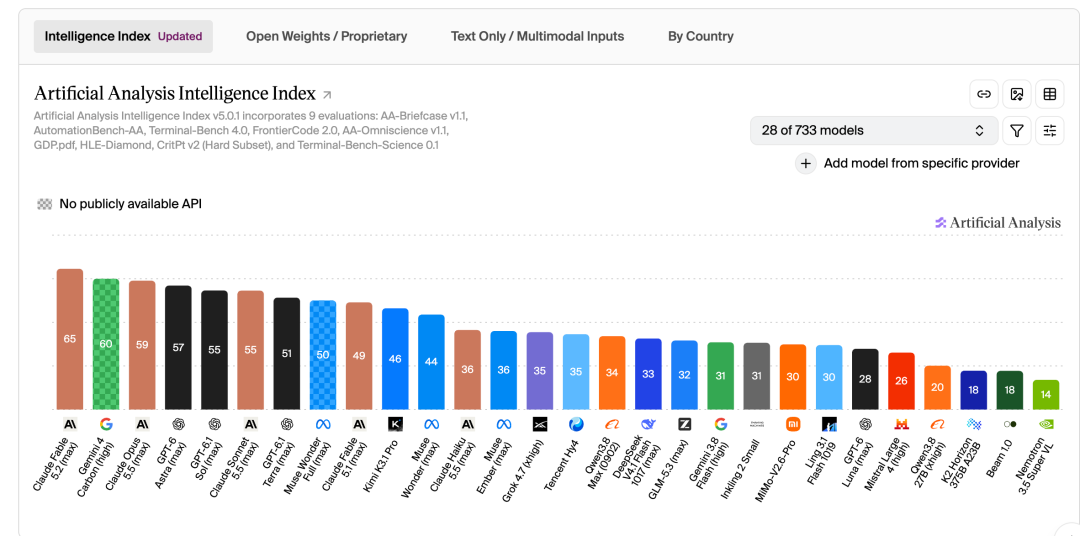
How strong is it? In more than a day, a major feat in the history of human mathematics was directly completed.
Within 30 hours, the formal verification of Fermat’s Last Theorem was completed; in addition, two unsolved problems in physics related to black holes and quantum gravity were also solved. It can also operate an operating system completely independently, independently design and manufacture electronic equipment, and predict the capsid structure of complex adeno-associated viruses...
Some people believe that Fable 5.2 means that AI is moving from a productivity tool to a digital workforce with engineering execution capabilities.
However, many developer groups believe that this may mean that Anthropic has "reached its end" in the coding direction. If it does not develop some new tracks and new models, it will be difficult to stimulate investors' perceptions. And now it coincides with the critical period for Anthropic to sprint towards IPO pricing.
The price is far ahead, so Anthropic recommends that you don’t use it
However, when many developers were excited to try out the capabilities of Fable 5.2, they found that there was something wrong with the pricing.
The standard pricing of Fable 5.2 is $8 for input and $40 for output per million Tokens, which seems to be a 20% drop from the $10 and $50 of the previous generation, and the output speed is up to 30% faster than 5.1. If it's too slow, you can turn on the fast mode, which increases the speed by 2.5 times and doubles the price. Input is $16 and output is $80.
Intuitively, the cost per task on Artificial Analysis is also far ahead.
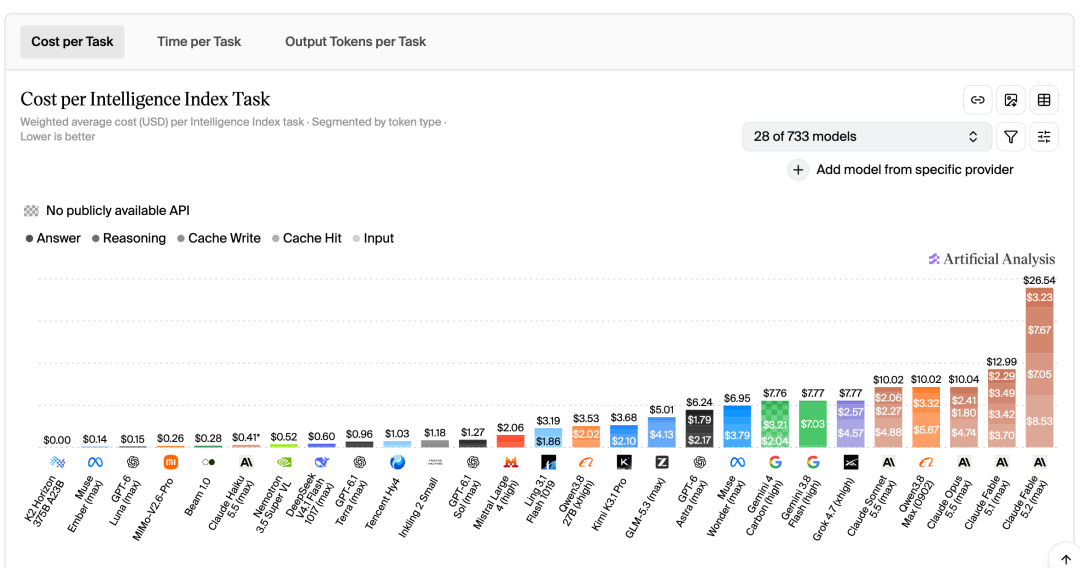
However, Anthropic itself put a "code accuracy vs. cost per task" curve in the release materials, and concluded that at the medium computing power level, Fable 5.2's 45.3% is already close to Opus 5.5's highest level of 45.5%, and the cost of completing a task is only about half.
At present, Anthropic officials have changed the scale for measuring smart consumption. In the past two years, the industry price comparison was based on how much it cost per million Tokens. This time it was replaced by how much it cost per completed task. The results measured by two rulers can be completely opposite. A model whose token unit price is 20% cheaper may cost twice as much if it takes three more rounds to get it right.
In addition, Anthropic’s official recommendation is, “For most coding and knowledge work, we recommend that users start with Claude Opus 5.5.”
Compared in the current price echelon, DeepSeek V4.1-Flash costs US$0.3 per million input and US$1.2 per million output, Kimi K3.1 Pro costs US$2 per million input and US$10 output, and GPT-5.5 standard version costs US$5 and US$30. The Fable 5.2 stands at the top, $8 and $40.
In other words, this model is very expensive every time it is opened. Its value lies in opening it once at a critical moment, not every day.
In this regard, Anthropic has assigned two new roles to it. One is Advisor. Cheap models such as Haiku, Sonnet, and Opus come to ask it when they encounter problems. The other is Orchestrator, a scheduler. It does not do it personally, but splits the tasks and assigns them to smaller models below.
Stronger than the Strongest is still being refreshed, but it is no longer the most important
Anthropic said that an engineer gave Fable 5.2 an empty folder, which coordinated more than 1,000 sub-agents and ran continuously for 8 days, and finally handed over a prototype operating system that could be booted on a laptop, with its own kernel, disk, keyboard and network driver, file storage, window, login interface and installation program.
Another set of Agents migrated one of Anthropic's own production services from Python to Rust, and the startup speed was about 26 times faster after the migration.
It's even involved in hardware. Anthropic said it collaborated with circuit board manufacturer Diode to design three products - a home voice assistant, a USB conference speaker, and a handheld electronic pet, including circuit boards, casings and software. The boards can work without any electrical modifications after they are built.
The mathematical sample is this. About 1,000 Agents spent less than 30 hours translating the existing proof of Fermat's Last Theorem into a form that Lean can verify step by step. Doing the same thing in September this year required 11 days, special scaffolding, and full guidance from researchers; this time, only one-third of the output Token was used, and the proof length was about one-seventh of the original length.
These cases sound like show-offs. But if you replace "1000 sub-agents" with "1000 subordinates", you will find that it actually describes an organizational structure, not a model.
An industry insider believes that the competition for top models has converged, that is, price convergence and data convergence. The next step is undoubtedly the "application" stage, where the upper limit of model capabilities and the lower limit of price are carried out at the same time, which means that AI can be used for different differentiated explorations. By then, for model manufacturers, the competition will be dimensions such as harness, memory and user habits.
At this point, we can see that large model manufacturers are making arrangements. For example, DeepSeek and OpenAI are also completing the same set of capabilities.
In August this year, DeepSeek has open sourced DeepSeek Harness under the MIT license. On October 17, when DeepSeek released V4.1-Flash-1017, it made it clear that the new model was optimized for intelligent products such as DeepSeek Harness, Tencent CodeBuddy, and WorkBuddy. And Cui Tianyi of the harness team has been recruiting people on a large scale. Ifeng Technology previously learned from industry insiders that Liang Wenfeng himself is better at "this is also the area."
Also on November 5, Kimi just released Kimi Hosted Agents (hosted agents), officially proposing Harness as a Service.
On the same day, Cat Wu, who was responsible for Claude Code products at Anthropic, joined OpenAI and was responsible for product management of the core product team. She was involved in driving Claude Code from internal prototypes to widely used commercial products, and then briefly joined Cursor.
Claude Code is one of Anthropic’s most representative products in the AI programming market. Cat Wu has direct experience in its process from product conception to commercialization. OpenAI's recruitment of her obviously means to strengthen the capabilities of Codex and wider Agent products.
In fact, just before the release of Fable 5.2, the alleged new model of Gemini was "leaked". User @chetaslua commented that "it takes twice as long and the amount of code doubles." This is a new checkpoint for Gemini 4 code-named "krypton" within Google. It is said that the performance in code generation visuals and 3D scenes significantly surpasses the newly released carbon. Therefore, the refresh speed of top models is increasing. Some people think it is due to RSI, otherwise there is no way to explain it.
Then the question comes. If intelligence is no longer a problem, then what is competitiveness? How will the next model competition go? The answer will soon be revealed.
Comments