
Abstract:
According to previous reports by WIRED and the latest disclosure by biotechnology company Exin Therapeutics, OpenAI’s AI model GPT-6.1 Sol has been used in live mouse brain surgery experiments, and in three consecutive operations, the positioning performance was improved through feedback from surgeons. By the third operation, the time it took to identify key anatomical landmarks was shortened from 169 seconds to 86 seconds, and the positioning error was reduced from 0.6 mm to 0.3 mm.
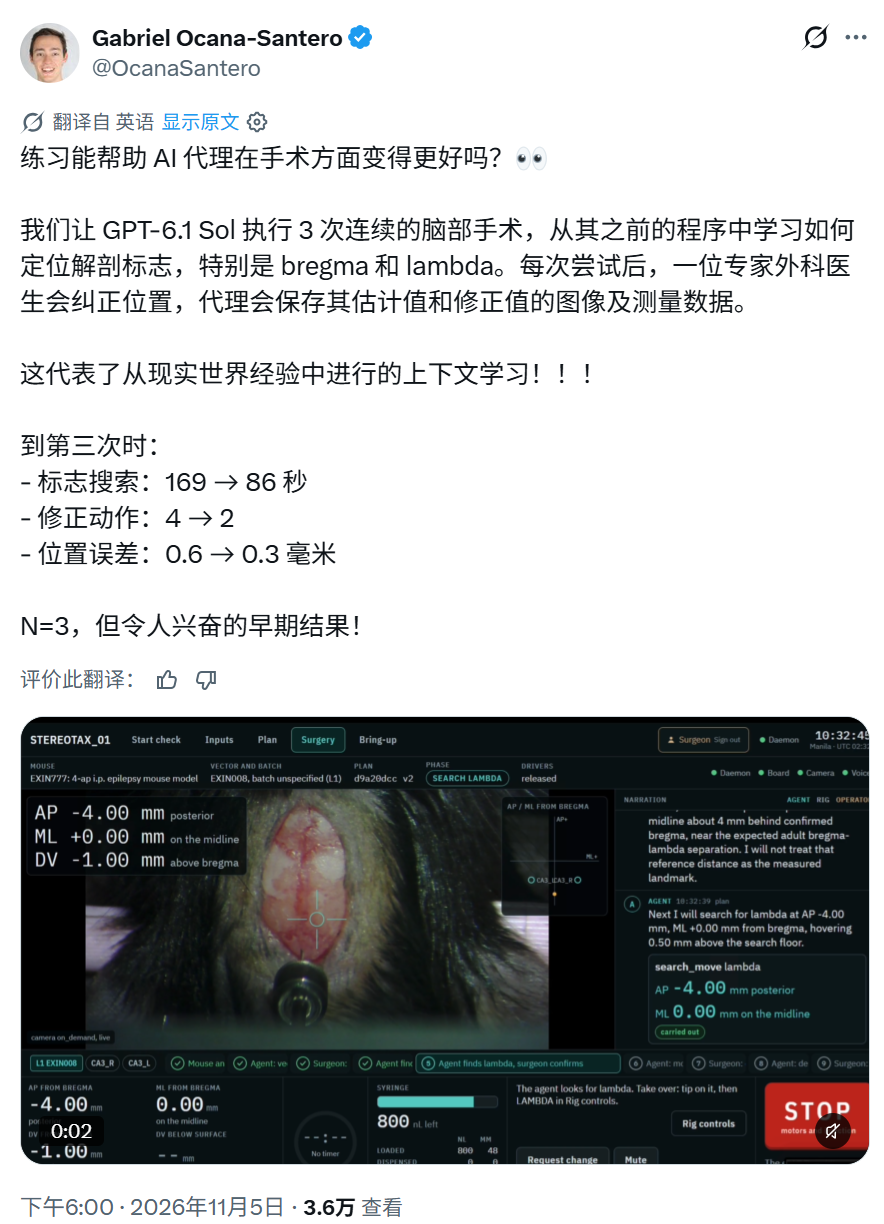
Gabriel Ocana-Santero, co-founder and CEO of Exin Therapeutics, announced the results on the social platform X on November 5. The research team let GPT-6.1 Sol participate in three consecutive anatomical landmark positioning tasks in brain surgeries on living mice. After each operation, professional surgeons will correct the position identified by the AI, and the model will save relevant images, measurement data and correction records for reference in the next operation.
The experiment mainly involves two key anatomical landmarks on the surface of the mouse skull: Bregma (anterior fontanel) and Lambda (posterior fontanel). These two positions are important reference points for brain stereotaxy surgery. Researchers need to use them to determine the coordinates of the brain area in order to accurately guide injection needles or other experimental instruments to the target location.
The research team stated that
After three rounds of operations, the manual corrective actions required by GPT-6.1 Sol were reduced from 4 to 2, and the positioning error was reduced by 50%
. It is worth noting that this progress is not achieved by retraining the model or updating parameters, but by using the experience accumulated in previous operations and expert feedback to adjust its own judgment in subsequent tasks, which is a practical application of context learning.This is not the first time Exin Therapeutics has used AI to participate in living brain surgery. Previously, the research team used Anthropic's Claude Sonnet 5, OpenAI's GPT-6.1 Sol and xAI's Grok 4.7 to participate in mouse brain gene therapy experiments.
The three AIs obtained the same 19 candidate gene treatment plans. They were all tasked with selecting treatments for epileptic mice and using electric brain stereotaxic equipment to perform injections. The results showed that the three models chose different treatment mechanisms and target brain areas: Claude chose the entorhinal cortex, GPT-6.1 Sol chose the hippocampus, and Grok chose the somatosensory cortex.
During the experiment, AI can observe the surgical area through the camera, plan the injection coordinates, injection dose, speed and waiting time by itself, and control the equipment to perform related operations. Among them, GPT-6.1 Sol viewed camera images 59 times in one experiment. It also discovered a small dark red spot at the craniotomy site, suspected possible bleeding, and left the judgment to the surgeon. The researchers later stated that this phenomenon was not considered abnormal bleeding during this type of surgery.
However, these surgeries are not entirely performed by AI independently. A licensed veterinarian is still responsible for the incision, craniotomy, and suturing, and supervises the entire surgical process. For irreversible critical steps, manual approval is required. The experimental equipment is also equipped with movement range, injection dose limit and emergency stop switch to prevent injuries caused by AI operation errors.
WIRED previously reported on the team’s early experiments using Claude Sonnet 5. At that time, the researchers initially tried to get Claude Opus 5.5 to perform related tasks, but the model refused to advance the injection needle into the mouse brain. The team then switched to Claude Sonnet 5 to complete the injection. On this basis, the researchers further tested GPT-6.1 Sol and Grok 4.7, and conducted the latest continuous operation experiments.
Currently, relevant experiments are still in the early stages of exploration. The person in charge of the research admitted that the sample size of three operations is very limited and is not enough to prove that AI can stably master relevant skills. Whether the treatment options selected in different models are truly effective requires subsequent observation of the behavior and brain activity of the mice to determine.
These preliminary experiments demonstrate the possibility of AI moving from analyzing scientific research data and formulating experimental plans to directly operating real experimental equipment. However, the relevant results have not yet been fully independently verified and peer reviewed, and there is still a long way to go before they can be used in human brain surgery.
Comments