
Abstract:
Google parent company Alphabet plans to send a self-developed AI chip into space aboard a SpaceX Falcon 9 rocket on Thursday, taking a key step toward realizing a space data center. The launch is scheduled for 11:15 a.m. Pacific time from Vandenberg Air Force Base in Santa Barbara County, California.
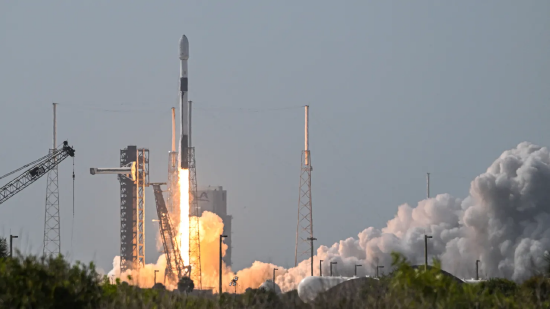
On July 21, 2026, a SpaceX Falcon 9 rocket was launched from Launch Station 40 of the Cape Canaveral Space Force Base in Florida, carrying Northrop Grumman's Mission Robotic Vehicle (MRV) and Mission Expansion Module (MEP).
SpaceX calls space supercomputers the next frontier of artificial intelligence infrastructure and promotes "infinite space" in orbit to get rid of all kinds of social resistance to building data centers on the ground. In this uncrewed "Transporter-18" ride-sharing launch mission, SpaceX will carry multiple Planet Labs satellites, including a solar-powered prototype satellite equipped with Google's Tensor Processing Unit (TPU).
This is the first on-orbit test of Alphabet’s “Suncatcher Project”. This high-risk research and development project was announced by Google in November 2025, with the goal of creating a reliable AI computing infrastructure that can continuously operate in space and rely on solar power.
Alphabet said in its official blog introducing the launch plan that the Suncatcher program aims to "explore whether space can host scalable machine learning infrastructure in the future."
Alphabet is a significant investor in SpaceX. SpaceX completed an unprecedented IPO in history in June this year. Although the AI departments of the two companies are competitors, the two companies maintain a deep cooperative relationship. Alphabet’s stake in SpaceX is currently valued at more than $82 billion.
Alphabet mentioned in a blog post that satellites in low-Earth orbit "can receive sunlight almost continuously, and the solar power generation can be up to 8 times that of the ground." The company's long-term vision is to "network multiple satellite constellations to handle larger-scale AI computing tasks in orbit."
The Google parent company has previously completed ground testing of TPUs running AI tasks in a laboratory at the University of California, Davis, but the actual performance of the chips in the harsh environment of low-Earth orbit is still unknown.
SpaceX, run by Musk, also announced plans to independently develop an orbital data center. The entire system consists of a large number of satellite clusters manufactured at the Redmond, Washington, factory. The satellites are equipped with graphics processors, and the solar panels will be assisted by Musk's car company Tesla.
Earlier this year, Musk said that space data centers will become the lowest-cost AI training solution and "can be implemented within two to three years at the latest." SpaceX COO Gwynne Shotwell said at an event in September that companies will deploy "space supercomputing" by 2027.
Industry experts point out that even if space data centers are feasible in the future, they are still a distant idea at this stage. On the one hand, rocket launch capacity is tight and costs are high; on the other hand, orbital data centers also need cooling systems and chips that can withstand extreme temperatures, as well as provide radiation protection. Space debris and orbital congestion issues will also restrict the implementation of this plan.
This "Transporter-18" is SpaceX's second landmark launch in a single day. The company will also launch NASA's Crew 13 mission from Florida's Space Coast on Thursday, carrying astronauts to the International Space Station for a six-month stay in orbit.
Comments