
Abstract:
Microsoft’s latest Windows 11 26H2 update is being pushed to users around the world. As more and more users complete the upgrade, some test results show that the new version has begun to bring about memory usage optimization, but the most obvious benefit is not the 8GB memory device that needs optimization the most, but computers with larger memory capacity.
After installing Windows 11 26H2, many users found that the memory usage of the system in idle state dropped significantly. One of the users shared on Reddit that after upgrading to 26H2, the memory usage of his computer after booting was reduced by about 2GB. However, the device is equipped with 48GB of memory, so the impact of this improvement on the actual user experience is relatively limited.
Another user reported a similar situation. He said that after the upgrade, the system memory usage dropped from approximately 9.1GB to 7.5GB. But judging from its public task manager screenshots, this device is equipped with 32GB of memory and is also a high-configuration platform.
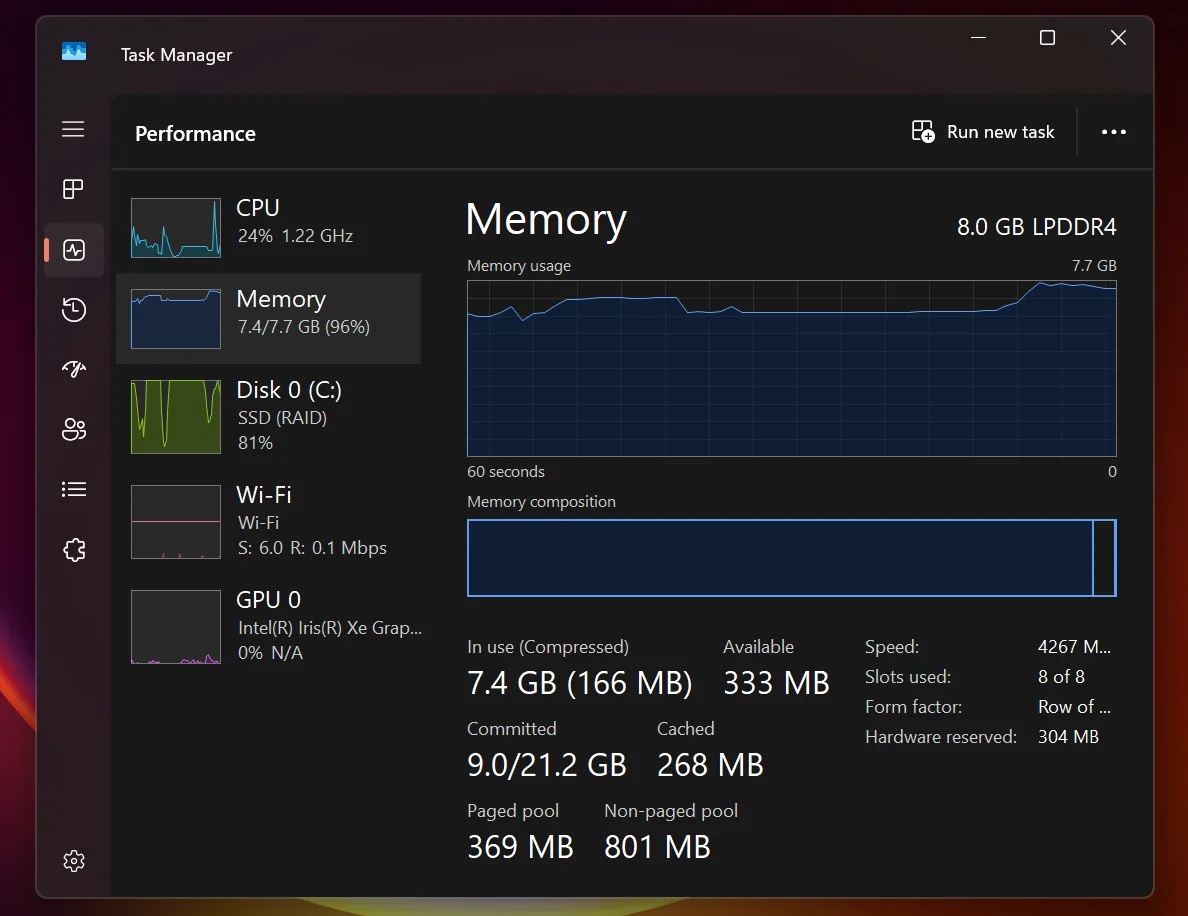
In stark contrast, some Windows 11 devices equipped with 8GB of memory did not experience significant changes. Some users said that after upgrading to 26H2, the system memory usage has hardly improved. In the relevant screenshots, this 8GB device has used about 7.4GB of memory after booting, accounting for about 96% of the total memory capacity, leaving very limited space for applications.
This phenomenon has triggered discussions on Microsoft’s optimization strategy. Microsoft has repeatedly emphasized that it will improve the operating efficiency of Windows 11 on devices with 8GB and above configurations, and plans to improve the overall experience by reducing system memory usage, optimizing the WinUI framework, and improving Chromium and WebView2 components.
Pawan Davuluri, head of Microsoft's Windows and Devices Department, has previously stated publicly that reducing system memory usage is one of the important goals of the Windows team in the future, hoping that more users can get a smooth Windows experience on 8GB memory devices.
However, judging from current user feedback, the optimization effects brought by the 26H2 version seem to mainly appear on devices with high memory configurations such as 32GB and 48GB, while 8GB computers with already tight memory resources have not yet received the same degree of improvement.
Industry insiders pointed out that as memory prices fluctuate and some manufacturers re-launch laptops with 8GB configurations, Microsoft is facing increasing pressure for optimization. For the large number of users who are still using 8GB devices, the Windows 11 system itself often occupies most of the available memory. When browsers, office software, or communication tools are running at the same time, the system is prone to performance degradation and slow response.
Although 26H2 shows that Microsoft is continuing to promote memory optimization work, judging from current feedback, the system still has a long way to go before it can truly improve the experience of using 8GB devices. For users with higher memory capacity, the new version has begun to bring certain benefits; and for 8GB users who need these optimizations most, the wait may continue.
Comments