
Abstract:
Although the overall circulation scale of stablecoins has hardly grown since 2026, its frequency of use and transaction amount in the payment field have increased significantly. The latest data from blockchain data analysis company Allium shows that in the first nine months of 2026, the amount of stablecoin payments reached US$482 billion, a year-on-year increase of 45%; during the same period, the number of payments increased by 71%, exceeding 1 billion. This shows that the stablecoin market is undergoing a noteworthy change: the driving force for the development of the industry is beginning to come more from the actual use of existing stablecoins, rather than just the expansion of issuance scale.
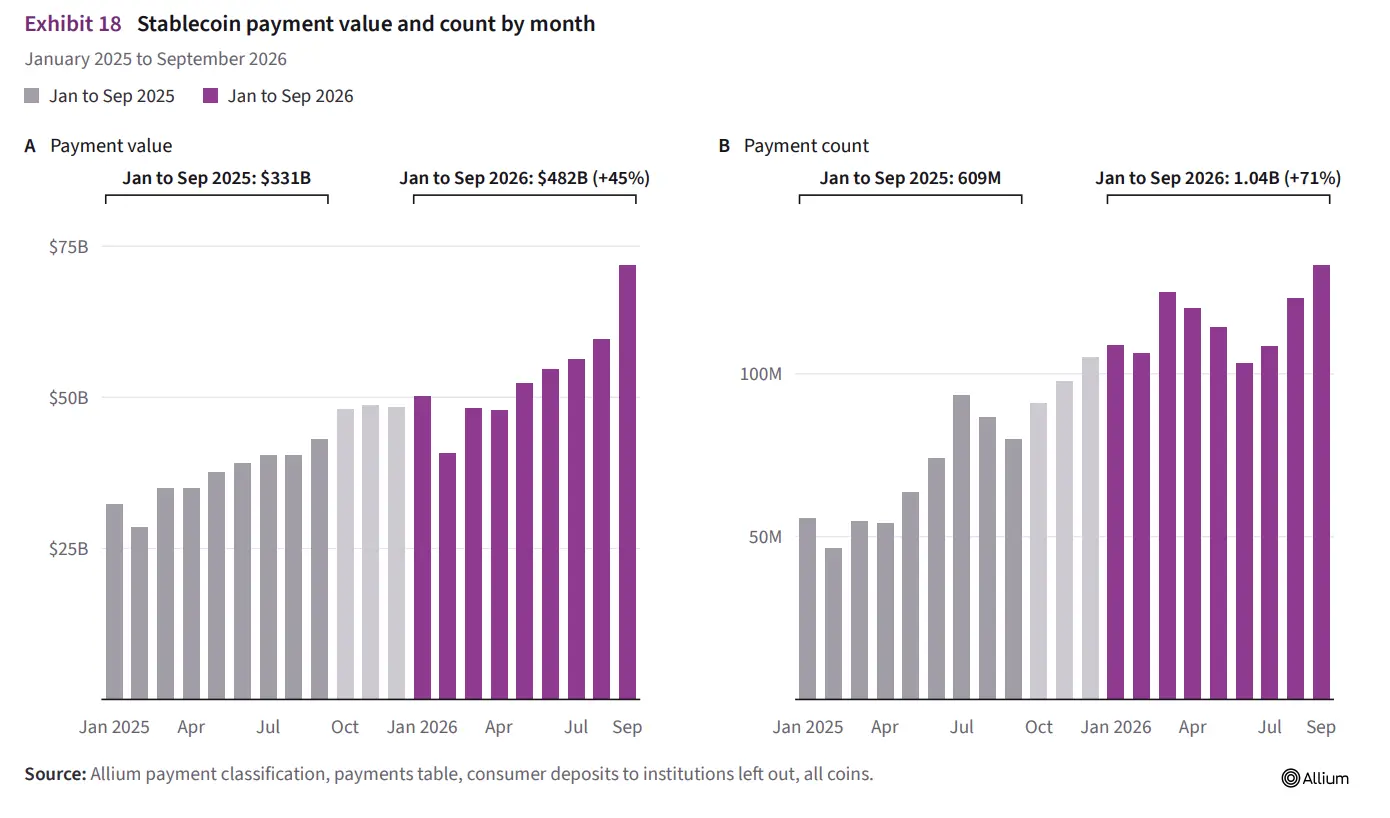
According to a CoinDesk report on October 18, as of the end of September 2026, the total global stablecoin circulation was approximately US$305 billion, an increase of only 0.4% from the beginning of the year. In stark contrast, both the stablecoin payment amount and the number of transactions have achieved rapid growth. At the same time, important companies in the traditional payment industry such as Visa, Mastercard and Stripe are accelerating the integration of stable coins with bank cards, cross-border remittances and corporate fund management systems, trying to integrate digital dollars into existing financial infrastructure more naturally.
Stablecoins are a class of cryptoassets that attempt to keep their value relatively stable relative to fiat currencies such as the U.S. dollar. Taking U.S. dollar stablecoins as an example, their issuers usually support the value of the token through mechanisms such as reserve assets, so that its price does not fluctuate as frequently as cryptocurrencies such as Bitcoin. Stablecoins can not only be transferred on the blockchain, but can also be used for settlement on trading platforms, cross-border fund transfers, and some real-world payment services.
In the past, the growth of the stablecoin market size was often seen as an important indicator of industry development, because more tokens in circulation usually meant more funds available in the market for trading and settlement. However, Allium’s data this time shows that the actual payment activity of stablecoins can continue to grow while the issuance scale has basically stagnated. In other words, the market does not necessarily require the issuance of more stablecoins, but may also expand the payment business by increasing the frequency of use of existing tokens.
This trend is especially important for traditional payment companies. There have long been clear infrastructure differences between cryptocurrency payments and traditional financial systems. Even if users hold stablecoins, they may need to convert them into legal currency in their bank accounts before they can complete daily consumption or send money to others through traditional payment channels. Enterprises may need to manage bank accounts, crypto asset wallets, blockchain transactions and legal currency settlement processes separately.
Today, payment companies are trying to integrate these links so that users and merchants do not have to build a completely independent financial system in order to use stablecoins.
Data show that in the first nine months of 2026, the amount of bank card consumption associated with stable coins reached US$3.9 billion, 10 times that of the same period last year. Among these bank card transactions, small purchases of less than $50 accounted for 84% of the increase in the number of transactions. This shows that the growth of stablecoin-related payments is no longer limited to fund transfers between cryptocurrency exchanges or large institutions, and has begun to appear more in daily consumption scenarios.
However, the growth in the scale of stablecoin payments still needs to be interpreted with caution. Allium statistics show that as of the end of September, the total original transfer amount of stablecoins on the blockchain reached 97.9 trillion US dollars, but this includes various types of internal fund transfers within exchanges, decentralized financial activities, and automated transactions. After screening, Allium classified approximately $2.4 trillion of this as end-user activity, accounting for 2.5% of the original transfer amount. The company’s $482 billion in payment statistics is based on filtered relevant data, not the total amount of blockchain transfers.
This distinction is important. Large transfers on the blockchain do not necessarily represent real transactions of goods and services, and some funds may flow repeatedly between trading platforms, financial protocols or automated systems. Therefore, analyzing the actual economic use of stablecoins requires distinguishing between the scale of movement of funds on the chain and the amount that end users actually use to pay.
A series of recent actions by traditional payment companies show that stablecoins are trying to enter more mature financial infrastructure.
Mastercard launched the Global Money Platform on October 15. This service was developed in partnership with stablecoin infrastructure company BVNK and aims to integrate traditional fiat currency accounts, stablecoin balances, currency exchange, bank card consumption, and bank account payments through a unified interface. Mastercard previously acquired BVNK in August 2026.
Through this platform, banks and financial technology companies can provide customers with accounts that support both fiat currencies and stablecoins, so that users do not have to use completely independent systems to manage two types of funds. Payment companies Nuvei and Marqeta have become the first customers to integrate related services.
The focus of this plan is not to require ordinary consumers to directly use blockchain wallets to complete all payments, but to use stablecoins as a source of funds or settlement tools in the existing financial system. For users, the payment experience can still maintain the familiar form of accounts and bank cards; for service providers, the bottom layer can choose the appropriate fund transfer method between the traditional banking system and the blockchain network based on actual needs.
Stripe is also promoting a similar layout. The company is working with blockchain financial services company Plasma to develop bank cards that support stablecoins. It plans to allow users to use currency balances such as U.S. dollars, euros, Brazilian reals, Mexican pesos and Colombian pesos, while supporting eligible stablecoin balances.
According to the plan announced by both parties, users can pay priority from the balance that matches the currency of consumption to reduce unnecessary currency exchanges. For example, when users make purchases in Euros, they can directly use their Euro balances without having to first convert funds into other currencies and then go through additional exchange processes.
Stripe's expanded bank card infrastructure currently covers more than 30 countries and regions, and the company plans to further expand coverage to more than 100 countries and regions in 2027. If this plan proceeds smoothly, stablecoins are expected to reach more consumers through existing payment networks, and will no longer be limited to user groups familiar with cryptocurrency.
Visa introduces stable currency into the fund preparation link of international payments.
Visa stated that payment coordination service company Inyo Global has taken the lead in putting Visa Direct’s stablecoin reserve fund service into commercial operation. Through this service, payment companies can use USDC, the U.S. dollar stable currency issued by Circle, to prepare funds in advance for cross-border payments, thereby reducing reliance on traditional bank business hours and settlement windows.
In the traditional cross-border payment process, funds may need to pass through multiple banks or payment institutions, and the arrival time will be affected by business hours, clearing arrangements, and the connection between financial systems in different countries. After using stablecoins to prepare funds, payment service providers can prepare or transfer relevant funds in advance on the blockchain, and then pay the final payee through traditional payment channels.
This does not mean that the recipient must hold cryptocurrency. According to the model introduced by Visa, stablecoins are mainly used for the preparation and transfer of funds between payment institutions, and the final payee can still collect funds through regular payment channels. This design helps combine the 24/7 operation characteristics of blockchain with the account and payment networks of traditional financial systems.
For enterprises, this type of service may be particularly suitable for businesses that require frequent cross-border payments, such as international e-commerce, overseas contractor settlement, corporate supply chain payments, and remittance services for financial technology companies. Companies do not have to completely abandon their existing bank accounts and payment systems, but they also have the opportunity to use stablecoins to improve some of the capital flow links.
Patrick Moral, co-founder and CEO of Fipto, a Paris-based corporate payment services company, believes that companies hope to integrate stablecoins directly into existing financial operations systems, rather than building an independent crypto-asset infrastructure outside of the traditional financial system. He pointed out that for enterprises, the difference between traditional currency and digital currency is gradually giving way to the question of which payment channel should be used for specific transactions.
This view also reflects the changes taking place in the stablecoin industry. Early cryptocurrency applications usually require users to understand concepts such as wallets, blockchain addresses, transaction fees, and private key management, while stablecoin services for enterprises place more emphasis on backend integration. Users can continue to complete operations through bank accounts, corporate financial systems or bank cards, and the underlying funds may be transferred through the blockchain.
However, stablecoin payments are still only a small part of the global payments market.
Allium estimates that in the second quarter of 2026, the consumption amount of stablecoin-linked bank cards is equivalent to only 0.03% of Visa’s total payment volume of approximately US$4 trillion in the same period. This means that even though stablecoin-related bank card consumption has achieved substantial year-on-year growth, its current market share is still very limited.
In addition, stablecoins are not without risks. Its value stability depends on the issuer's reserve arrangements, redemption mechanism and market confidence; cross-border business may also be affected by regulatory requirements, anti-money laundering regulations and customer identity verification rules in different countries and regions. For enterprises, adopting stablecoins also requires consideration of issues such as custody security, counterparty risk, network fees, and fiat currency exchange channels.
Therefore, the 45% increase in stablecoin payment volume does not mean that stablecoins have replaced traditional bank cards or bank transfers. More precisely, this data shows that stablecoins are being used more frequently for payments and fund transfers amid slow growth in circulation, while companies such as Visa, Mastercard and Stripe are trying to lower the threshold for integrating into the traditional financial system.
Whether this trend can continue in the future depends on whether stablecoins can form sufficiently clear advantages in terms of cost, transfer speed, compliance and ease of use. If payment companies can allow users to use stablecoins without changing their existing consumption habits, and at the same time allow merchants and financial institutions to complete fund settlements at a lower cost, then the application scope of stablecoins may continue to expand.
Judging from the current data, the development focus of the stablecoin market is shifting from simply expanding the scale of token issuance to improving the actual use efficiency of funds. Although its proportion in the global payment system is still small, cooperation between traditional financial institutions and blockchain companies is opening new channels for digital assets to enter daily payments and corporate financial management.
Comments