
Abstract:
Affected by higher-than-expected AI capital expenditures in the third quarter report and pressure on short-term profits, Tencent Holdings (00700.HK) stock price fell today and hit a new low since August 2024. As of press time, it fell 6.12% to HK$350. This also affected other tech giants and even indices. Alibaba-W (09988.HK) and Kuaishou-W (01024.HK) fell 5%, Meituan-W (03690.HK) fell 3%, and the Hang Seng Technology Index fell about 2.5%.
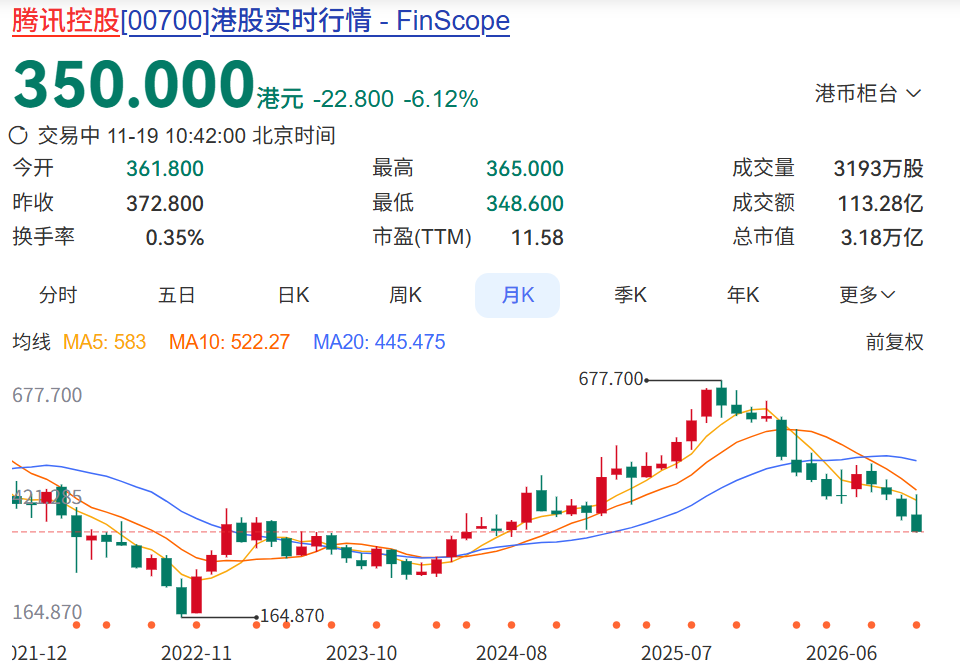
Core business remained stable in the third quarter, AI investment grew rapidly
According to Tencent’s 2026 third quarter report announced on the 18th, revenue was 207.336 billion yuan, a year-on-year increase of 8%; gross profit was 115.911 billion yuan, a year-on-year increase of 7%; net profit attributable to the parent company was 63.612 billion yuan, a year-on-year increase of 0.8%.
AI is becoming Tencent’s new business growth driver. In the third quarter, Tencent Cloud's revenue increased by 35% year-on-year, and revenue from WorkBuddy, MaaS and other businesses increased significantly. At the same time, its capital expenditure increased by 527% year-on-year, and it continued to increase its research and development of AI infrastructure and models.
Since this year, Tencent is increasing investment in AI infrastructure and model research and development. This change is also reflected in the company's capital expenditure and cash flow data.
Data show that in the third quarter, Tencent’s capital expenditure reached 81.433 billion yuan, a year-on-year increase of 527%; the cumulative capital expenditure in the first three quarters reached 166.153 billion yuan, a year-on-year increase of 179%.
It is reported that Tencent’s substantial increase in capital expenditures this year has mainly been invested in AI infrastructure construction.
It is worth noting that the supply of computing power is still a practical constraint faced by the current AI business. Talking about the impact of the latest tightening of restrictions, Tencent executives said that the actual available computing power will be reduced in the short term, both leasing and self-built computing power will be affected, and model training will also be under pressure. Tencent’s current Hunyuan Hy4 adopts higher precision training efficiency, but the launch of the next generation model may take longer.
The executive also said that in the long term, relevant restrictions may push more Chinese companies to switch to domestic supply chains and domestic chips, speeding up the construction of domestic supply chains, and related R&D forces will further concentrate in this area.
Some institutions lowered their target prices
Morgan Stanley issued a report stating that higher investment in artificial intelligence will put pressure on Tencent's short-term profits, and lowered the target price of Tencent's Hong Kong stock by nearly 13% to HK$480, maintaining an overweight rating.
Citigroup maintains a buy rating on Tencent Holdings with a target price of HK$755. The agency believes that the company has increased its investment in AI computing power and chips, and its capital expenditures have increased significantly, which will suppress short-term operating profit margins and profits, but will consolidate long-term AI competitiveness.
Repurchase of HK$7 billion in the third quarter, a sharp year-on-year decrease
The company spent approximately HK$7 billion in a single quarter to repurchase and cancel 15.8676 million shares in Q3, a 65% decrease from the quarterly average of HK$20 billion in 2025; a total of 50.4657 million shares have been repurchased since the repurchase authorization in May (as of the last transaction on October 15, the purchase ban period was suspended due to performance and can be restarted from November 19). Management uses write-off repurchases to hedge valuation fluctuations during the AI investment period.
Why does Tencent’s decline in technology and internet stocks have such a huge impact?
Tencent is the "anchor" of Hang Seng Technology's weight and southbound funds, and its pace of AI investment is regarded as a benchmark for China's Internet platforms to switch from "cost reduction and efficiency improvement" to "actively building computing power." The advertising, cloud, and WeChat ecology are still stable, but the market is re-pricing "free cash flow under pressure in 2026-27" in the short term, and the sentiment of Alibaba and other sectors in the same sector is simultaneously limited.
The domestic side also has support. WeChat and WorkBuddy have good daily activity data, and AI has moved from the story to the revenue side. Institutional consensus is that starting from 2028, computing power advances will peak and inference costs will decrease, and profit elasticity will be truly released.
Comments