
Abstract:
Tesla’s latest Full Self-Driving (FSD) update brings technology that goes far beyond traditional driving visualization interfaces. According to CEO Elon Musk, the company is running a diffusion model with a parameter scale of about 1 billion directly inside the vehicle to generate a realistic picture of the vehicle's surrounding environment in real time with fairly limited computing resources.
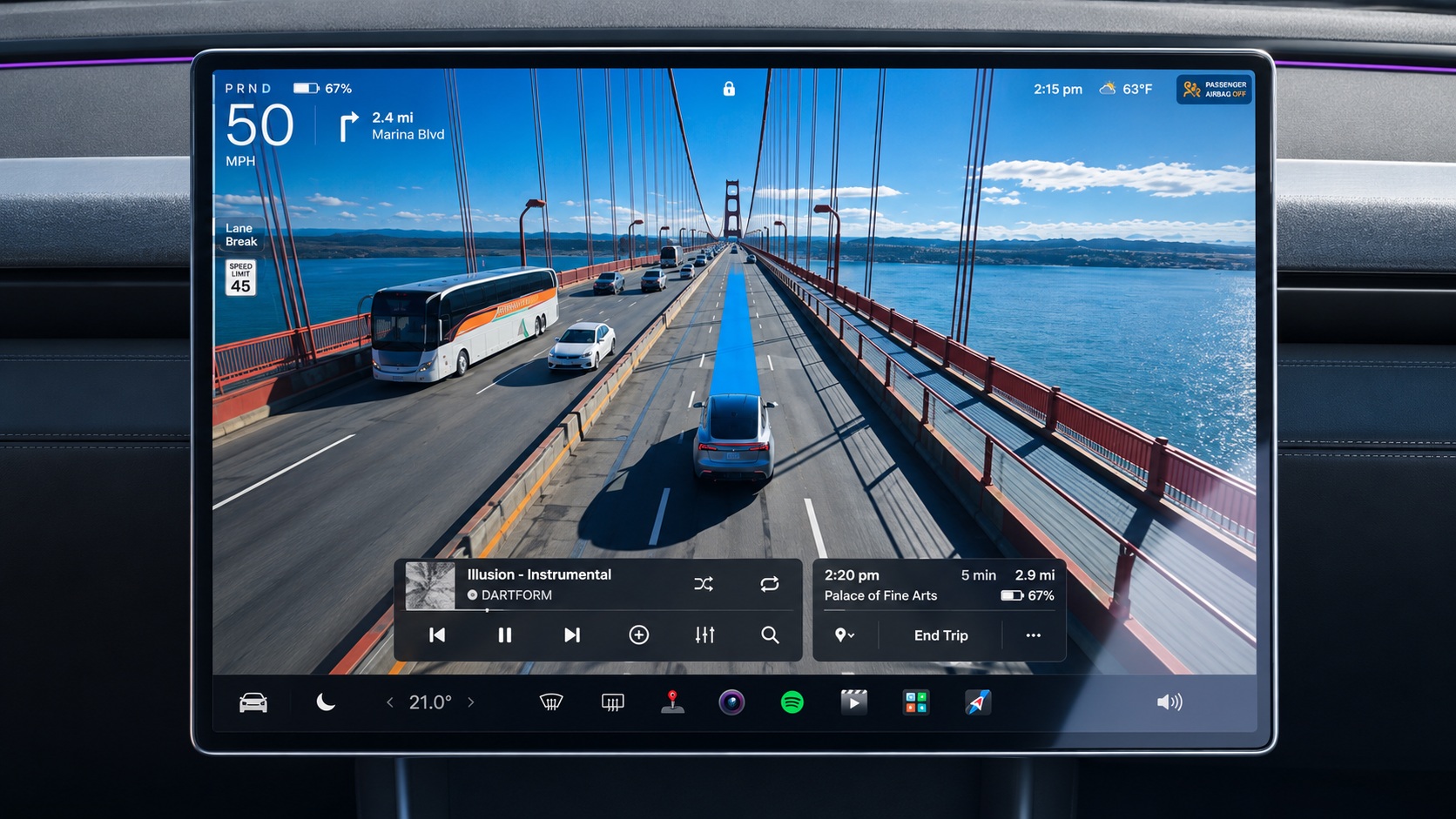
This technology is used in Tesla’s “Reality View” function. It was launched with FSD (Supervised) v15.0.1 and has been pushed to some vehicles since November 21. Rather than relying on conventional 3D graphics to represent nearby vehicles, roads, and buildings, the system generates visual output through artificial intelligence rather than building graphical objects in the traditional sense one by one.
Musk revealed that Tesla already has a world model that he described as "near pixel-level accuracy" as early as 2025, which is mainly used for synthetic data generation. However, the system deployed in production vehicles is significantly smaller and uses a conditional mean-flow approach.
The core of the system is Tesla's Universal Vision Encoder (UVE), which is responsible for processing visual information collected by the vehicle's camera. The resulting features are not only fed into a separate model with about 3 billion parameters responsible for generating driving actions, but also input into a model with about 1 billion parameters specifically responsible for generating images.
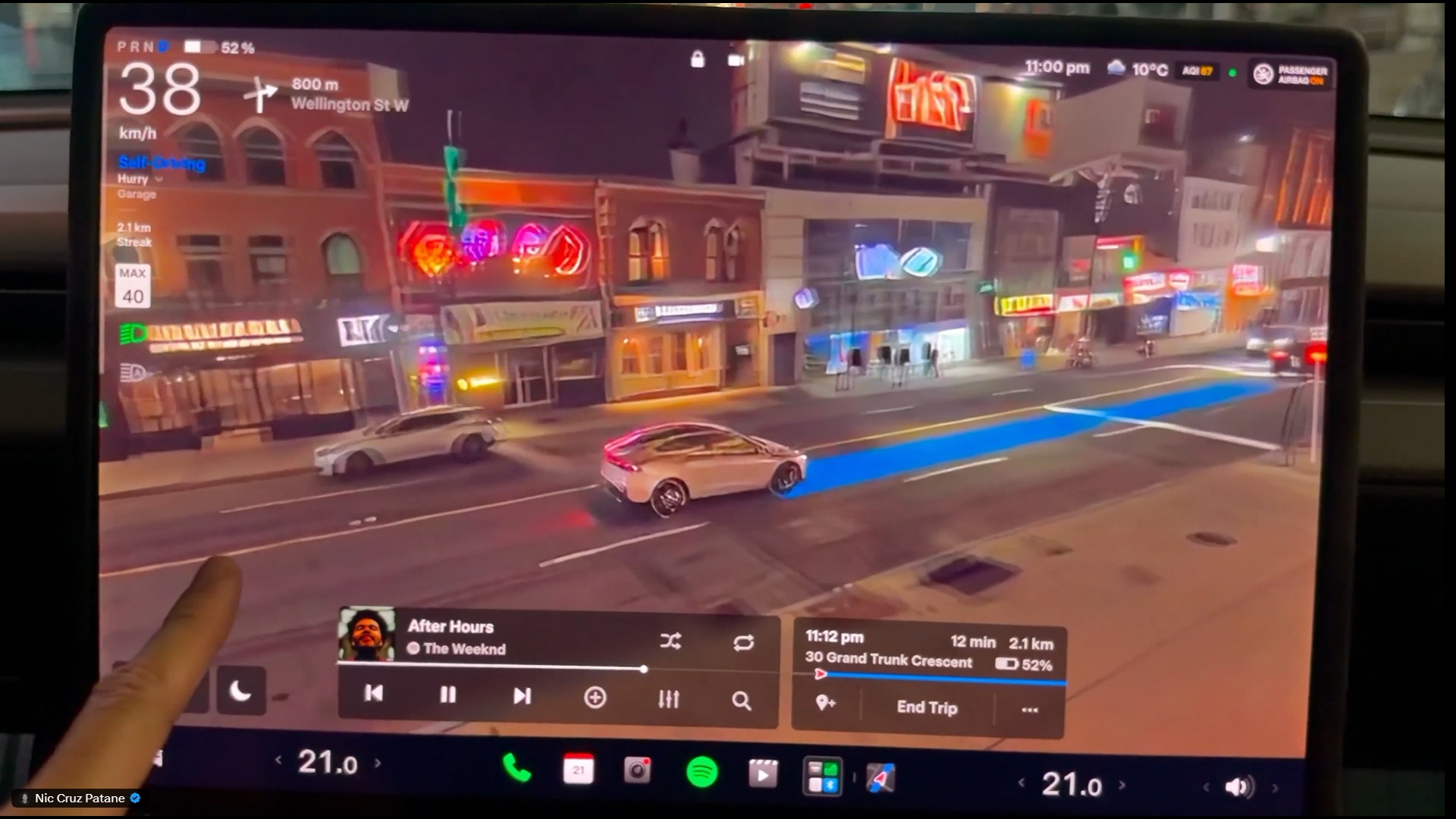
This generative model will take the previously generated Reality View image, add noise to it, and then gradually remove the noise to update the representation of the surrounding environment. This approach allows Tesla to maintain visual coherence in the environment without having to rely on traditional graphics rendering pipelines to build objects piece by piece.
What’s more noteworthy is that Musk said that the model can generate image patches containing 8 images at 36 frames per second and match the resolution of the vehicle user interface. The relevant calculations are divided into 4 processing cycles, and the UVE runs at 18 Hz.
In other words, Tesla is actually running a real-time AI video generator alongside the driving system, and the two share the same underlying visual information. But importantly, this generative visualization system is independent of the network responsible for driving decisions.
Musk also explained the hardware resources used by Reality View. He said that after Tesla moved a small decoder into SRAM, it freed up enough resources that the visualization function could run using only half of the three TRIP accelerators on the relevant system-on-chip.
However, hardware limitations are still apparent. Musk pointed out that the TRIP accelerator mainly handles 8-bit integer operations, and softmax calculations must be simulated in 28 steps. This makes running Transformer-based generative models particularly challenging on this hardware.
These limitations are also reflected in the system's response speed. Musk admitted that Reality View still has relatively high latency, but Tesla believes that if the newer UVE features are interleaved and embedded into the layers of the diffusion Transformer, the latency is expected to be reduced by about 35%.
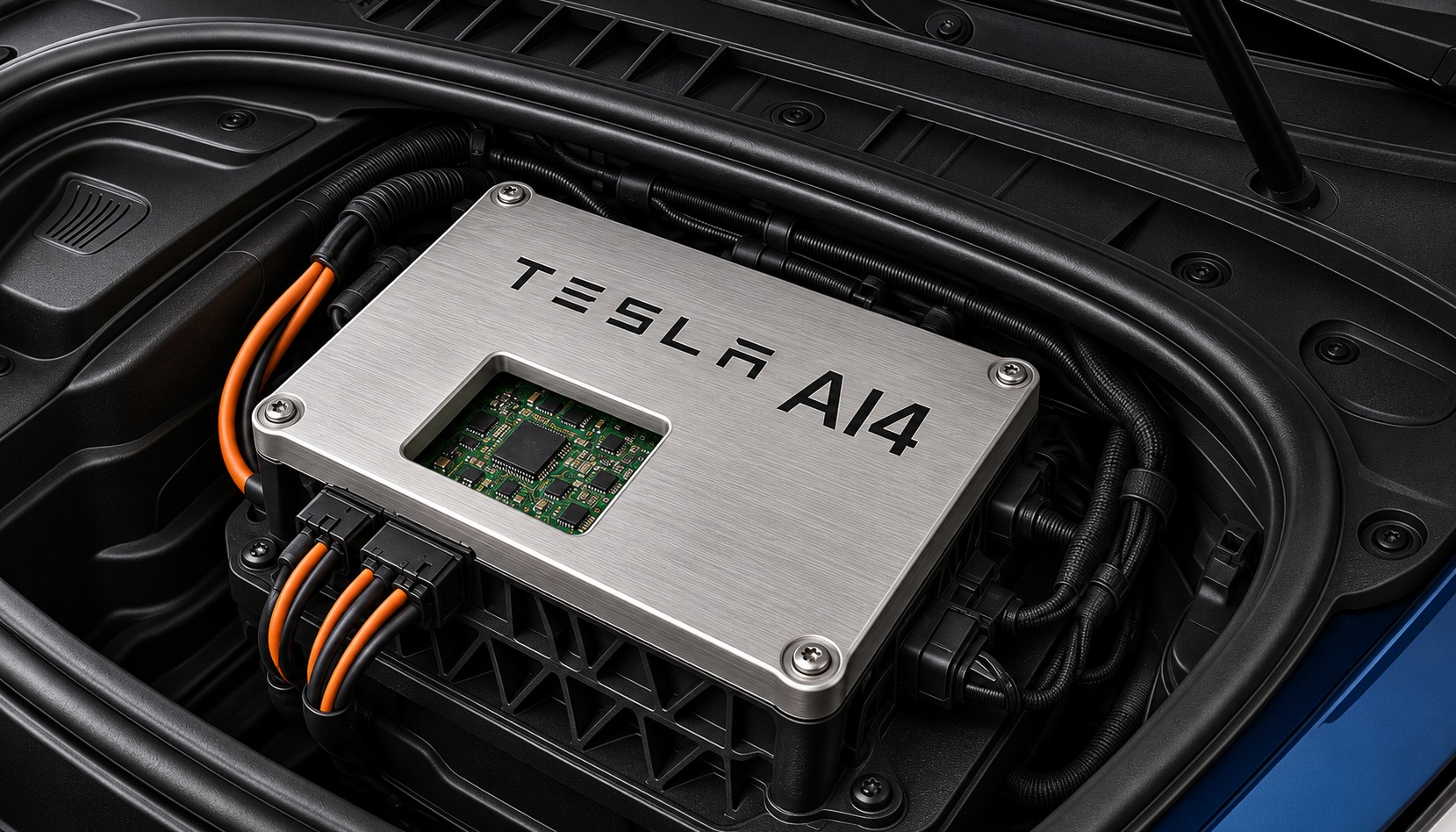
Musk also claimed that Tesla’s upcoming AI5 hardware will provide approximately 12 times the computing power of existing solutions. However, he also said that Tesla vehicles will still use AI4 hardware, and AI5 will be used in products such as Optimus.
Nevertheless, deploying a billion-parameter generative model on existing in-vehicle AI hardware demonstrates how far highly optimized, purpose-built inference technology has come. Tesla's FSD v15 release notes also claim that critical intervention rates have increased by 25 times thanks to an upgraded visual encoder shared by FSD, Robotaxi and Optimus, but this number is still a self-reported result by the company.
It should be pointed out that Reality View itself cannot be regarded as proof of improved autonomous driving capabilities. It is an AI-generated visual representation of the vehicle's surrounding environment and its planned behavior, and does not guarantee that every detail in the picture accurately reflects reality. In addition, FSD is still a driving assistance system that requires driver supervision.
As FSD v15.0.1 has begun to be delivered to the first batch of users and is expected to be more widely rolled out in December, Tesla's latest practice provides an enlightening sample of the trend of increasing integration of real-time generative AI, computer vision and edge computing.
Comments