
Abstract:
Tesla once again directed the outside world's attention to the highly anticipated next-generation Roadster sports car. Tesla showed off the new Roadster related to SpaceX technology and once again emphasized that this pure electric sports car may have performance that surpasses traditional cars. The relevant design even involves the idea of briefly taking the vehicle into the air, making this car not only a showcase for Tesla's performance technology, but also a continuation of Elon Musk's idea of combining automobiles with aerospace technology over the years.
However, a distinction must be made between concept displays, technology demonstrations and mass-produced cars that can actually be delivered to consumers. The Roadster's extreme performance and flight capabilities have long been accompanied by bold hype and repeatedly delayed schedules. Before formal mass production, completion of necessary safety verification and delivery to consumers, relevant capabilities cannot simply be regarded as product specifications that have been actually verified.
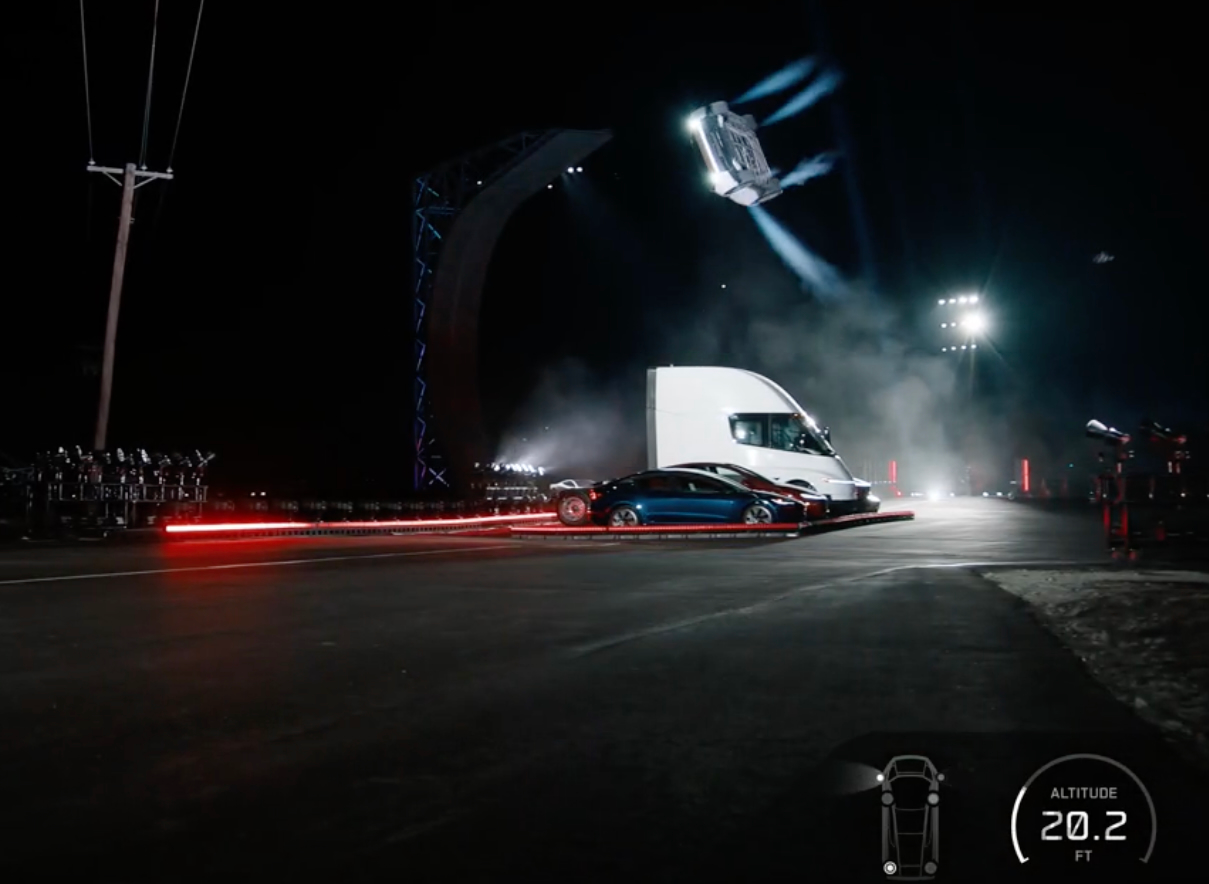
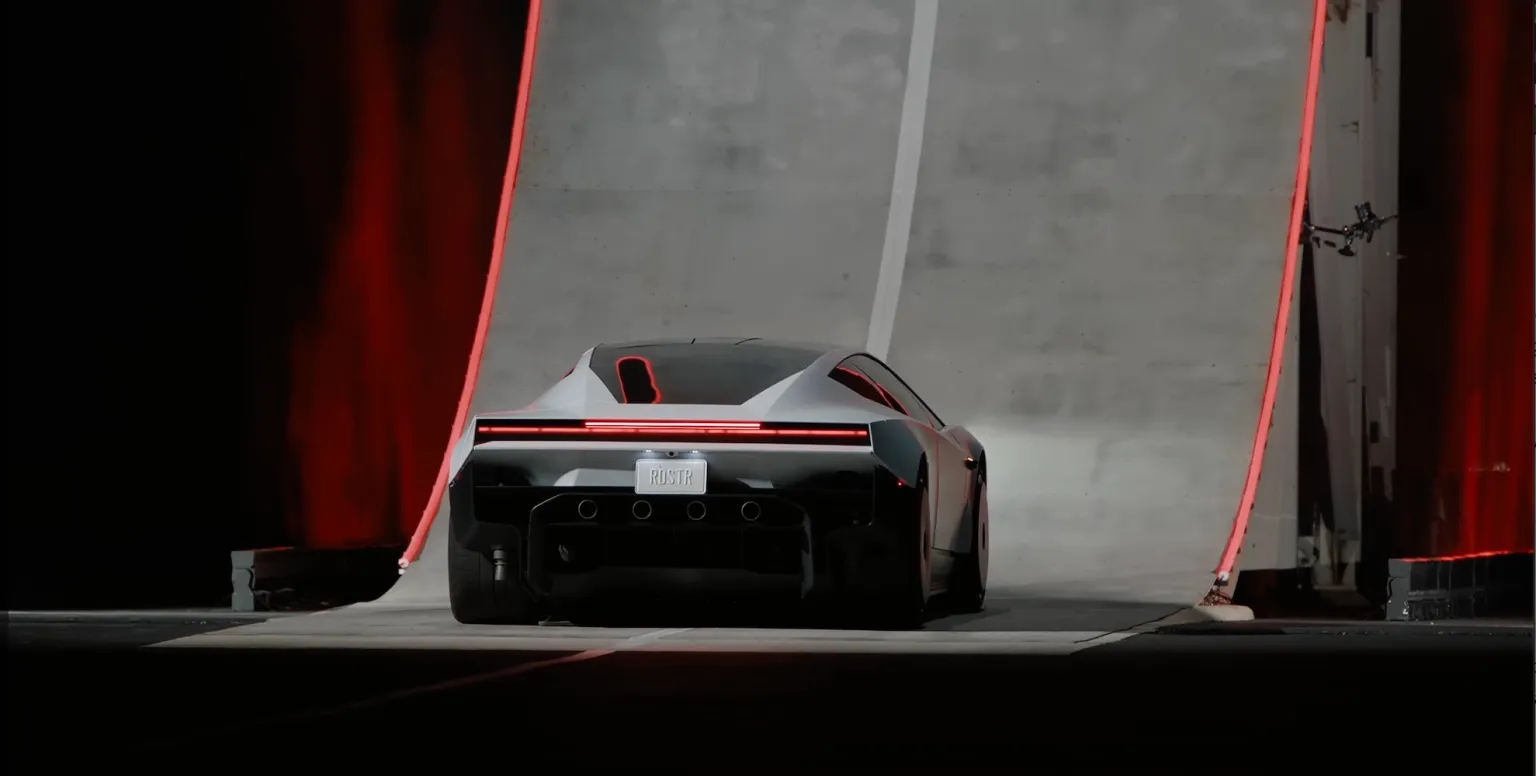
At the display site, Tesla first demonstrated the special chassis control system of the new Roadster. The vehicle travels along an arc-shaped ramp, then flips upside down, completes an airborne spin with the help of a propulsion system, and finally falls back to the ground smoothly. Tesla also showed images of vehicles jumping over Cybercab, Cybertruck, Tesla Semi, Model Y and Model 3, trying to prove that this system can not only allow the vehicle to briefly leave the ground, but also complete a certain degree of attitude control in the air.
This system was jointly developed by Tesla and SpaceX engineers and uses a high-pressure compressed gas propulsion solution. According to Musk's introduction at the launch event, the vehicle is equipped with a high-pressure gas storage system, a rear main thruster and an auxiliary thruster for controlling flight attitude. Unlike traditional cars that rely on contact between tires and the ground to obtain driving force, this device can generate reaction force when gas is ejected at high speed, providing the vehicle with short-term lift and attitude adjustment capabilities.
In addition, the bottom of the vehicle is equipped with a powerful fan system that can press the body against the ground by generating adsorption force. Tesla hopes to use this method to enhance the contact between the tires and the road, thereby improving stability when driving at high speeds, accelerating and cornering. The press conference showed the vehicle using the adsorption system to drive along a special ramp, but this does not mean that vehicles on ordinary roads can replicate the same performance under any road conditions.
Musk described the system as a combination of automotive engineering and aerospace technology. He said that when he first proposed the idea, he also doubted whether the idea was too crazy. In the end, Tesla and SpaceX engineers completed relevant development work together, trying to bring technology that mainly appeared in science fiction movies in the past into the real world.
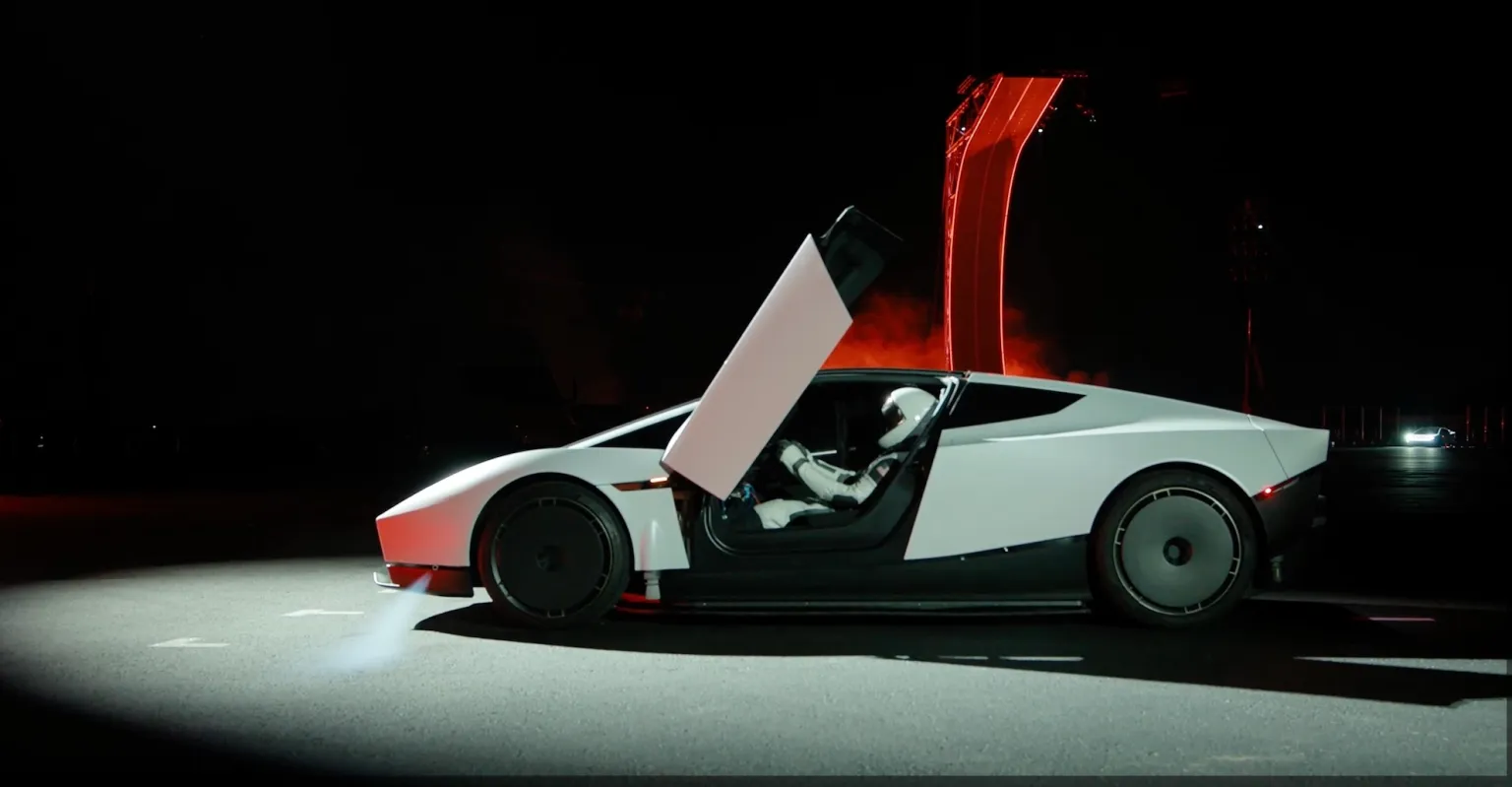
However, there are still clear differences between live demonstrations and daily use. The demonstration took place in a specially arranged venue and the movements required precise control. Just because a vehicle briefly leaves the ground and completes an in-flight flip does not mean that it has the ability to continue flying, change direction freely, and land safely like a helicopter or airplane.
Musk also did not position the new Roadster as an ideal tool for ordinary consumers' daily commuting. He has previously said that this car is not a product with safety as the primary goal, and recommended that consumers who put safety first should not buy the Roadster. Such a statement further highlights the special positioning of this car: it is more like a product that demonstrates extreme engineering capabilities, rather than a household electric car with practicality and comfort as its primary goals.
In terms of performance, the data displayed by Tesla stated that the new Roadster only takes about 0.81 seconds to accelerate from 0 to 60 miles per hour (about 96.6 kilometers per hour), has a top speed of more than 230 miles per hour (about 370 kilometers), and a cruising range of more than 300 miles (about 483 kilometers). These numbers are quite astonishing, but should still be regarded as targets or demonstration data announced by the manufacturer, rather than production vehicle results that have been fully verified through independent testing.
It is worth noting that these parameters are significantly different from the promotional data when Tesla first announced the second-generation Roadster in 2017. At that time, Tesla claimed that the new car would accelerate from zero to 60 miles per hour in just 1.9 seconds, with a top speed of over 250 miles per hour, and a cruising range of 620 miles (approximately 998 kilometers). The endurance target announced today is significantly lower than the promise of the year, and the top speed data has also changed.
This does not necessarily mean that the new car will end up performing worse than earlier designs, as the vehicle structure, powertrain and propulsion may all have changed. But it once again illustrates that early publicity numbers cannot be directly regarded as final production specifications until the product is officially shipped. Especially for a car that has experienced many years of delays, the actual range, acceleration performance and reliability of the propulsion system all need to be confirmed through follow-up testing.
In terms of product positioning, Tesla showed different configurations this time, including Performance, Thrust and Rocket versions. Among them, the Performance is aimed at the traditional high-performance electric sports car market, the Thrust version emphasizes the special capabilities brought by the propulsion system, and the Rocket version adopts a more radical design and is targeted at a small number of invited customers.
According to relevant reports, the Performance version requires an initial deposit of US$5,000 and an additional US$45,000 within 10 days; the deposit for the Thrust version reaches US$250,000. The Rocket version is invitation-only, and the specific purchase conditions and final selling price have not yet been fully clarified. The reservation arrangements announced on Tesla's official website show that there are obvious differences in configurations, usage scenarios and purchase thresholds between different versions.
The Rocket version is particularly worthy of attention because it is given the ability to truly lift off the ground briefly, but it is not currently approved for legal driving on public roads. The Thrust version is positioned as a model that can be used on the road. This means that consumers cannot simply think that as long as they buy a Roadster equipped with propellers, they can fly or flip in the air at will on ordinary roads.
In fact, how to strike a balance between road regulations, vehicle safety and special propulsion systems will become one of the most difficult issues in the commercialization process of the new Roadster. Designs such as mechanical structure, external raised parts, vehicle lighting and rearview mirrors may all affect whether it can meet the road regulations of different countries and regions. Even if a vehicle is able to complete the demonstration in a closed venue, it does not mean that it has permission to use its full capabilities on public roads.
This press conference also once again triggered discussions about the relationship between Tesla and SpaceX. Both companies are led by Musk. Although they focus on automotive and aerospace businesses respectively, there is some room for collaboration in the fields of propulsion technology, engineering talent and high-end manufacturing. Some observers believe that introducing SpaceX's technology into Roadster will not only enhance the uniqueness of the product, but may also further intensify the market's attention to the technological synergy between the two companies.
However, there is currently no sufficient evidence that this cooperation means that the two companies are about to merge. The propulsion system cooperation for the Roadster project itself does not prove that Tesla and SpaceX have made a decision to merge. Related speculation still needs to be distinguished from officially announced corporate strategy and transaction information.
For Tesla, the financial significance of the Roadster may not be as great as its publicity. Musk has acknowledged that the car's impact on the company's overall revenue may be relatively limited. Compared with models targeting mass markets such as Model 3 and Model Y, the Roadster's price, output, and target customer base are all narrower.
But high-end sports cars often have special brand value in the automotive industry. Manufacturers can use it to showcase power systems, materials engineering, aerodynamics and control technologies, and thereby shape the brand's technical image. For Tesla, the Roadster would also be a way to showcase the company's engineering capabilities beyond electric vehicles, particularly the propulsion system developed in partnership with SpaceX.
The launch of this product also occurs against the backdrop of Tesla’s changing business focus. In recent years, the company has continued to emphasize areas such as autonomous driving, robotaxi and humanoid robots, and has invested a large amount of resources in artificial intelligence and automation technology. In contrast, the Roadster's mass production schedule has been delayed many times, which has become a case often mentioned when outsiders discuss Tesla's product development pace.
The second-generation Roadster was originally unveiled in November 2017. At that time, Tesla had planned to start deliveries within the next few years and accept deposits from consumers for reservations. Some customers even paid US$250,000 to reserve the Founders Series founder's edition model, which is limited to 1,000 units. However, the mass production plan has been postponed many times since then, and Musk has adjusted relevant timetables in 2020, 2021, 2023 and 2024.
The new car has finally been officially displayed, but Tesla still schedules mass production in 2028. This means that the entire project will span approximately 11 years from the initial announcement of the second-generation model to the planned start of production. For reservation customers who have been waiting for many years, this demonstration undoubtedly provides more specific product information, but they still need to wait for the vehicle to actually enter the production stage.
TechCrunch pointed out that Musk had previously described the demonstration as potentially being one of the most exciting product demonstrations in history, and even said that even if the demonstration failed, it would still be impressive. In the end, the vehicle completed its intended actions, but the demonstration itself is still only a stage in the development process and cannot replace engineering verification before mass production.
Next, Tesla needs to prove that the propulsion system can remain reliable during repeated use, that the vehicle can drive safely under ordinary road conditions, and that related functions can meet regulatory requirements. The high-pressure gas storage system, noise and vibration of the propeller, the stability of the body when moving in the air, and the safety of the occupants during special maneuvers all need to be fully evaluated.
For ordinary consumers, the most noteworthy thing about the Roadster is not just whether it can take off briefly, but whether this complex system can become a product that can actually be purchased and used without sacrificing basic safety and reliability. Even if the future production version is unable to perform flight demonstrations on public roads, it may still enter the market as an extreme performance electric sports car.
Judging from the current situation, Tesla has advanced the second-generation Roadster from the concept and preview stage that has lasted for many years to the public display stage, and plans to start production in 2028. But until delivery times, final selling prices, full specs and road legality are further confirmed, the car remains closer to a bold engineering project than a fully-fledged production product.
The appearance of Roadster demonstrates Tesla and SpaceX's attempts to combine automotive engineering and aerospace propulsion technology, and once again highlights Musk's preference for high-risk, high-profile technology projects. However, what really determines the final success or failure of this car will not be how amazing the mid-air flip at the launch is, but whether it can be mass-produced as planned, meet regulatory requirements, and deliver a reliable car to long-awaited consumers.
Comments