
Abstract:
What has long been considered one of the earliest records of solar activity interfering with human technology may have the wrong year, a new study finds. An anonymous report in Nature magazine in 1871 recorded that on October 18, 1841, a "very strong magnetic disturbance" interfered with the telegraph equipment of the South Devon Railway in England, causing a 16-minute delay for an evening train in Exeter. Researchers believe that this incident is more likely to have occurred on October 18, 1848, and "1848" in the original text was mistakenly printed as "1841".
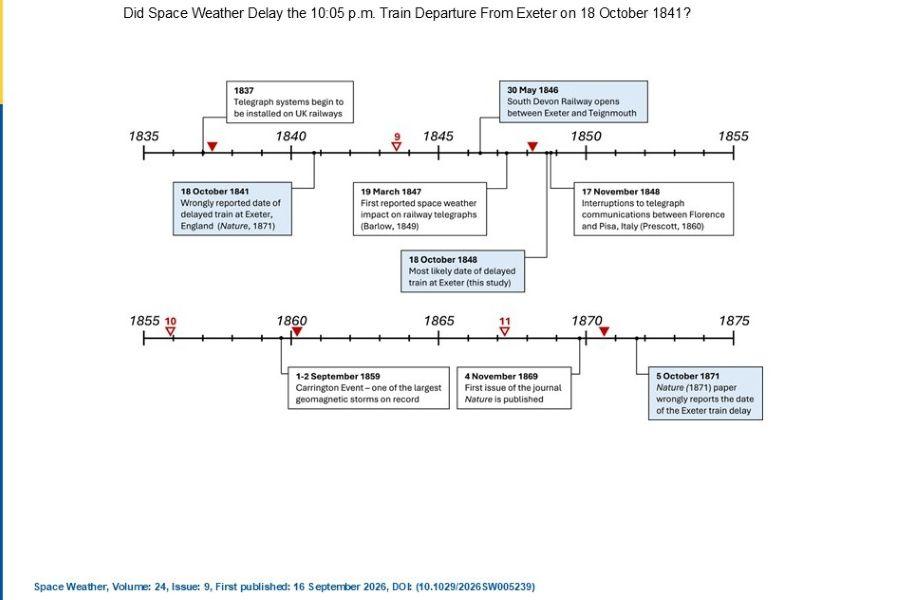
After re-comparing railway construction archives, historical timetables, astronomical observations, Greenwich Observatory magnetic field records and newspapers at the time, the research team found that the relevant railway section from Exeter to Starcross was not opened until May 1846, and it was impossible for a train to run on this line in 1841. On the other hand, Exeter did have a train that left at 10:05 pm, and the timetable shows that it ran in 1848 and 1849; on October 18, 1848, bright aurora also appeared over the United Kingdom. Magnetic field records showed that strong disturbances began to occur that night, and astronomical records showed that a large sunspot group was facing the earth. Multiple clues point to the same date, but researchers describe their conclusion as strong circumstantial evidence rather than finding an original report directly documenting the 1848 accident.
At that time, railway signalmen relied on the Cook-Wheatstone needle telegraph to communicate whether the lines were open. Changes in current will deflect the magnetic needle in the instrument; strong geomagnetic disturbances may induce currents in the telegraph wires, causing the signalman to be unable to confirm whether the line near Starcross is safe, and the train was delayed for 16 minutes. The incident demonstrated that early electrical communications facilities were affected by space weather, but existing historical data do not imply that widespread equipment damage occurred at that time.
Date correction also changes the "oldest record" sorting. Research believes that the event recorded by William Barlow on March 19, 1847 is still the earliest credible case of a solar storm affecting the telegraph system: the railway telegraph magnetic needle experienced abnormal deflection that night, and bright auroras were visible in the UK. The Revised Exeter Affair remains one of the early cases, but is no longer the first; it preceded the famous Carrington Affair of 1859 by eleven years. The study, published in "Space Weather," also reminds researchers that a typographical error in historical documents may affect the judgment of the relationship between early space weather and technology.
Comments