
Abstract:
Lao Yu, the host of Hangzhou Traffic Radio, recently did something that many online ride-hailing drivers have thought about but never did: register their own account and run on Didi for two days with real swords and guns. After running 21 orders, he took out his calculator and calculated, and found that the average commission was fixed at 13.22%. This number is in sharp contrast to the "heartache" he felt when his order was drawn 23.9% during the peak of the night before.
Lao Yu’s experience is not an isolated one. From the independent research by the Tsinghua University team to the transparent billing data disclosed by Didi, multiple sources are pointing to the same conclusion: online ride-hailing commissions have never been a simple "fixed ratio" arithmetic problem, but a dynamic mechanism that fluctuates with supply and demand. There is often an emotional filter woven by "loss aversion" between the driver group's general perception of commission and the actual bill.
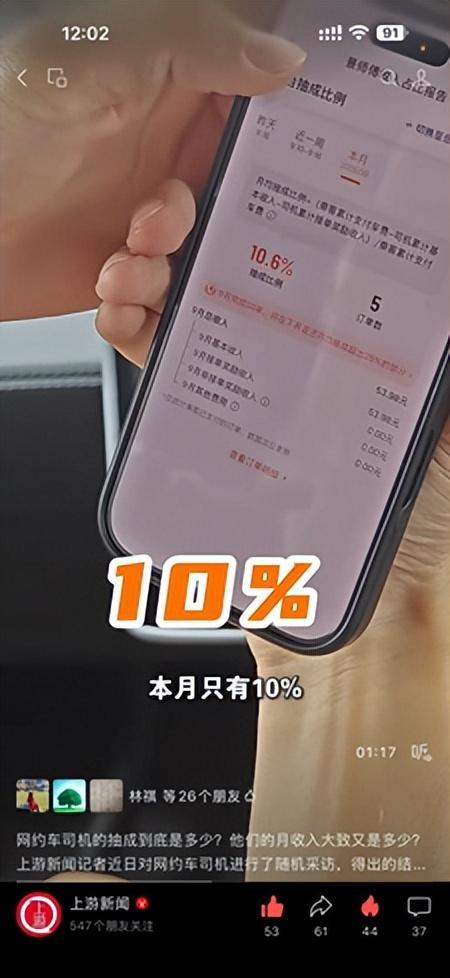
Upstream News also conducted an actual vehicle investigation on the commissions of Didi drivers and found that the drivers generally believe that the commissions are high, but many drivers actually don’t pay much attention to their bills. Their actual monthly commissions are often between 10-14%, rather than the “more than 20%” they “feel”.
One order is 23.9%, why is it only 13.22% for 21 orders?
Lao Yu’s confusion is very real: One order was clearly marked down by nearly 24%, how come it was spread among 21 orders and the average was just over 13%?
The answer lies in the word "dynamic". The commission ratio for online ride-hailing is affected by multiple factors such as time period, supply and demand, and order type. When there is congestion and capacity is tight during the evening peak, platforms often encourage rides by reducing commissions or even subsidies; during off-peak hours or during specific events, mechanisms such as commission-free cards, commission-free carpooling, and novice protection will also reduce commissions for some orders to zero or even negative numbers. Among Lao Yu's 21 orders, there were both "high-priced orders" that were charged more than 20 points, and "flat orders" that were charged no or low commissions. After all were leveled out, the average figure of 13.22% came to light. This is basically consistent with Didi’s previously announced “average commission of 14% for all orders in 2024.”
The measured data from Tsinghua University provides evidence from a larger sample. The team conducted a questionnaire survey on 894 Didi drivers between July and August 2025, and took photos and evidence of the "income reports" of 768 drivers. After combining the actual payments made by passengers and the actual income received by drivers, it was concluded that the average monthly commission of Didi drivers is 15.3%, 90% of drivers' average monthly commission is less than 20%, and even 4% of drivers have a negative monthly average commission - which means that the platform subsidizes drivers.
Where does the intuition of “overestimation” come from?
What is more interesting than the average figure is another finding in the survey: 71.8% of drivers overestimated their commission ratio. More than one-third of the drivers interviewed believed that the average monthly commission was higher than 25%. However, based on the real data recorded in the photos, only one of the 768 drivers had an average monthly commission of more than 25%.
The "loss aversion" in behavioral economics is most vividly reflected here. Drivers have the deepest impression and strongest emotions on the orders with high commissions. After finishing an order and seeing "23% commission", the frustration will last for a long time. However, those orders with no commission, low commissions, and even the platform's discounts will not leave any memory traces because they "did not suffer any loss". Over time, "the platform is pumping hard" has become an intuition, and intuition cannot replace bills.
The Tsinghua report also pointed out another information gap: most drivers rarely open monthly bills and are more accustomed to seeing the instant commission on a single order. After Didi implemented "Operation Sunshine" in 2022, it has launched transparent billing in the App. Drivers can check the income and commission of each order, and can also access the average commission report for the 7th and 30th day. After the experience, Lao Yu also advised his colleagues: "Speak with your own real data instead of being carried away by the emotions of a certain order."
Where did the commission money go? An account of "secondary distribution"
There is another question that drivers are most concerned about: does the platform use the money raised to make profits?
Didi’s stance is that commission is not equal to profit. A considerable part of the order commission flows back to the driver through rewards, subsidies, commission exemptions, etc. The capital pool comes from this source of incentives for driving during peak hours, two-way subsidies in rainy and snowy weather, guaranteed savings in off-season, and commission-free activities for carpooling and holidays. In terms of the upper limit of commission, Didi has lowered the maximum commission for a single transaction from 29% to 27%, and uses the "rebate treasure" to ensure that the average monthly commission does not exceed 25% for drivers who complete more than 50 orders per month, and the excess will be automatically refunded the following month.
In terms of driver protection, Didi Driver Protection Plan 2.0 covers income protection, care and benefits, rights protection and opinion collection; the health protection plan launched in 2026 includes public hospital medical subsidies, online consultations, and free physical examinations for qualified drivers in some cities. This year it plans to cover more than 50,000 express drivers across the country.
Of course, the stinging feeling caused by a high commission on a single transaction is real, and the platform also admits that the mechanism is still being optimized. But the greatest value of Lao Yu's "immersive sports car" may be that he used a verifiable sample to illustrate a fact that is easily obscured by emotions: in the highly dynamic supply and demand system of online ride-hailing, the commission for a single transaction depends on "what the market is like for this order", while the overall commission depends on "how the water in the pool is divided after a month of running."
Seeing the whole picture clearly is closer to the truth than focusing on one order.
Comments