
Abstract:
According to "Business Insider", in the face of SpaceX's entry into the wireless network field, Dan Schulman (Dan Schulman), CEO of Verizon, the largest operator in the United States, said on Monday that it would take up to eight years and an investment of US$500 billion for SpaceX to compete in this field.
SpaceX CEO Elon Musk aims to make Starlink an important player in the U.S. network market and become the "fourth largest operator in the United States." Schulman said on the earnings call that he would not underestimate SpaceX's strength and take the company's competition seriously.
"Obviously, the landscape of the technology and wireless communications industries is changing rapidly, and we must quickly adapt accordingly. I also operate under the assumption that everything SpaceX says it will do will come true, and they will execute it flawlessly." Schulman said.
However, he also said that if Starlink wants to compete meaningfully with mature networks such as Verizon, it still must overcome significant technical and financial obstacles. But it's possible.
Schulman said that to build a competitive communications network in the United States, especially mobile communications networks, it may be necessary to build as many as 80,000 large cellular base stations on the ground and connect them through a combination of satellites and optical fibers.
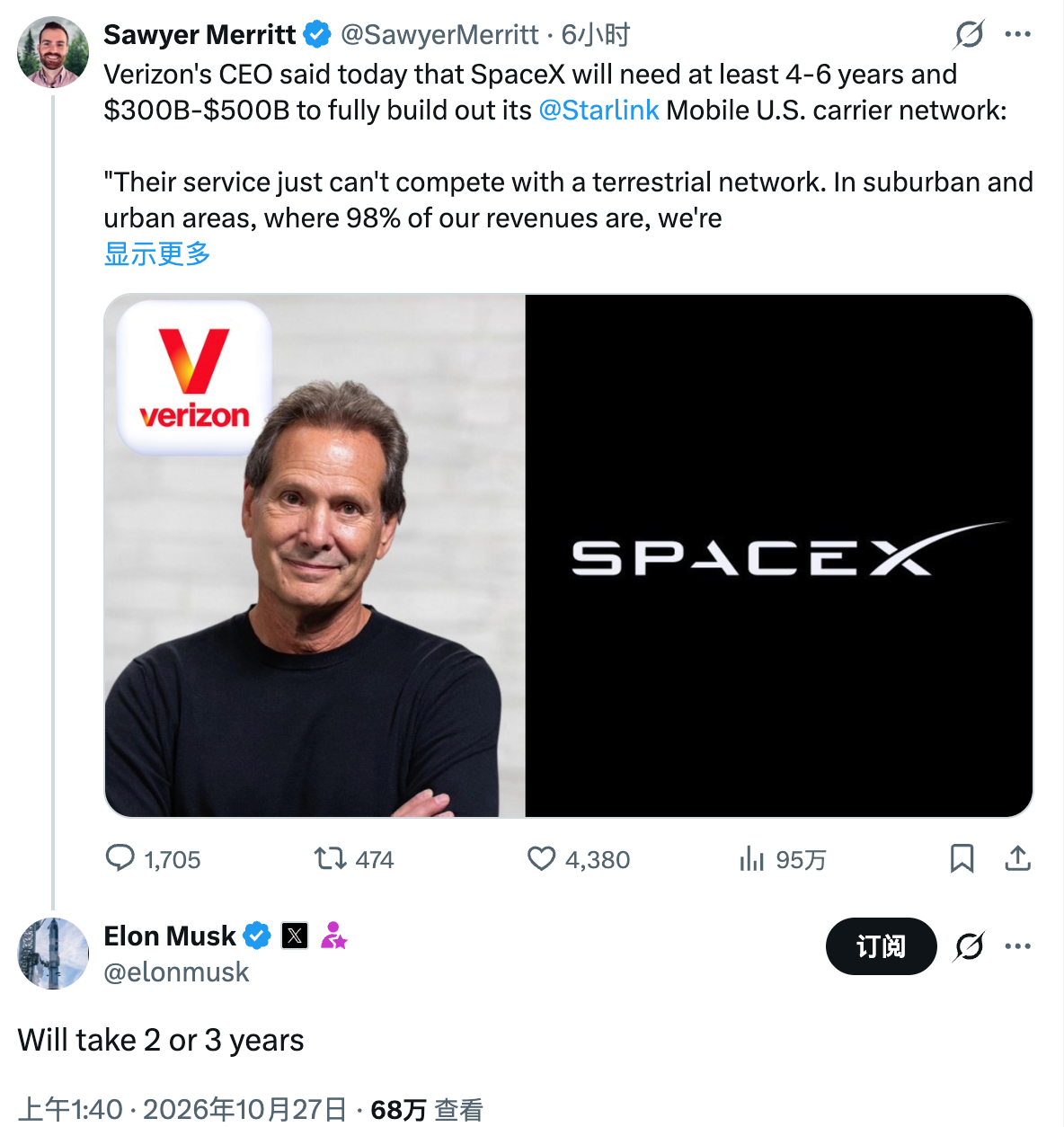
Musk said it would only take two to three years
He estimated that the project would cost up to $500 billion within 6 to 8 years, and that it would take at least 4 to 6 years to actually build the network. "Then they also need to set up retail customer service, back-end systems and so on, and all of that gives them basically the same network, the same capabilities and the same cost structure that we have today," Schulman said.
However, Musk obviously did not agree with this prediction. He responded on X: "It will only take two to three years."
Less than a week before Schulman made his remarks, rival AT&T CEO John Stankey downplayed concerns that the Starlink mobile communications network could threaten AT&T's business. "I wouldn't be overly concerned about an operator that only has low-band spectrum," he said.
Comments