
Abstract:
The Anthropic mathematician who used 17.37 million lines of Lean code to break the Riemann Hypothesis
Levent Alpöge
, just publicly stated on X:He has received fatal threats.

After the proof was made public, a large number of comments poured into his X posts, each of which could reach hundreds or thousands of comments, and all of them were mixed.
Some people say that he has made epoch-making achievements, while others accuse him of being a thief and helping AI subvert his own discipline, which is disgusting.


Some people believe that it was Claude who proved the Riemann Hypothesis, and Alpöge just pulled the trigger.

So, who is the person who broke the Riemann Hypothesis?
Levent Alpöge
, now 34 years old, works at Anthropic.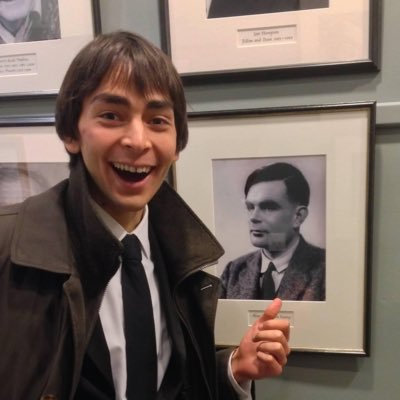
He graduated from Harvard’s Department of Mathematics with the highest GPA in his class, won the Morgan Prize for his undergraduate thesis, and later received a PhD in mathematics from Princeton. He can also speak six languages...
He was also one of two people who tried to solve the Navier-Stokes problem, but the proof of this problem was later released by OpenAI.
Why did he conquer the Riemann Hypothesis? How did he do it?
How did Alpöge break through the Riemann Hypothesis?
At around 4 a.m. on November 20, Alpöge returned to his temporary home in New York City.
It's almost over. He could finally sleep.
In order to prove the Riemann Hypothesis, he has not slept for many days. In fact, many of his collaborators noticed this problem - he hardly slept.
On this night, he uploaded the 17 million lines of code that broke the Riemann Hypothesis. A few hours ago, Anthropic had just completed its listing, setting the highest valuation in the history of the stock market, which also made Alpöge rich overnight.
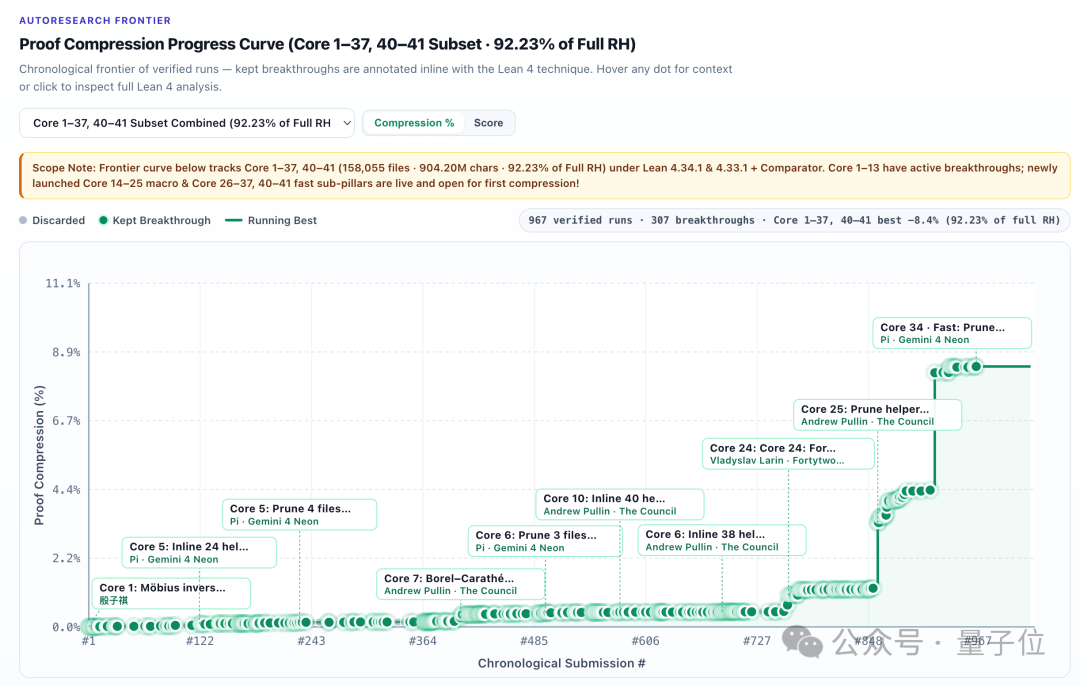
△
Riemann Hypothesis Lean code compression progressOnce the code is uploaded, he will become one of the most famous mathematicians in the history of mathematics.
The Riemann Hypothesis was first proposed by mathematician Bernhard Riemann in 1859. This conjecture holds that the positions of prime numbers that appear randomly on a number line are actually determined by a complex and meaningful law.
Since then, this conjecture has become the North Star of the entire field of number theory and the most famous unsolved mystery in mathematics.
In 2000, the Clay Mathematics Institute, which funds mathematical research, announced seven "Millennium Problems" with a reward of US$1 million for each problem. The Riemann Hypothesis was one of them.
Progress in solving the Riemann Hypothesis is also quite slow, and most top experts will hardly spend much time actually studying it because there is currently no clear path to proving the Riemann Hypothesis.
How long did it take for Alpöge and Claude, the pinnacle of human intelligence and the pinnacle of current artificial intelligence, to join forces to break the Riemann Hypothesis?
Six weeks.
In the readme released with the code, Alpöge disclosed this timeline:
The following is a rough timeline provided by Claude after a thorough search.
2026/10/6: Stepanov determinant.
2.2026/10/9: For p that is inert in K, Dp ≡ 0 on the CM curve, where D is an invariant derivative; and D_a − θ(0)/Ω_a is divisible by p^a + p^(3a) + ⋯ − O(log a).
As of 3.2026/10/19: qN = Mk + R, using x₁·x₂ + ⋯ + x_{k−1}·x_k; N is expected to be "automorphic" since µ is automorphic through θ (as the periodic integral of theta) on the GL₅ sixfold cover; the quadratic surface is on the corresponding CM curve (e.g. C/Z[ω]) has a natural interpretation, Weil's interpretation⁵; placing a Poincaré bundle on the edge gives θ.
From 4.2026/10/6: W(1_S) ≥ 0 is obtained through the determinant, which is again interpreted as "multiplicity is one" Stepanov; bootstrap! !
5.2026/10/20: A radical shift to Λ, i.e. Λ{n≤X} Λ(n)·(X/n − 1)+ − X log Type integral...
6.2026/10/8: W(1_(0,1] + (∼ X^η)·1_(0,1/X]) ≥ 0 gives > 1 − η.
7.2026/10/14: Construct a determinant for W(·) containing the desired period (which is indeed a GGP period), with values 0, 1 meaning staggered weights, or up to m non-staggered weights.
8.2026/11/15: Iterate theta between fully definite unitary groups to improve U(X₀) → U(X₁) → ⋯ → U(X_m), π ↦ π ⊞ µ_j[t], and win the multiplicity m. It’s time to let m take the magnitude of √X...
9.2026/11/15: Boosted norms and levels, and cancellation of m-order terms with divisibility proved by the Chowla–Selberg, Weyl and Siegel mass formulas.
10.2026/11/15: A sufficient lower bound on the divisibility of m-heavy iterative lifting.
11.2026/10/6: Obtain the Iwasawa tower by analogy with the drawer principle on F_q^n / F_q.
12.2026/11/15: Seesaw: The cycle of iterative improvement is a Bessel cycle that does not depend on the Hecke characteristics, Rallis.
13.2026/10/6: Bost slope inequality.
14.2026/11/15: Accurate calculation of the "cost" of each lift shows a priori that it will stop at 2/3; try to get the main term and transfer the constant to the function domain, or eliminate it by twisting; "division" is required.
15.2026/11/15: Glue the integral structure together across Hecke features, resulting in a "greatest common divisor" (gcd), i.e. additional averaging.
16.2026/10/14: The relative trace formula - seen in the argument for another half-plane: the automorphism of µ via the GL₅ six-fold covering and its Cauchy–Schwarz reduction to the bound on the norm of the Poincaré series for the appropriate projection; the approximate orthogonality of the columns of the integral structure.
17.2026/11/15: For those classes in H¹(o_E[1/ℓ], ℚ_ℓ/ℤ_ℓ(−e)) that cannot be eliminated by distortion, strive to significantly weaken the Vandiver conjecture. ⁶
18.2026/11/15: Calculation of co-volumes, exponents of theta series, ascension and congruence between forms.
19.2026/10/19: Precise selection of Iwasawa Tower, specifically using Behrend! ! ⁷
20.2026/11/16: GRH (Generalized Riemann Hypothesis).
According to Alpöge's self-report, he is mainly responsible for controlling the overall idea and direction, and Claude is responsible for execution.
He and Claude first tried to connect the two ideas in a simplified situation, and then looked for places where the same idea could be used in integer problems.
One of the clues came from the Soviet mathematician Stepanov. The version of the Riemann Hypothesis corresponding to the curve in the finite field has already been proven. A key tool in Stepanov's method is called "multiplicity", which can be used to measure how completely a function disappears at a certain point.
When it comes to integer problems, the original method of constructing multiple zeros is difficult to copy. Alpöge's analogy is that it's like trying to differentiate an integer.
He and Claude turned to trying to string together another mathematical operation so that the effects would stack up again and again. But how many times should you do it to achieve a similar effect?
Claude proposed that if the length of the weighted sum is X, repeat this operation about √X times.
This is a very critical step. "This line alone is enough to make colleagues jump out of their chairs in shock," Alpöge wrote. He had experienced dozens of moments like this when he was amazed by Claude's thoughts.
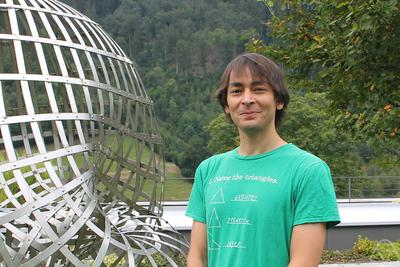
Alpöge described that when it turned out that the finish line was approaching, Claude was already far ahead of him. "Claude was flying and dancing near the finish line, shining brightly."
In the end, the two wrote the entire set of arguments into Lean code.
Why only upload Lean code? Because Alpöge admitted that he himself had not fully understood the mathematics involved in the argument.
He wrote in his self-report:
I presented a complete argument to the world before I had grasped the vast mathematical neighborhood surrounding it. It was obviously not appropriate to post something that was huge, unreadable, and simply an "AI slop", so I decided to present only Lean code.
The timing of the announcement also embarrassed him, as Anthropic was about to go public. Alpöge recalled that late that night, he sent a message to CEO Dario Amodei, asking when he could make it public:
The timing sucks. If it had been up to me, I would have done all this a long time ago. Hell, it would definitely be better if he could do it before this age. This all happened late Sunday night, I messaged Dario and said "Hypothetically, what if I..." and ended up asking if I had the right to publish it.
Dario asked him to wait until the company goes public before announcing it. Finally, we have the version you see now.
"Scientific American" commented on this:
He defeated everyone with the help of a machine.
But he himself is the most critical link in this process.
In his self-report, Alpöge also specifically emphasized his subjective initiative:
"The secret of my student days is that my plans were prepared to solve this problem (Riemann Hypothesis)."
Proving the Riemann Hypothesis has been his dream for more than ten years
Alpöge wrote in his autobiography: "Since childhood, this question has had an almost sacred status in my heart."
When he was a student, he planned to spend many years preparing for the Riemann Hypothesis, learning as many mathematical tools as possible that he might use in the future, so that he could figure it out when he could really solve the problem.
In 2014, 22-year-old Alpöge had just graduated from Harvard. In an interview with Turkish TV station CNN Türk,
he said that his dream is to solve the Riemann Hypothesis
.Now, he has realized that dream. How?
Alpöge declined media interviews. Scientific American reached out to dozens of people who knew him and asked his friends, mentors, and research collaborators to tell their stories about Alpöge.
Mathematician Scott Armstrong was one of Alpöge's few close friends. He said:
"He has the determination to conquer the world and win everything, and this determination is extremely strong."
Even the Holy Grail of mathematics, the Riemann Hypothesis, may not be his limit.
In 1992, Alpöge was born in Long Island, New York, USA. It happened to be April Fool's Day.
His parents, both Turkish immigrants, realized their son's unusual intelligence when he was just three years old.
My mother remembers that once she got tired of reading a story, and the young Alpöge took the book and continued reading where she left off. At first she thought her son had just memorized the page, but when she gave him another book, he continued reading.
For some reason, Alpöge can learn many things without a teacher.
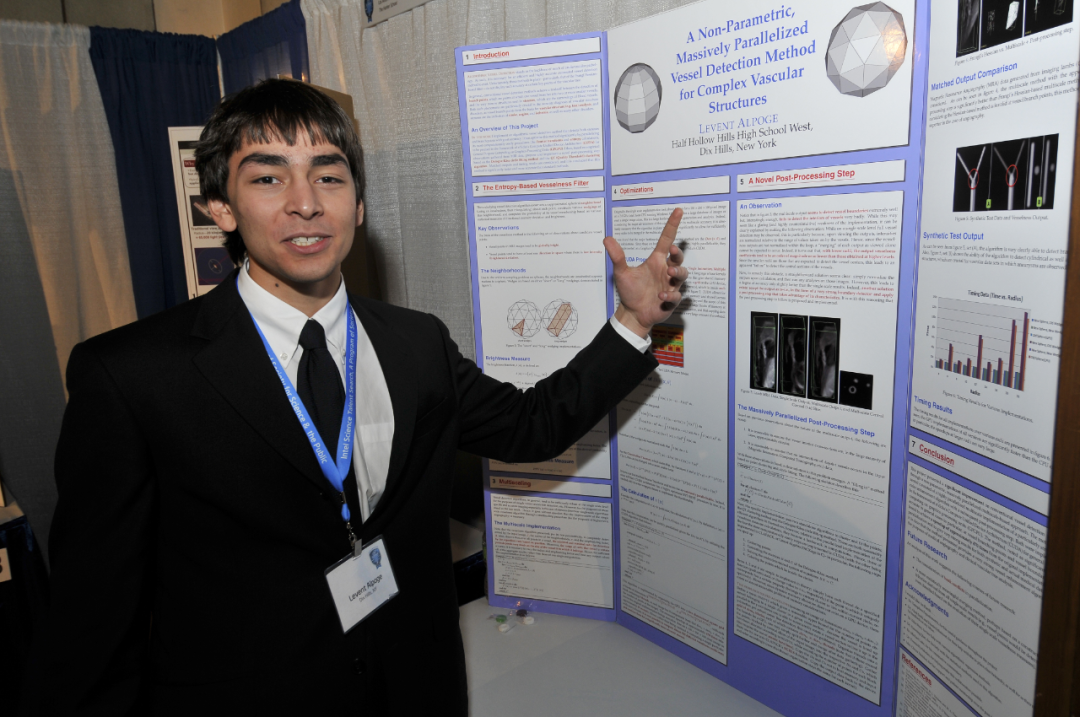
He was exposed to programming very early. At the age of 17, Alpöge, who was still in high school, collaborated with researchers at Yale University on a research project. The core idea was to use Nvidia's GPU to identify vascular structures in medical images.
Alpöge participated in the first GPU implementations of image analysis algorithms. Xenophon Papademetri, professor of bioinformatics at Yale University, recalled:
He was still a 17-year-old boy at the time, but he could definitely say "I will do it."
His enthusiasm is contagious, his energy boundless, and his confidence in his ability to overcome obstacles is almost astonishing.
Ultimately, he was a finalist in the 2010 Intel Science Talent Competition with this project, and MIT Lincoln Laboratory also recognized his scientific research achievements through the asteroid naming project.
As a result, Alpöge has since had an asteroid named after himself, number 25898.

△
Source: NASA official websiteAfter entering Harvard University, Alpöge chose mathematics. Even among high-achieving freshmen, he stood out. Noam Elkis, who was his mathematics professor at the time, said: "He found more than half of the corrections in the textbook that I had not noticed before."
In his junior year, Alpöge participated in an undergraduate summer research project and soon published papers in top journals, putting even senior professionals in awe.
Two weeks before the start of school, his tutor Galian gave him a particularly difficult question and asked him to do it to pass the time.
Gallian: You should do this question first until school starts. It doesn’t matter if you can’t solve it.
Alpöge (Steady Eyes version): I'll keep doing this until I figure it out.
Gallian:......
△
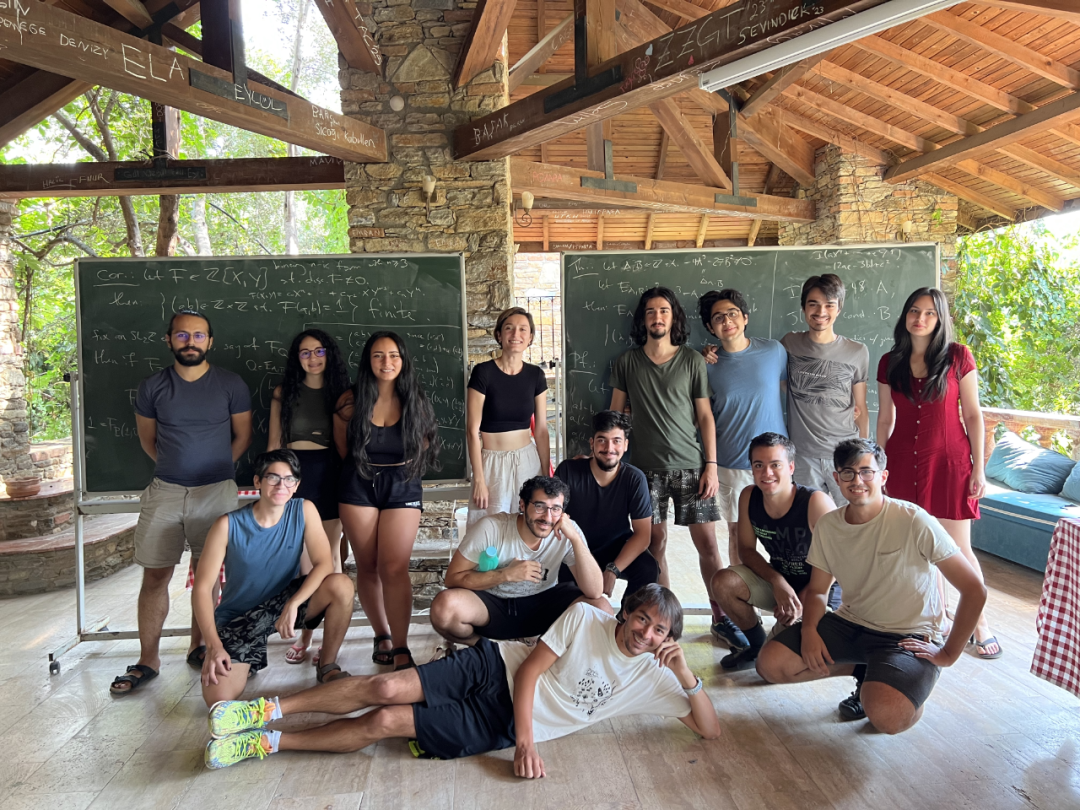
In 2023 at Nessing Math Village, Alpöge taught students about integrals on elliptic curvesThis tenacity is not only reflected in his studies, but also in eating ice cream.
Alpöge once participated in a "pig trough" challenge: if you ate a large pie filled with ice cream in 15 minutes, you could win a free T-shirt.
It only took him 3 minutes and 43 seconds to complete this challenge, a record that no one can even break.
It seems that doing math is similar to eating ice cream.

And Alpöge's fun-loving spirit has not even let go of the release notes of the Riemann Hypothesis.
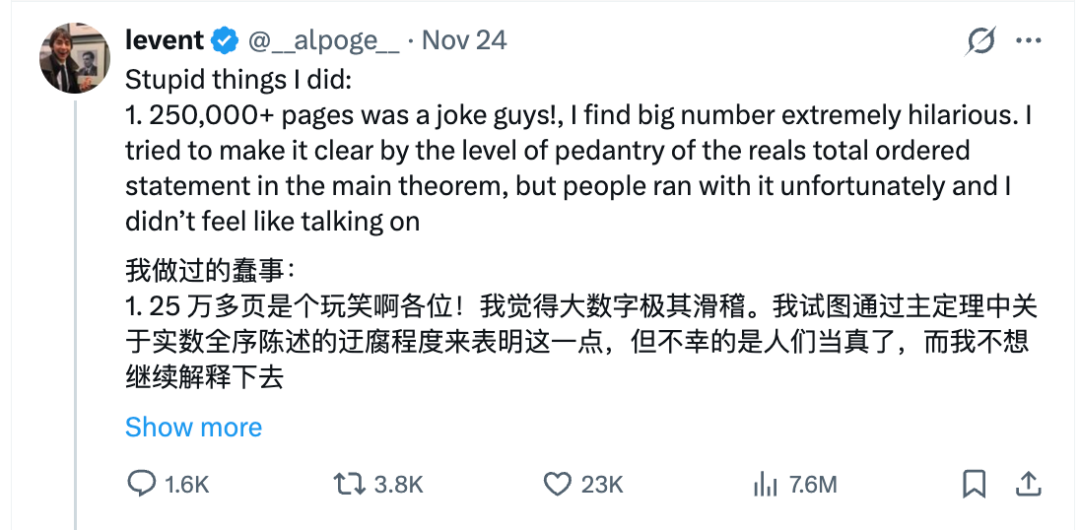
On a whim, he asked Claude to write down the argument in writing, and he wrote more than 250,000 pages in one go. Claude also called it a "book".
As a result, Alpöge opened it and saw that the first theorem is: If a real number is not equal to ½, then it is either larger than ½ or smaller than ½.
Later he explained specifically on X: "More than 250,000 pages is a joke, brothers! I just think big numbers are particularly funny."
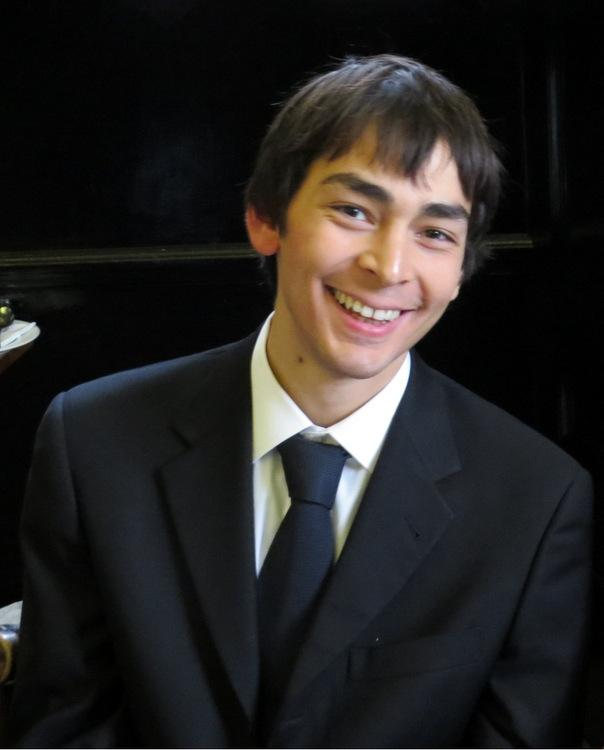
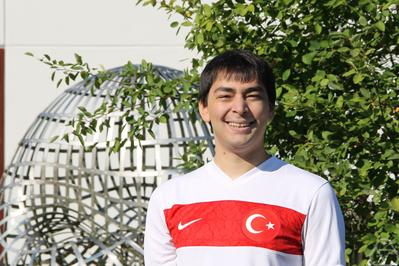
All the photos of him on the Internet are wearing a fluffy pot head and a naughty smile on his face. His clever and naughty nature can be seen at a glance.
Give a person who knows mathematics a strong enough model and enough computing power, and sooner or later he will use it to do mathematics
Genius is not perfect. In fact, in the eyes of some people, Alpöge is quite opinionated.
While at Harvard, Alpöge would ask so many questions in class that other students criticized him. "I was really worried that someone was going to hit him in class," recalls physicist Matt Reese.
He is indeed an arrogant genius, even a little immoral.
According to "Scientific American", he once posted a post claiming that he had solved a "Hilbert problem", but in fact, two other mathematicians had already solved this problem.
But until now, Alpöge proudly lists this honor on his personal website and in his X profile.

Alpöge has often expressed dissatisfaction with the old journal publishing system in mathematics academia. Especially after coming into contact with GPT-4, he became very interested in AI. "This is really the most interesting thing that humans have ever created."
He firmly switched from mathematics to AI, and joined Anthropic in the summer of 2024, giving him more opportunities to use the internal most cutting-edge version of Claude.
Give a person who knows mathematics a strong enough model and enough computing power, and sooner or later he will use it to do mathematics, "whether you want him to do it or not."
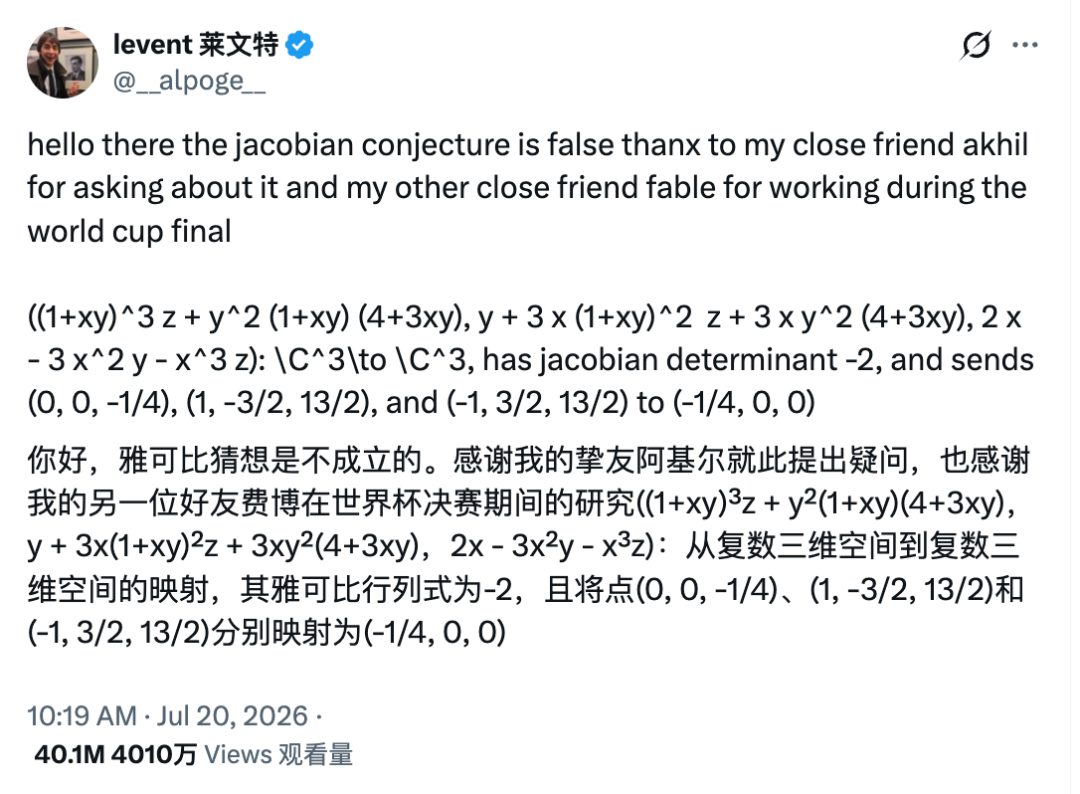
In July 2026, he posted on X and announced that he had solved the Jacobi conjecture. It starts with:
"Hi everyone, the Jacobi conjecture is wrong."
At least for a long time, Alpöge has been trying to use Claude to solve mathematical problems.
The topics sometimes come from number theory that he is familiar with, and sometimes they are proposed by colleagues. After choosing the topic, he invested a large amount of tokens and asked a batch of internal version of Claude agents to try along the selected direction.
When there is progress, he will send it to a few trusted external experts for a look, and then move forward based on their feedback.
These puzzles are numerous and profound, covering a wide range of mathematical topics that any single mathematician can effectively study in depth.
Of course, Alpöge does not need to fully understand every topic. He only needs to act as a liaison between the many Claudes under his command and human collaborators.
He will point out the direction for his Claude army. Sometimes, what Claude spits out are thousands of pages of calculations, or even some "mathematical gibberish" that even colleagues who are familiar with this field find it difficult to understand directly.
At this time, Alpöge will use another large model to transform these output contents into mathematical expressions that peers can understand and discuss. Alpöge also named this process "AI psychosis" (AI psychosis).
He has become a "communicator" of large language models and can run faster than his peers.
So, how many tokens does it cost to solve these mathematical problems?
Anthropic did not disclose the computational cost of this Riemann Hypothesis study. For reference, in another summer study Alpöge participated in, the search for just one of the matrices cost about $1 million to $4 million.
Altman recently admitted that OpenAI spent about $10 million to do the Navier-Stokes proof, maybe a little more. Currently, OpenAI’s investment in this type of mathematical research has reached the level of hundreds of millions of dollars.
Alpög uses Claude to solve the Riemann Hypothesis, and the cost will probably not be less than tens of millions of dollars.
After announcing the proof of the Riemann Hypothesis, he received threats
Today, Alpöge has many enemies. After announcing the proof of the Riemann Hypothesis, he posted on X that he had received threats.
Many netizens doubted how much Alpöge actually contributed to the proof of cooperation with Claude.
Some people say that he is a thief.
Some people say that Anthropic wants to use AI to replace human intellectual labor. As a mathematician, Alpöge is still promoting AI to subvert mathematical research, which is disgusting.
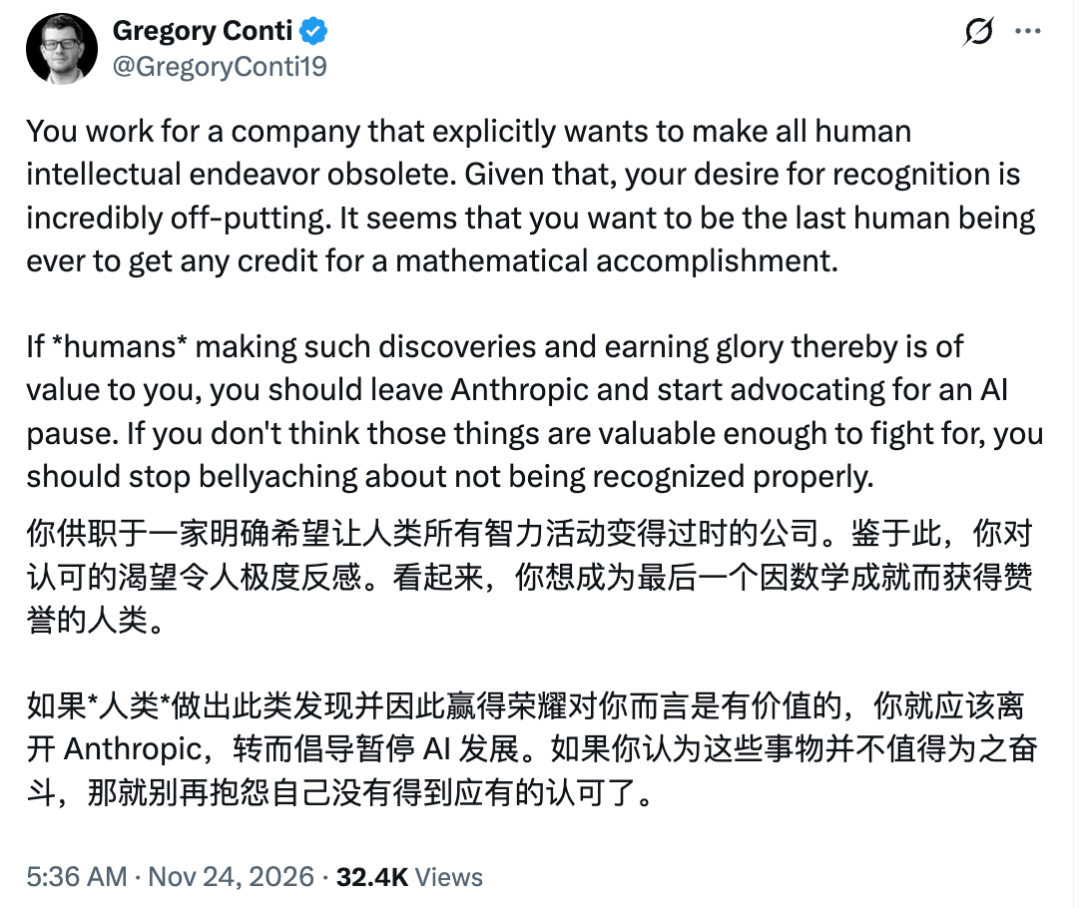
In response to various remarks, Alpöge’s refutation is:
I expected the threat, but why did you make up a story? According to what you say, everything I have done in the past few years is all a coincidence, and I have no role at all. This proof does not reflect my understanding of mathematics at all, right?
As of now, the comment area of Alpöge’s X post is still full of doubts and criticism. He also retweeted a post with the text "Providing the world with a regular reply to the Riemann Hypothesis."
But that post is no longer visible, and there is reasonable suspicion that it involved a personal attack.

If we borrow the metaphor of "The Three-Body Problem", Alpöge is obviously a supporter of the "AI Adventist".
He believes that using AI to do mathematical research is the future of mathematics, and he is firmly pursuing this route.
More than one collaborator described him as "extraordinarily energetic" and "he focused on the goal, as if he was saying, 'I'll go to sleep after this is done'".His goal has been achieved. With bloodshot eyes, he started the compiler.
Driven by many Alpöges, Claude - or AI, this behemoth with amazing power, is constantly breaking through ancient problems in mathematics.
Comments