
Abstract:
Nearly 40 years after the Chernobyl nuclear accident in 1986, researchers conducted the first complete crystal phase analysis of a single nuclear fuel "hot spot particle" released by the accident. Detection of six tiny particles found that the structure of some uranium oxides is still largely intact and may continue to fix fission products and actinides inside the particles, meaning that the chemical stability of this type of debris may be higher than previously estimated.
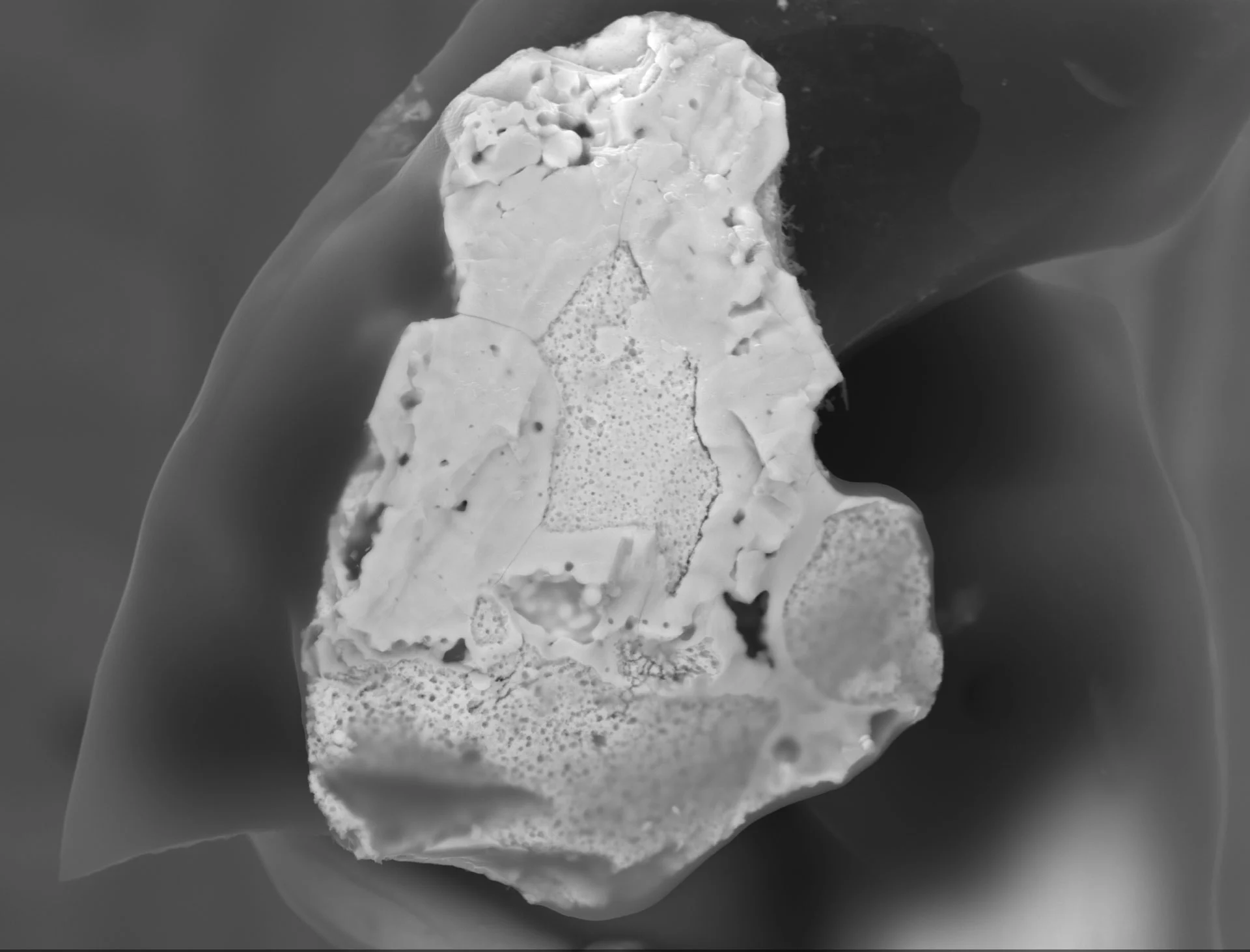
These particles are about 8 to 50 microns in diameter and came from two locations in the Chernobyl exclusion zone: the research team separated two particles from an asphalt drill core in Pripyat, with a sampling point about 3 kilometers northwest of the reactor; the other four particles came from the top soil of farmland about 5 kilometers away near Kopacz. The samples were collected in 2015 and 2017 respectively. They are still highly radioactive, and the researchers conducted experiments under the protection of multi-layer packaging.
The research team fixed the particles and sent them to the Synchrotron Radiation Facility in Grenoble, where they were scanned with a focused X-ray beam and measured by rotating each particle from about 2,000 angles to capture crystal diffraction signals. Uranium dioxide (UO₂), uranium trioxide (U₃O₈), uranium tetrauranium tetraoxide (U₄O₉) and zirconium-containing mixed phases were analyzed and identified. Researchers believe that part of the UO₂ and U₄O₉ lattice remains intact and may continue to act as a "holding matrix" in the near future, limiting the outward migration of radioactive fission products and actinide elements.
The different structures of the particles reflect the different temperatures and chemical environments experienced during the accident. Some are still close to the original uranium dioxide fuel; some are partially wrapped or fused with the zirconium material in the outer layer of the fuel; when the graphite moderator burns, the fuel may be oxidized into a variety of uranium oxides. Among them, U₃O₈ is relatively fragile and can easily form particles that can be blown away by the wind. Inhaling this type of radioactive dust can cause serious health risks.
However, the six samples came from two locations and cannot represent all the fuel debris in the entire Chernobyl exclusion zone. The researchers emphasized that the structure of each particle is different. Even if the sample is expanded and an average is obtained in the future, there may still be "outlier" particles that are more stable and can release radionuclides over a longer period of time. This discovery can only help improve models of pollution dispersion and waste management, but it does not necessarily mean that the surrounding environment is generally safe, nor does it mean that no-go zones can be lifted.
The research, published in the Journal of Hazardous Materials, was completed by a team from the Leibniz University of Hanover in Germany and the Helmholtz Research Center Dresden-Rosendorf. Researchers are continuing to analyze the highly radioactive transuranic element phases in the wreckage to learn more about changes in these particles over time as they are exposed to soil and asphalt, and the potential for future releases of radioactive material.
Comments