
Abstract:
Linux kernel version 7.3 was officially released on October 18. This update was launched according to the established plan, bringing a number of performance optimizations and hardware support improvements, covering areas such as storage I/O, AMD's next-generation Zen 6 processor platform, older AMD graphics cards, video memory management, and game controllers. In addition, the new version also includes compatibility fixes for some Samsung solid-state drive firmware issues, as well as a patch to fix long-standing and rare system startup failures.
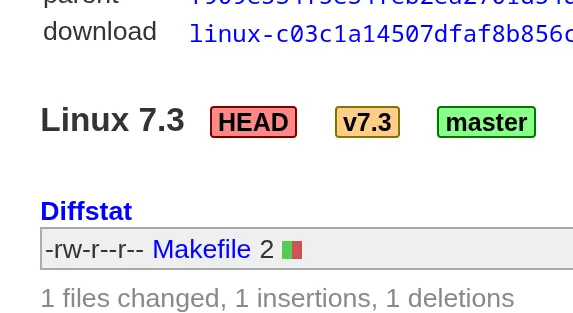
Download address:
https://git.kernel.org/pub/scm/linux/kernel/git/torvalds/linux.git/
Linux 7.3 is an important version in the Linux kernel development cycle. As processors, graphics cards, solid-state drives, and game peripherals continue to be updated, the Linux kernel needs to continue to improve the underlying driver and hardware adaptation mechanisms while solving performance bottlenecks and stability issues in existing functions. This update includes proactive support for future hardware platforms as well as fixes to improve the experience on existing devices.
Storage performance is one of the important improvements in Linux 7.3. The new kernel has made many optimizations in I/O processing of modern systems, and some file systems and storage subsystems have also received performance improvements. For Linux systems running databases, virtual machines, development tools, and large-scale data processing tasks, storage I/O efficiency will directly affect the response speed and overall throughput of the application.
Among them, the Btrfs file system has received noteworthy optimizations during this development cycle. Previous tests have shown that under specific workloads, the new version of Btrfs can achieve significant performance improvements. However, actual benefits will depend on hardware configuration, file system settings and specific task types, and it cannot be assumed that all devices will experience the same performance increase after upgrading.
AMD platform support is also the focus of Linux 7.3. As AMD prepares to launch a new generation of processors based on the Zen 6 architecture, kernel developers continue to improve related support and prepare for the normal operation of future hardware platforms.
This type of work usually includes processor identification, platform initialization, power management, and other low-level function adaptation. For Linux, merging relevant support into the kernel mainline in advance can reduce the probability of users encountering compatibility problems after new hardware is launched, and also help distributions and hardware manufacturers conduct testing in advance.
However, the presence of Zen 6-related support in the kernel does not mean that all processors that are not yet on the market have received full support. Specific features of the new platform may still require subsequent kernel versions, firmware updates, and other software components.
In terms of graphics cards, Linux 7.3 continues to improve support for some older AMD GPUs, while optimizing the video memory management mechanism. For systems with limited video memory capacity, proper management of video memory resources is particularly important, because when the graphics workload exceeds the video memory capacity, the system needs to handle resource allocation and data transfer more efficiently to avoid significant performance degradation.
Such improvements may be of practical significance to some gaming devices, thin and light laptops, and systems using integrated graphics. As the demand for video memory from games and graphics applications continues to increase, video memory management efficiency has become one of the important factors affecting the Linux graphics experience.
Game hardware support is also a highlight of this update. Linux 7.3 adds kernel driver support for the 2026 Steam Controller, allowing related devices to better integrate into the Linux input device system.
Steam Controller is an important product of Valve in promoting innovation in PC game control methods. For Linux game users, kernel-level device support helps the operating system identify the controller and provide corresponding input interfaces for upper-layer applications. However, entering the driver into the kernel does not mean that all functions will be immediately available on all distributions. The specific experience still depends on the kernel version, user space software and device firmware used by the distribution.
In addition to the new Steam Controller, the Linux 7.3 development cycle has also added support for a variety of game controllers and other human-computer interaction devices. The HID subsystem in the Linux kernel is responsible for handling a large number of keyboards, mice, controllers and other input devices, so the improvement of related drivers can allow more peripherals to work normally in the Linux environment.
Stability fixes should not be ignored either. Linux 7.3 includes a fix for a rare SMP boot hang issue before its official release.
SMP, symmetric multiprocessing, is an important mechanism in modern multi-core processor systems. The operating system needs to coordinate the initialization and operation of multiple CPU cores to ensure that they can correctly participate in scheduling and executing tasks. If there is a problem with the synchronization mechanism during the startup process, the system may not be able to complete startup normally under certain conditions.
This fix targets a rare type of problem that dates back to 2024. Due to the specific conditions under which the failure occurs, the affected system may not encounter problems every time it is started, but for devices with relevant hardware or software combinations, repairs are still of practical value.
In terms of solid-state drive compatibility, Linux 7.3 also adds workarounds for some Samsung 990 PRO and 990 EVO Plus solid-state drives.
The issue involves incorrect reporting of device capability information by certain firmware versions. When the operating system recognizes an NVMe solid-state drive, it needs to read the capability information provided by the device to determine how to communicate with the hard drive. If the information reported by the device is inconsistent with the actual capabilities, the kernel may adopt inappropriate processing methods, thereby affecting device compatibility or operational stability.
Linux developers have added corresponding workarounds this time to allow the kernel to handle these specific situations better. However, this does not mean that all Samsung 990 PRO and 990 EVO Plus hard drives have problems. The relevant impact is related to the specific firmware version and device status. Users should still judge whether the kernel or hard disk firmware needs to be updated based on the actual situation.
The development process of Linux 7.3 also reflects the increasingly obvious impact that artificial intelligence-assisted programming is having on open source software development. Phoronix pointed out that in the last week before the official version is released, the Linux code repository continues to receive bug fixes and regression problem corrections, including related development activities generated after artificial intelligence and large language models assist in discovering problems.
The Linux kernel code is huge and involves processor architecture, file systems, networks, graphics drivers and a large number of peripherals. As code continues to grow, artificial intelligence tools are being used to assist in analyzing code, finding potential flaws, and assisting developers in understanding complex program logic. However, problems generated or discovered by relevant tools still need to go through developer review, testing and maintenance processes, and the patch cannot be deemed to be correct solely based on the participation of artificial intelligence.
Before this release, there is another personnel change that has attracted the attention of the Linux development community: Darrick Wong, who has long been involved in Linux file system development, announced that he will temporarily reduce related work investment. He has been deeply involved in Linux kernel development for the past 23 years, especially closely related to the maintenance and development of the XFS file system. This news also reflects that the Linux kernel not only needs to continue to attract new developers, but also relies on the accumulated expertise and experience of long-term maintainers.
With the official release of Linux 7.3, development work will shift to the next version, Linux 7.4. According to the usual development rhythm of the Linux kernel, the new version will first enter the merge window. Developers will focus on submitting new features at this stage, and then test and fix them through multiple candidate versions.
If subsequent development progresses smoothly, Linux 7.4 may be released before the end of December 2026. By then, it may also become a long-term support release in 2026. However, which version is ultimately selected as the annual long-term support kernel still depends on the maintainer's decision and cannot be determined in advance based solely on release time.
Overall, Linux 7.3 is not an update that simply pursues the number of new features, but also promotes performance optimization, future hardware adaptation, game device support and system stability repairs. For desktop users, gamers, developers and server administrators using Linux, the new version provides a variety of improvement opportunities.
However, whether ordinary users need to upgrade immediately should also consider the Linux distribution used and device compatibility. Rolling update distributions typically deliver new kernels more quickly, while distributions with a long-term support strategy may continue to use older proven versions and provide necessary fixes via rollback patches.
For users who want to get the latest hardware support or test the performance of the new kernel, Linux 7.3 deserves attention; for production environments that pursue stable operation, priority should be given to the release's update strategy, driver compatibility, and actual test results. With the launch of the Linux 7.4 development cycle, kernel improvements in processor performance, graphics drivers, and storage efficiency will continue to advance.
Comments