
Abstract:
According to a report by technology media The Next Web on November 27, local time, this year’s “Black Friday” has become the biggest test for AI shopping agents so far. Adobe data shows that on Thanksgiving Day, the traffic brought by AI services to U.S. retail websites doubled year-on-year, and online consumption reached US$7.1 billion, a year-on-year increase of 10.4%; however, the transactions completed by AI agents accounted for only 0.4% of global e-commerce transactions and 0.2% of the value.

Consumers still dare not easily hand over payment rights to AI. A Visa survey shows that 54% of American adults have used AI to complete shopping tasks, but only 23% trust it to pay on their behalf. Visa then asked 22 models from 12 laboratories to complete 15 shopping tasks, and 42.8% of the runs failed; in 54% of the failed tests, the model still made a purchase decision, and some products did not meet the user's requirements. This test has not yet covered the real payment process.

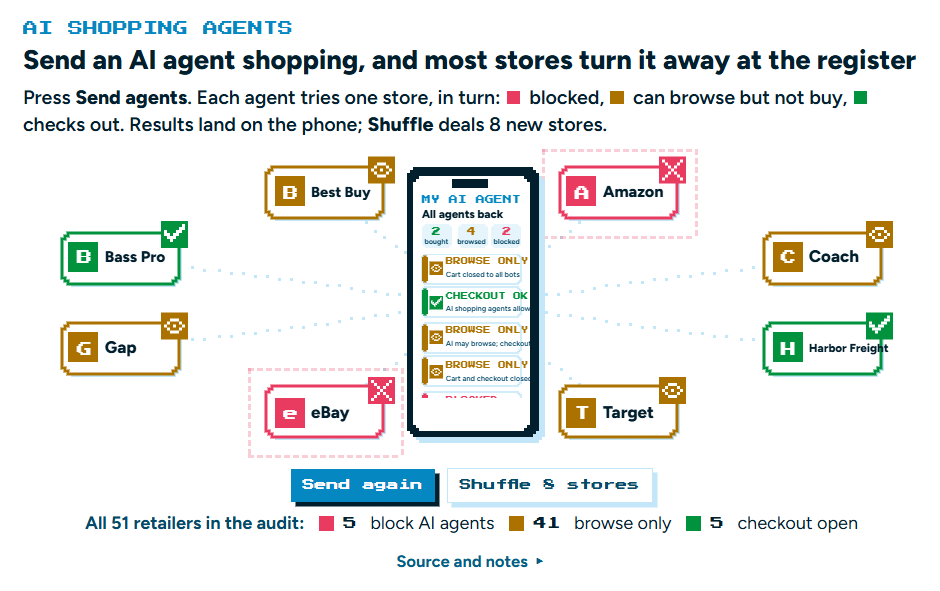
AI agents also face website blocking. Human Forward tested 200 websites and found that about half of large retailers and popular brands did not allow AI assistants to complete purchases. Amazon has blocked Meta’s Muse from entering the mall and sued Perplexity over Comet shopping agents; eBay, United Airlines and Kohl’s have also restricted agent functions.
There is also no unified answer to the division of responsibilities. Best Buy clearly states in its terms that it is not responsible for errors by digital agents; American Express plans to provide error charge protection for eligible registered agent transactions; JPMorgan Chase prohibits outside agents from operating on behalf of customers. Muse once failed to purchase windshield wipers from AutoZone. After waiting for 17 hours, the user was advised to go to Amazon to place the order.
Domestic platforms mostly use built-in AI assistants or A2A docking, and the e-commerce system handles goods, contract fulfillment and after-sales. Meta continues to expand Muse: its users exceeded 10 million about six weeks after its launch in the United States and Canada. About a quarter of users shop through it, and the average amount of related orders is about US$200.
Comments