
Abstract:
In the past three years, NVIDIA has become one of the most active investors in artificial intelligence start-ups, small cloud service providers and cutting-edge AI laboratories. The core reason behind this is CEO Huang Jensen’s continued efforts to ensure that the demand for its own dedicated AI chips remains strong. After he suddenly left office, this source of large capital supply is now cast into a shadow.
Venture investors, startup founders and semiconductor industry executives say they expect Nvidia to slow its frenzied investment pace.
In just two months this year, Nvidia completed a total investment of US$140 billion, including huge credit guarantees. These deals include large capital injections into major chip customers: Nvidia plans to invest $10 billion in Anthropic's IPO next week. But the highest risks are those companies that are in the process of financing and originally expected Nvidia to invest.Once NVIDIA's aggressive investment willingness shrinks, the flow of funds into unlisted companies may slow down. Previously, even if technology stocks fluctuated sharply, this type of private equity financing was basically unaffected. Financial executives said that the market originally defaulted that when companies like CoreWeave encountered difficulties, Nvidia would provide support, which is what the industry calls Nvidia's "put option protection", but this expectation has now basically dissipated.
“Nvidia relied on its own balance sheet to leverage massive investments.” said Craig Coburn, a former equity capital markets banker at Bank of America and managing director of financial consulting firm Seda Experts. Huang Renxun's departure raises a question: "Without Huang Renxun at the helm, can this company maintain this frenetic investment pace?"
Huang Renxun will personally follow up on many investment projects, such as the US$12.9 billion acquisition of Hugging Face this year. Once there are other bidders for the startups he likes, he will quickly push for a deal. In investments, NVIDIA generally does not dominate pricing or serve as the lead investor, but it often contributes the highest amount of investment. Huang Renxun also often meets and communicates with the founders.
An investor who has invested in many Nvidia post-investment companies said: "Huang Renxun is very supportive of the start-up ecosystem because he is a founder himself. If the next CEO does not have the same idea, there is a high probability that he will not support start-up companies as much as he does."
The interim CEO appointed by the board of directors is Nvidia Chief Financial Officer Colette Kress, and the outside world expects her to advance transactions at a speed far slower than during Huang Renxun's period. She has raised objections to many projects that Huang Renxun promoted. People familiar with Nvidia's investment process said that Huang Jenxun often requires the team to prioritize speed rather than detailed due diligence, and Kress's management style will be significantly different from his. A spokesman for Nvidia did not respond to a request for comment.
However, venture capitalists do not believe that investment will completely stop. Investors in start-up companies invested by NVIDIA said that even if Huang Renxun leaves, as long as the company purchases NVIDIA chips and uses NVIDIA computing power, NVIDIA will still be motivated to continue investing.
Startups that have signed investment contracts with NVIDIA are basically unaffected. For example, people close to AI startups Safe Superintelligence (NVIDIA plans to invest US$5 billion) and Thinking Machines Lab (NVIDIA plans to invest approximately US$2.5 billion) said that relevant investments should be able to be implemented, and the two parties had signed legally binding agreements a few months ago.
The media previously reported that bankers and investors originally expected that under the leadership of Huang Renxun, Nvidia would continue to invest and acquire start-ups in robotics, autonomous driving, and end-side AI model tracks next year. People involved in past transactions revealed that many banks even regard Nvidia as the preferred buyer for AI start-ups seeking M&A exits.
Nvidia has also invested in listed AI cloud vendors: earlier this year, it participated in the private placement of CoreWeave, spending US$2 billion to purchase shares, and at the same time promised to undertake its unsold cloud computing resources. Nvidia itself will also purchase computing power. For example, in May, it officially announced that it would purchase cloud services worth US$3.4 billion from Iren. Shares of both new cloud vendors fell about 7% on Thursday.
The prospects for all of the above transactions are now uncertain. Semiconductor executives said that competitors such as AMD and Broadcom do not have the ability to provide huge credit guarantees to cloud service providers and data center developers as Nvidia has done in the past year. Although AMD has also invested in many start-up companies, the scale and number of investments are far less than that of NVIDIA; Broadcom has almost no investment in small start-up companies over the years.
The following is the situation of some AI companies that are deeply tied to NVIDIA's funds:
OpenAI
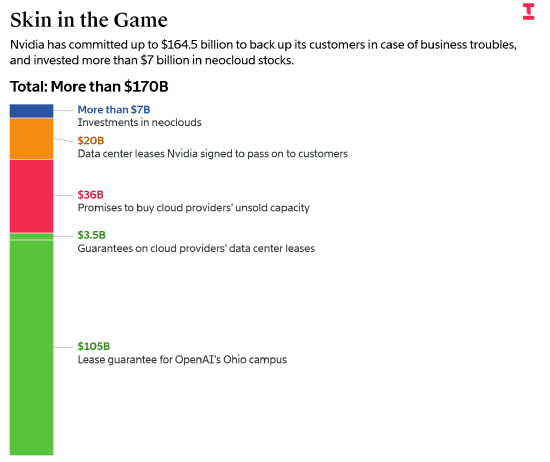
Nvidia is one of the most important investors in OpenAI, making both direct equity investments and providing credit for its computing power projects. The ChatGPT developer has received at least US$30 billion in funding from Nvidia. At the same time, the lease of a large data center project in Ohio has been guaranteed by Nvidia for US$105 billion. The project plans to use a large number of Nvidia chips.
Two people familiar with the financing said that Nvidia originally did not plan to participate in OpenAI’s current round of financing. But the chip giant and its founder could have participated in OpenAI's IPO next year, just as it planned to invest $10 billion in the Anthropic IPO.
Firmus
After the Australian cloud vendor withdrew its IPO due to valuation disputes, Nvidia negotiated an investment in it late last month. This investment negotiation sends a signal: Nvidia is willing to continue to support this type of niche, immature cloud vendors that are burdened with high debts and purchase Nvidia servers.
After Firmus terminated its IPO, it planned to raise at least US$2 billion from private equity investors, and Nvidia was originally prepared to participate in its IPO investment. Like NVIDIA's other investments, the cooperation between the two parties is multi-level. Firmus is the first participant in NVIDIA's new support program: NVIDIA provides credit support to new cloud vendors in exchange for a share of cloud business revenue. A Firmus spokesman could not be reached for comment.
Lambda
Nvidia continues to support Lambda in a variety of ways, including equity investment and a $1.5 billion agreement to lease back its own chips to the cloud vendor. Nvidia also pledged to guarantee nearly $20 billion in Lambda leases. Lambda is launching a new round of financing, which is expected to be the last round of financing before the IPO. It is not yet clear whether Nvidia plans to participate. A Lambda spokesman did not respond to inquiries.
Figure AI
Huang Renxun regards physical AI and robots as the next frontier of AI, and is particularly optimistic about humanoid robots. He also appeared on the same stage as humanoid robots at the NVIDIA conference.
Nvidia will invest in humanoid robot company Figure AI in 2024, with additional investment the following year. Media previously reported that Nvidia has been negotiating to inject another US$1 billion into Figure in recent months. The progress of the investment is currently unclear, and its spokesperson cannot be reached.
Nscale
Media reports that Nvidia is negotiating to provide billions of dollars in credit guarantees to new cloud vendor Nscale to build a 460-megawatt data center for use by Anthropic. According to industry estimates, the construction of a 1 GW computer room framework requires US$12 billion, and the total size of the transaction is expected to exceed US$5 billion. As of late October, the agreement had not yet been signed. A spokesman for Nscale declined to comment.
Thinking Machines Lab (TML)
This AI startup founded by former OpenAI chief technology officer Mira Mulati plans to raise US$4 billion to US$5 billion, with a valuation of at least US$40 billion, of which Nvidia plans to invest half. Earlier this year, Nvidia also stated that it would reach a "long-term, gigawatt-level strategic partnership" with TML. The two parties plan to deploy at least 1 gigawatt of servers equipped with Nvidia's Vera Rubin chips early next year. People close to the company said the project schedule is still advancing.
Reflection AI
Nvidia invested US$800 million in Reflection AI last year. Huang Renxun personally met with the company's co-founders in August last year and suggested that the company change its direction and stop focusing on coding AI agents and instead develop self-developed open source large models. People familiar with the matter said that Nvidia has continued to invest more since then, with the total investment exceeding US$1 billion. This investment reflects Huang Renxun’s judgment: diversified open source models will drive more chip demand.
The start-up recently released its first model, and media reported last month that it was in talks with Nvidia to increase capital. However, people close to the company said that Reflection AI has not launched a new round of financing at this time.
Comments