
Abstract:
Nvidia CEO Jensen Huang called on Europe to speed up the implementation of artificial intelligence. In the context of many investors beginning to question the return on huge investment in computing power infrastructure, he remains optimistic about the prospects of AI. This company, headquartered in Santa Clara, California, whose chips are supporting the current AI boom, released new data center hardware, software, and models for the European market at this Berlin conference, and also announced cooperation with leading local companies.
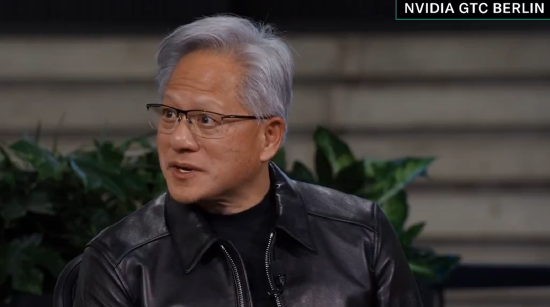
"If Europe wants to benefit from the AI dividend and truly build an AI ecosystem and AI economy, it must allow all terminal industries to use AI." Huang Renxun said at the NVIDIA Berlin GTC Conference on Wednesday. He mentioned the automobile, finance, and medical fields as examples: "All walks of life must transform into AI companies."
This press conference is part of Huang Renxun's European itinerary. He successively signed contracts with local companies and demonstrated the safety of AI to European political and business leaders. This visit coincides with a sensitive node in the industry: the share price of the AI sector has continued to be under pressure in the past two weeks, and the closely watched Philadelphia Semiconductor Index has ended its longest losing streak since 2008.
Huang Renxun and his senior management team held GTC conferences in many places around the world to showcase the cutting-edge progress of AI and at the same time expand business opportunities for the continuously expanding product matrix.
This new product includes DSX Pod, a container-type mini data center that helps enterprises quickly complete the deployment of computing hardware. According to Nvidia, servers, cables and supporting pipelines are pre-installed and debugged in a single container. After the customer arrives, he only needs to power on and interconnect with other units of the same model to put it into use.
This solution created by NVIDIA partners such as Dell has shortened the hardware deployment cycle from the original 6 months to 14 days.
This container product is suitable for small and medium-sized computing power deployments less than 1 gigawatt. Data center projects usually use power consumption as the core measurement indicator, and power supply is a key constraint on computing infrastructure.
NVIDIA said that many customers in Europe have adopted DSX AI data center solutions and the latest Vera Rubin processors, and Nscale, a data center developer invested by NVIDIA, is one of them.
Nvidia is the world's most valuable listed company, and supply chain capacity bottlenecks have long restricted its growth. To this end, IFI, Samsung Electro-Mechanics, and Xinxing Electronics will increase the supply of packaging substrates; Amkor plans to quadruple its chip packaging production capacity by the end of 2028; KYEC Electronics will expand its chip testing capacity. NVIDIA is also advancing in-package optical interconnection technology to speed up data communication between chips.
As the market becomes increasingly concerned about AI being out of human control, NVIDIA is developing supporting software to constrain AI agents (intelligent agents that schedule multiple large models and programs) to run within a defined range. NVIDIA provides a set of software and hardware reference solutions to prevent agents from accessing data without authorization and obtaining operating permissions that are not authorized by the designer.
In terms of embodied intelligence (the track where robots belong), Nvidia said it is making rapid progress. In the first half of this year, the revenue of this segment increased by up to 30% year-on-year, with a scale of approximately US$11 billion.
NVIDIA announced that it will cooperate with Siemens’ business units to implement advanced radiotherapy equipment based on AI. This type of equipment can monitor the patient's breathing and posture changes in real time and dynamically adjust the radiation dose.
Humanoid robots are the core carrier for AI to be implemented in the real world, but implementation is extremely difficult. A large number of companies are relying on NVIDIA chips and software to tackle key problems.
Nvidia said that the research and development of this track is highly complex and requires huge investment. Currently, only companies with strong funds can participate.
In order to lower the research and development threshold, NVIDIA has joined hands with Siling Robotics to create an open source robot development platform for scientific researchers to use; the supporting hardware of the platform is the Agile ONE SN humanoid robot equipped with Jetson Thor.
In the automotive field, Volvo uses NVIDIA chips to develop self-driving vehicles; Volkswagen's commercial vehicle business uses NVIDIA solutions; Bolt Technology OU relies on NVIDIA software and hardware to develop self-driving taxis.
Comments