
Abstract:
On November 17, local time, Isomorphic Labs, a Google-based AI pharmaceutical company, announced the completion of a US$5 billion (approximately RMB 35.5 billion) Series C financing, jointly led by Greenoaks and Sequoia Capital, with the participation of new investors such as a16z, and Google parent company Alphabet continues to invest heavily. Original investors such as Temasek, Thrive Capital, and MGX also participated.
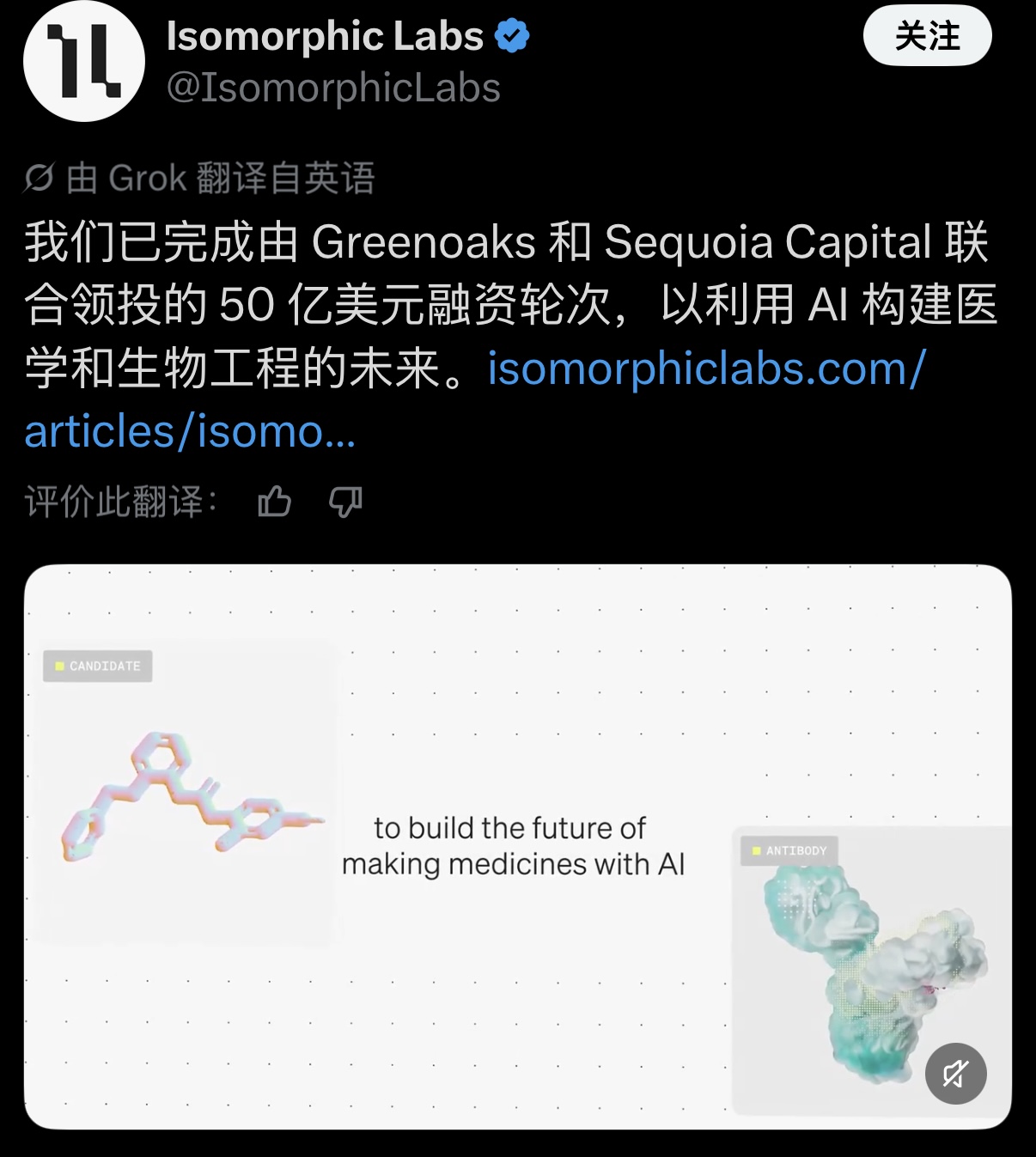
This round of financing sets a new record for the size of a single round of financing in the global AI pharmaceutical field. It is only half a year after Isomorphic Labs’ last round of financing. In May this year, the company just received US$2.1 billion in Series B financing, which at that time also set a single financing record in the global AI pharmaceutical industry. Coupled with the US$600 million in first external financing completed in March 2025, the cumulative publicly disclosed financing of this five-year-old company has reached US$7.7 billion.
Isomorphic Labs was founded in the UK by Demis Hassabis, Nobel Prize winner in chemistry and former co-founder of GoogleDeepMind. The company was spun off from GoogleDeepMind in 2021, with Hassabis serving as CEO. In August this year, after Hassabis stepped down as CEO of Google DeepMind, he focused on AGI's long-term strategy, the social impact of AI, and the AI pharmaceutical company Isomorphic Labs.
Why is capital willing to invest huge amounts of money in an AI company that has no drugs on the market yet? For Hassabis, this is the next major scientific breakthrough he is trying to achieve using AI after AlphaFold successfully predicted protein structures.
Traditional new drug research and development is a long and expensive process. Researchers need to find potentially effective candidate molecules from a large number of compounds, and then optimize their efficacy, safety and other characteristics through repeated experiments. Even when entering clinical trials, the risk of eventual failure remains high.
Isomorphic Labs hopes to greatly improve the efficiency of this process through AI. Its core technology is the proprietary drug design engine IsoDDE, which integrates a series of basic simulation AI models covering multiple therapeutic areas and different drug types. It can explore chemical space and help R&D teams design, screen and optimize molecules with ideal drug properties.
To put it simply, in the past, scientists needed to conduct a large number of experiments to find suitable molecules. Now AI can first explore a large number of possibilities in a computing environment and narrow the scope that requires actual verification.
In addition to simulation models, the company has also developed proprietary Agents (intelligent agents) for exploring complex biological systems and performing reasoning. Isomorphic Labs said that the combination of models and agents has promoted progress in multiple types of candidate drug pipelines. Currently, the company's internal oncology and immunology programs as well as collaborative projects have achieved preclinical results.
Isomorphic Labs stated that it has established R&D cooperation relationships with large pharmaceutical companies such as Novartis, Eli Lilly, and Johnson & Johnson to explore the application of AI in different drug research and development projects.
Hassabis mentioned in his blog that when he founded Isomorphic Labs, the team believed that biology could be understood and modeled at the most basic molecular level, and that AI could significantly accelerate this process. According to him, this round of financing will help the company further develop basic biological models, increase understanding of disease mechanisms, and promote the first batch of treatment projects into clinical trials to provide patients with a new generation of drugs.
However, in contrast to the huge financing, Isomorphic Labs is still a long way from launching a drug that can be marketed.
In January this year, Hassabis stated at the World Economic Forum in Davos that the company expected to launch the first batch of clinical trials before the end of 2026. This timetable has been delayed from the previously proposed target of the end of 2025.
This is also the core issue that the AI pharmaceutical industry has not yet solved. Although AI can accelerate the discovery of drug molecules, whether these molecules can become safe and effective drugs still requires lengthy verification. Drug research and development must not only prove that it can treat human diseases, but also ensure that it will not cause major side effects.
Some practitioners believe that although there are huge capital investments in the field of AI drug research and development, the risk of clinical trial failure is still high, "because huge amounts of money do not guarantee the launch of market-ready drugs." The improvement of model prediction ability does not mean that the entire clinical development cycle can be shortened by the same proportion.
Isomorphic Labs is undergoing another form of commercialization test in the AI industry. In the past few years, the market has been accustomed to evaluating the value of AI companies through model ranking, generation speed, and user scale. But in the pharmaceutical field, model performance is only the starting point, and clinical trial results are ultimately needed to prove the actual value of the technology.
But the attraction of this field is that, if successful, the value brought by AI will no longer just make machines smarter and work more efficiently, but it can also directly change the way diseases are treated and benefit mankind.
Compared to "half of the timeline spent billions of dollars to make chatbots more interesting," some netizens believe that 5 billion dollars spent on conquering diseases seems more worthy of attention. If the first real killer application of AI is not an application, but a drug, that is exactly the plot reversal he is looking forward to.
“Using AI to improve human health is one of the most important challenges facing our generation.” Partners of investor Sequoia Capital said they hope to help promote further scientific discoveries in the medical field.
Comments