
Abstract:
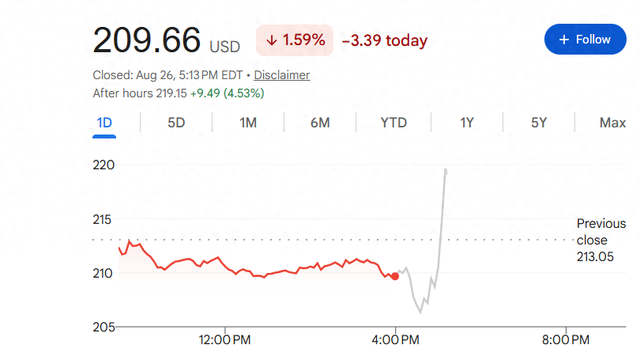
After the market closed on Wednesday Eastern Time, Nvidia announced its second quarter results for fiscal year 2027. The company's revenue and performance guidance were both higher than market expectations. Although the company's stock price once plunged during after-hours trading, stimulated by the optimistic statements of the company's executives, the company's stock price rose rapidly, rising 4.53% as of press time.
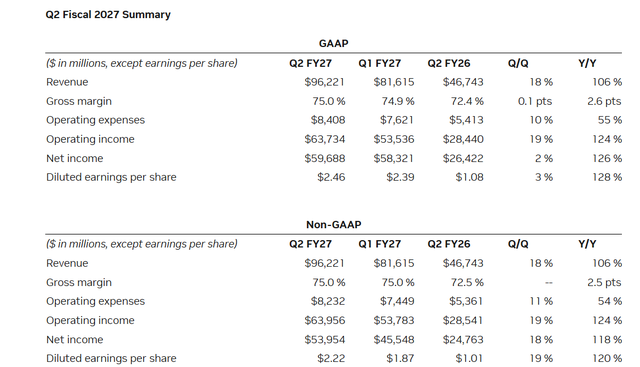
The financial report shows that in the second quarter as of July 26, Nvidia’s actual performance compared with analysts’ expectations according to LSEG statistics:
Adjusted earnings per share: $2.22, better than expected $2.10;
Revenue: US$96.22 billion, better than expected US$92.17 billion, an increase of 18% month-on-month and a year-on-year increase of 106%;
GAAP and non-GAAP gross profit margins for the quarter were both 75.0%.
Nvidia’s outlook for the third quarter of fiscal 2027 is as follows:
Estimated revenue is $108 billion (plus or minus 2%). Nvidia did not include data center computing revenue from China in its outlook.
GAAP and non-GAAP gross margin is expected to be 74.0%, plus or minus 50 basis points.
GAAP and non-GAAP operating expenses are expected to be approximately $9.2 billion and $9.0 billion, respectively.
NVIDIA expects the full-year GAAP and non-GAAP tax rates for fiscal 2027 to be between 16.0% and 18.0%, excluding any special items and significant changes in NVIDIA's tax environment.
"Artificial intelligence has reached an inflection point. AI is creating real value, and each set of tokens generated has the ability to produce and can bring benefits. Today, computing power itself is a source of income." NVIDIA founder and CEO Jensen Huang said,
"Market demand is still accelerating. At this time last year, only a few laboratories were promoting the construction of computing power; but now, new AI laboratories and startups are entering a golden period of development. Many cutting-edge institutions are simultaneously expanding production, the open source model ecosystem is booming, and physical AI is gradually implemented. The United States and other parts of the world are showing strong development momentum. AI infrastructure construction is advancing at full speed, and Vera Rubin, which is now in full production, is built for this era."
Strong growth prospects for fiscal year 2028
Nearly four years have passed since OpenAI launched ChatGPT, and NVIDIA still maintains high growth. In the second quarter, not only revenue doubled year-on-year, but quarterly net profit also doubled, growing from US$24.76 billion last year to US$53.95 billion.
However, after three consecutive years of epic gains, investor enthusiasm for the stock has clearly cooled this year.
As of Wednesday's close, Nvidia's gains for the year were only 13%, only slightly outperforming the Nasdaq index. After the financial report was released, Nvidia's stock price also experienced a small dive after the market closed, but then rose rapidly.
What boosted the company's stock price performance was the optimistic expectations revealed by company executives at the financial report meeting.
In the earnings call, Nvidia's chief financial officer said that the company's revenue in fiscal 2028 will grow by about 70%, which is much higher than the market's previous estimate of 45%. NVIDIA's CFO expects supply to remain a bottleneck restricting growth until at least fiscal 2028.
Nvidia CEO Jensen Huang said that if there were no supply constraints, the company's performance outlook for fiscal year 2028 would be "much higher."
Although the company's business is still booming, competitive pressure from competitors such as AMD and Google is emerging. At the same time, the global shortage of memory chips has not eased, which has also caused Nvidia's storage procurement costs to rise significantly. NVIDIA's CFO also admitted at the financial report that NVIDIA is facing extremely high memory prices.
Comments