Sandisk is developing a new architecture for high-capacity SSDs called Stargate. Sandisk CEO David Goeckeler calls it a "dynamite" project that will significantly advance enterprise storage, especially with the company'sBiCS 8 QLC NANDWhen used with flash memory. He also added that the arrival of Stargate is just around the corner.
Sandisk was once a subsidiary of Western Digital but was spun off from its parent company earlier this year after several years. David Goeckeler, the former head of Western Digital and now CEO of Sandisk, has some ambitious projects in the works.
Goeckeler discussed Stargate's potential during a recent investor Q&A session. ComputerBase notes that the project involves a new controller architecture and ASIC design, but technical details are still unclear. However, Sandisk's current product roadmap sheds light on the role Stargate may play.

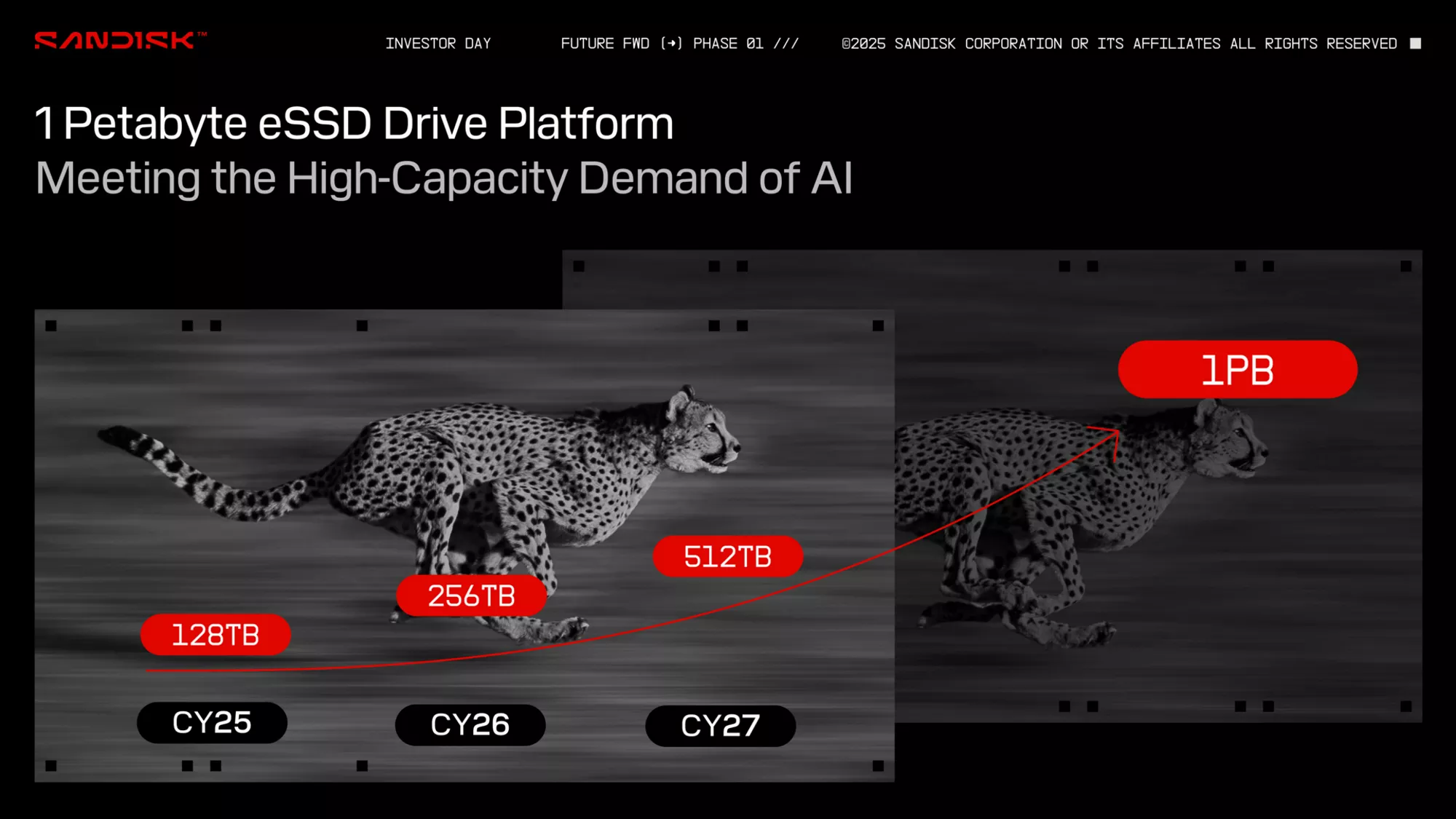
The roadmap revealed by Sandisk at its investor day includes the release of a 128TB SSD this year, followed by a 256TB model in 2026 and a 512TB version in 2027. The ultimate goal is to launch 1PB storage units to meet the high-capacity needs of artificial intelligence enterprises and large technology companies, which are continuing to shift their operations to chatbots. Hard drive manufacturers see the same opportunity, with Seagate planning to launch a 100TB hard drive in 2030.
Stargate will support a new enterprise storage platform called "Ultra QLC" (also known as DC SN670), with 64TB and 128TB models available in the third quarter. Customers can expect significant performance improvements. Random reads will be 68% faster, random writes will be 55% faster, and sequential reads and writes will be 7% and 27% faster respectively.

The new drive uses the PCIe Gen5 bus, but Stargate may also take advantage of the newer PCIe 6.0 standard. Thanks to QLC memory, each storage unit will have a single-chip capacity of 2TB. Tome's Hardware notes that Stargate can scale to 64 chips per channel, and a 512TB drive will use 32 channels.
Typical client SSDs offer up to eight channels, so complex storage management technology like Stargate won't appear in consumer SSDs anytime soon. The technology will be targeted at the enterprise market, which will remain Sandisk's focus area.