The total box office of the mainland film market in 2024 was 42.502 billion (including service fees), a decrease of 22.6% year-on-year; the number of moviegoers was 1.01 billion, a decrease of 22.3% year-on-year; and the number of screenings was 140 million, a year-on-year increase of 8.4%. There were 497 new films released, 11 fewer than in 2023. Among them, there are 72 films with a box office of over 100 million, an increase of 2 compared with 2023, but the number of films with a box office of more than 500 million is only 16, a decrease of 13 films compared with 2023.
As of April 30, A-share film and television companies have released their 2024 annual reports. The total revenue of the five theater chain companies of Wanda Film, Hengdian Film and Television, Jinyi Film and Television, Happy Blue Ocean, and Shanghai Film was 16.69 billion yuan, a year-on-year decrease of -17.5%; the net loss attributable to the parent company was 1.229 billion yuan, while the profit in the same period last year was 1.196 billion yuan, a year-on-year decrease of 202.74%.
After a brief recovery in 2023, the film and television industry has once again fallen into a cold winter, and none of the five theater companies have been spared. Except for Shanghai Film, which remained profitable, the other four companies all suffered losses. Jinyi Film and Television, Wanda Film and Hengdian Film and Television turned from profit to loss, and Happy Blue Ocean extended its losses. Among them, Happy Blue Ocean has been stuck in a quagmire of continuous losses since 2020. In 2024, its operating income and net profit will lead the decline, becoming the biggest loser in this film and television winter.
Wanda Film’s profit “polar reversal”, Happy Blue Ocean’s revenue significantly lags behind
In 2024, the overall box office and number of moviegoers in the Chinese film market will decline. Affected by this, the revenue and profits of theater companies will both decline.
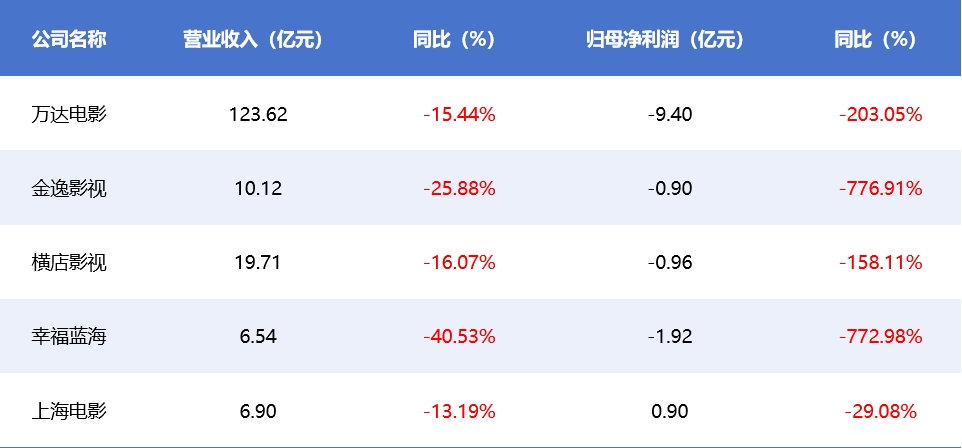
Wanda Film led the way with revenue of 12.362 billion yuan, contributing approximately 74.1% to the total revenue of theater companies, which was 6.27 times the revenue of second place Hengdian Film and Television in the same period. The largest year-on-year decrease was the bottom-ranked Xingfu Blue Ocean, with total revenue decreasing 40.53% from 2023 to 654 million yuan. Although Shanghai Film's revenue has the smallest year-on-year decrease, its scale ranks second to last among the five companies.
Wanda Film is also the company with the most serious losses, with a net loss of 940 million yuan for the year, a significant decrease of 203.05% year-on-year, and a "bipolar reversal" from the previous year's profit of 912 million yuan. Coincidentally, Hengdian Film and Television and Jinyi Film and Television both turned from profits to losses, with losses of 96 million yuan and 90 million yuan respectively in 2024. Happy Blue Ocean is the only company that continues to lose money, with losses significantly expanding by 772.98% compared with 2023. Although Shanghai Films remained profitable, its net profit decreased by 29.08% year-on-year, a decline that exceeded revenue.
For theater companies, movie screenings, sales and advertising services are the "troika" that drive revenue growth.
In 2024, Wanda Film's viewing revenue was 6.687 billion yuan, a year-on-year decrease of 20.82%, accounting for 54.09% of total revenue, a decrease of 3.67 percentage points from 2023. Excluding Wanda Film, in order of revenue decline from high to low, they are Happy Blue Ocean, Jinyi Film and Television, Hengdian Film and Television, and Shanghai Film, with 28.94%, 27.65%, 19.49%, and 17.33% respectively. The total theatrical distribution and screening revenue of the above four companies is 3.546 billion yuan, which is approximately 53.03% of Wanda Film’s similar revenue.
In terms of non-ticket business, Wanda’s film sales and advertising services revenue were 1.545 billion yuan and 1.278 billion yuan respectively, a year-on-year decrease of 20.53% and 3.46%, and together contributed about 23% of total revenue. The segmented income of the remaining four theater chain companies is in the tens of millions, which has limited impact on performance. Among them, only Hengdian Film and Television did not disclose the products and advertising services in detail.
According to Article 12 of the Shanghai Stock Exchange's "Industry Information Disclosure Guidelines for Listed Companies No. 26 - Film and Television", "Listed companies engaged in selling business and advertising business related to theater screenings shall disclose the relevant business operation model, operating income, single-person selling revenue contribution, and single-person advertising revenue contribution. If there are significant changes from the previous year, the reasons shall be explained. If the total revenue from selling business and advertising business related to theater screenings accounts for less than 10% of the total operating income for the current period, they are exempt from disclosing the above information."
This means that Hengdian Film and Television’s non-ticket business revenue accounts for less than 10% of total revenue, while Wanda Film, Shanghai Film, Jinyi Film and Television, and Happy Blue Ocean’s non-ticket business account for 22.84%, 14.88%, 13.54%, and 9.45% respectively.
Happy Blue Ocean’s gross profit margin and net profit margin are both at the bottom
In terms of gross profit margin, Jinyi Film and Television is the only theater company with a positive gross profit margin in its movie screening business, but it is still only 2.78%, which is far lower than its comprehensive gross profit margin of 14.19%. The gross profit margins of Hengdian Film and Television, Shanghai Film, Wanda Film, and Happy Blue Ocean Film Screening Business are all negative, which are -1.10%, -2.66%, -8.85%, and -17.62% respectively.
Thanks to the higher gross profit margins of non-ticket business, the comprehensive gross profit margins of the five theater companies are all positive, but the differences are still significant. In 2024, the comprehensive gross profit margin of Shanghai Film and Wanda Film will exceed 20%, ranking first and second respectively; Jinyi Film and Television is second, with a comprehensive gross profit margin of 14.19%; Hengdian Film and Television and Happy Blue Ocean Industry are at the bottom, with 3.06% and 3.21% respectively, both in single digits.
It is obvious that there is a clear positive correlation between the profitability of theater chain companies and the proportion of their non-ticket business. The non-ticket business of Hengdian Film and Television and Xingfu Blue Ocean accounted for less than 10%. Affected by this, the gross profit margins of the two companies fell significantly behind.
In terms of net interest rate, only Shanghai Film’s net interest rate is positive, while the other four companies’ net interest rate is negative. Among them, Happy Blue Ocean’s net interest rate is as low as -29.61%, ranking at the bottom.
Interestingly, the gross profit margin of Happy Blue Ocean is almost the same as that of Hengdian Film and Television, but the net profit margin is about 25 percentage points different. Specifically, it is mainly affected by period expenses and impairment factors.
On the one hand, Happy Blue Ocean confirmed a total of 52 million yuan in asset impairment losses and credit impairment losses, a significant year-on-year increase of 177.45%, second only to Wanda Film, but the latter diluted the impact of impairment factors on net interest rates due to its larger revenue scale. During the same period, Hengdian Film and Television's asset impairment losses were only 760,000 yuan, while credit impairment losses were reversed to 4.38 million yuan.
On the other hand, Happy Blue Ocean's period expense ratio was as high as 26.77%, a year-on-year increase of about 10 percentage points, the fastest growing among the five theater companies. Hengdian Film and Television was the complete opposite, with an expense ratio of only 8.96% during the period, a year-on-year increase of less than 1 percentage point.