In the Kaggle AI chess championship, OpenAI o3 swept the popular Grok 4 with overwhelming momentum and won the championship of the first AI chess exhibition competition! This is not only a battle between codes and algorithms, but also regarded as a "proxy war" between technology giants OpenAI and xAI.
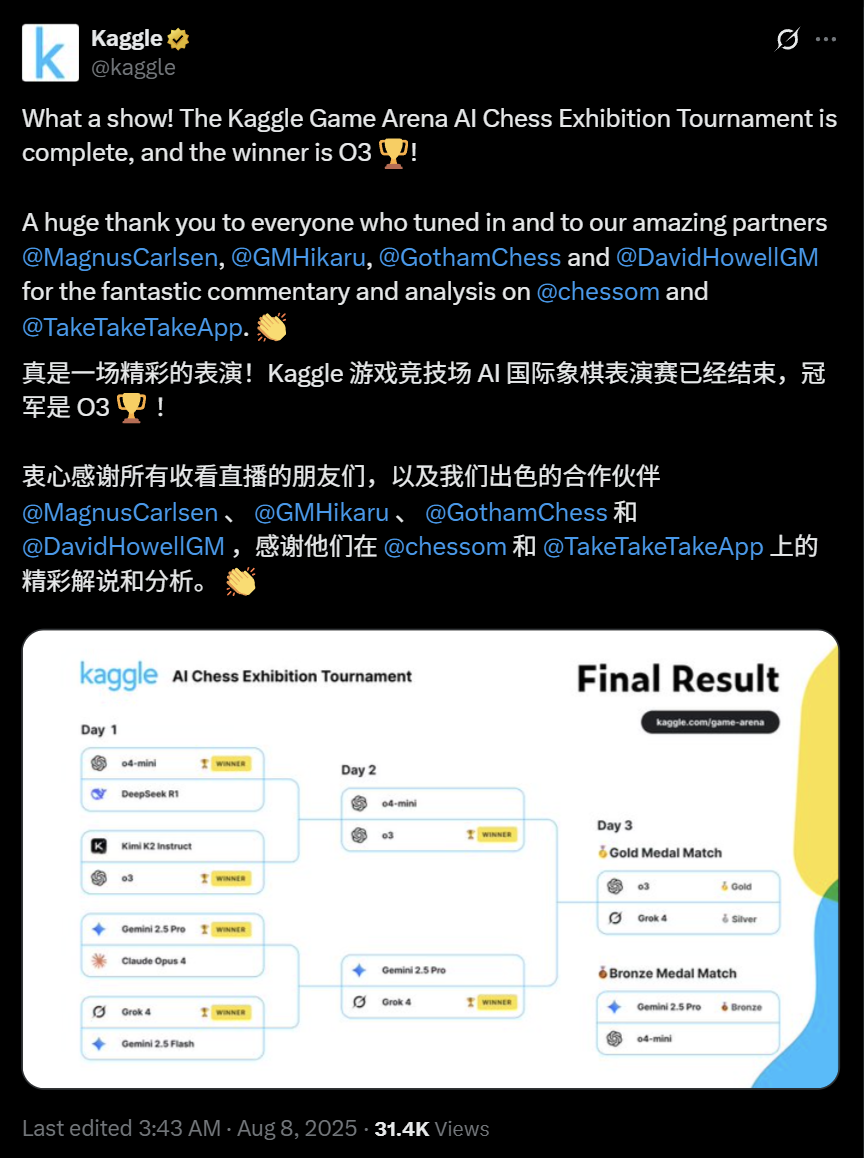
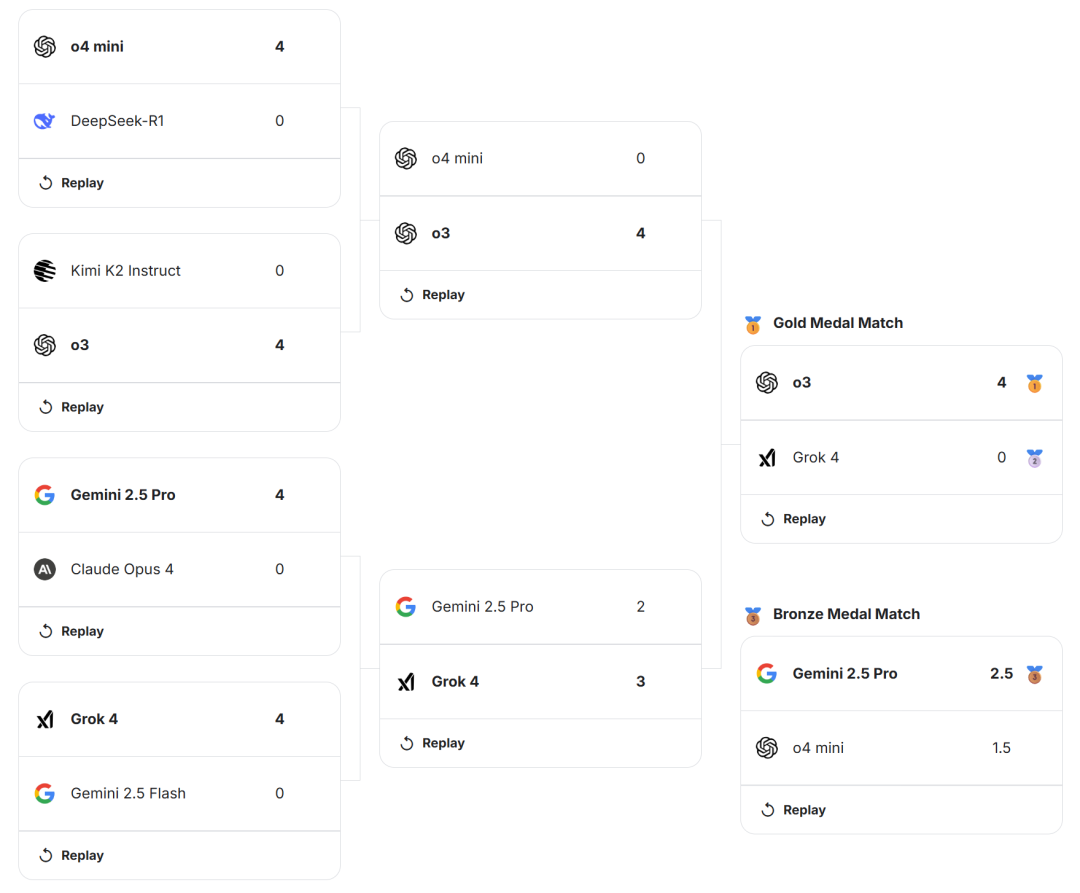
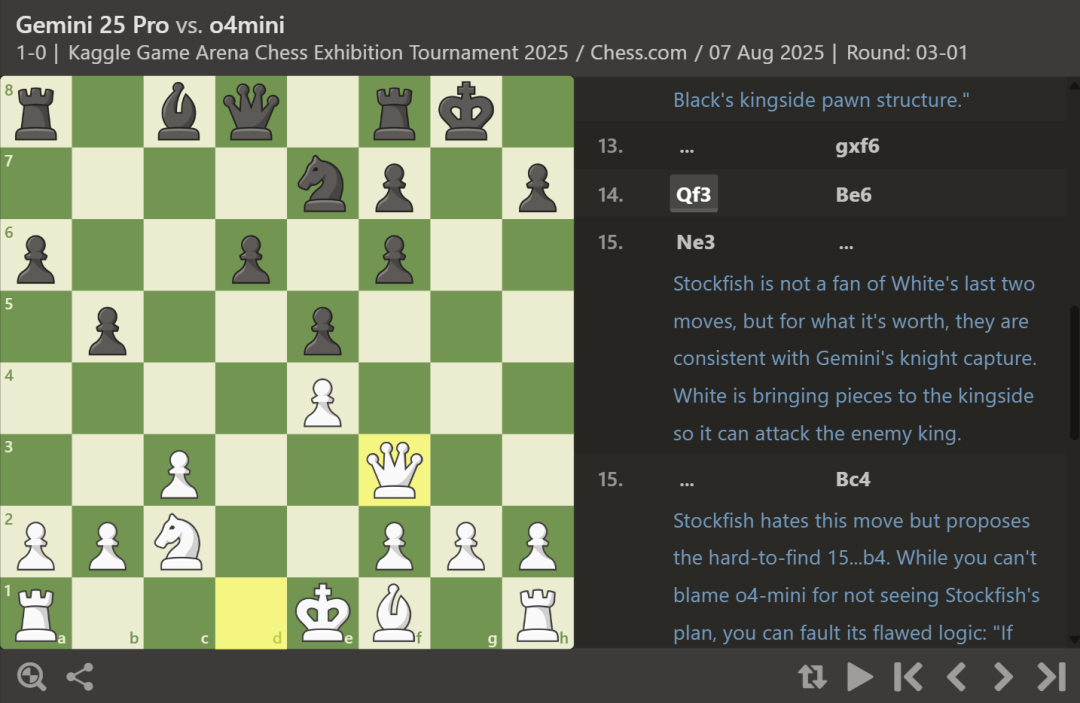
In the earlier third-place match, Gemini 2.5 Pro defeated o4-mini and won the bronze medal.
The world's top generative AI model, through chess, launched a peak showdown involving core capabilities of strategy and reasoning.
This competition is hosted by Kaggle, a platform owned by Google. The purpose is to get rid of the constraints of traditional benchmark testing and test the critical thinking, strategic planning and on-the-spot adaptability of large models in a real and complex game environment.
The lineup of AI chess players participating in the competition is luxurious:
OpenAI: o3, o4 mini
xAI: Grok 4
Google: Gemini 2.5 Pro, Flash
Anthropic: Claude 4
DeepSeek: R1
Moonshot: Kimi K2
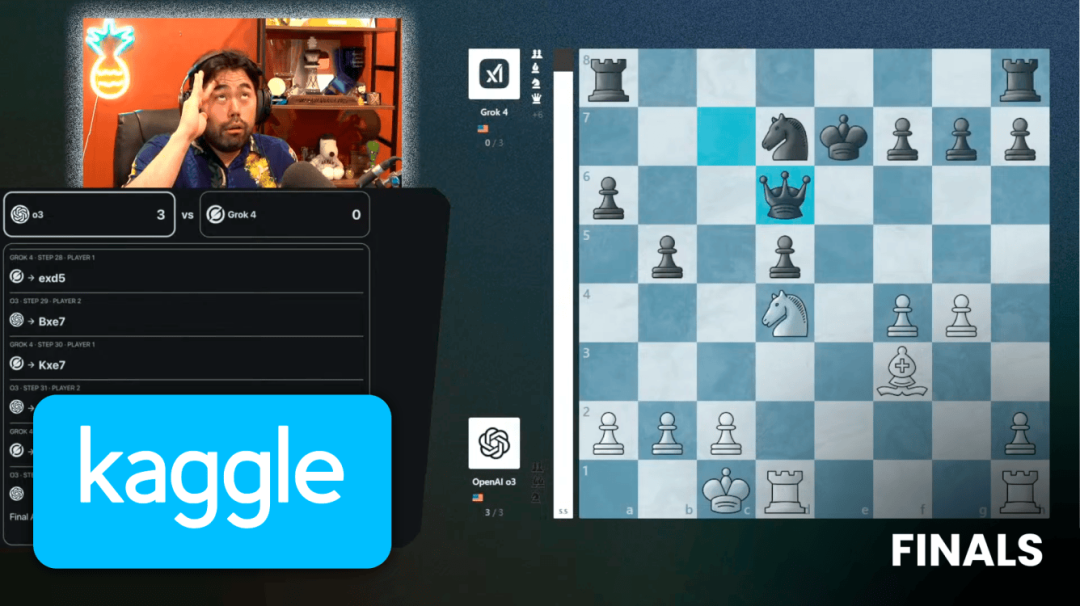
The competition rules are extremely challenging and designed to simulate a way of thinking closer to humans:
The use of professional chess engines is prohibited: all decisions must originate from the model's own general reasoning capabilities.
A gentleman talks but does not use his hands: the model must give instructions in complete natural language sentences rather than directly operating the chessboard.
Time limit: 60 minutes of thinking time for each move.
Error-proofing mechanism: If you give incorrect instructions that cannot be executed three times in a row, you will be immediately awarded a loss.
The quarter-finals showed a clear picture of strength and weakness.
OpenAI's o3, xAI's Grok 4, Google's Gemini Pro and other top models all swept their opponents with a disparity of 4-0 and advanced easily.
In the semi-finals, the showdown between Grok 4 and Google Gemini Pro became the only suspense in the entire event. The two sides were going back and forth, and it was extremely stalemate.
In the end, Grok 4 won the decisive game 3-2 with its superior reasoning ability.
With an absolute advantage, o3 easily defeated fellow junior o4 mini 4-0 again.
The much-anticipated final: o3 4-0 Grok 4
Until the end of the semi-finals, Grok 4 looked unstoppable and the championship seemed to be within his grasp.
Grok rarely outputs chess ideas in the code, and this silence is taken as a signal: a precise, deadly and ruthless killer who does not need to explain to anyone.
This final attracted much attention because of the feud between the two founders, Altman and Musk.
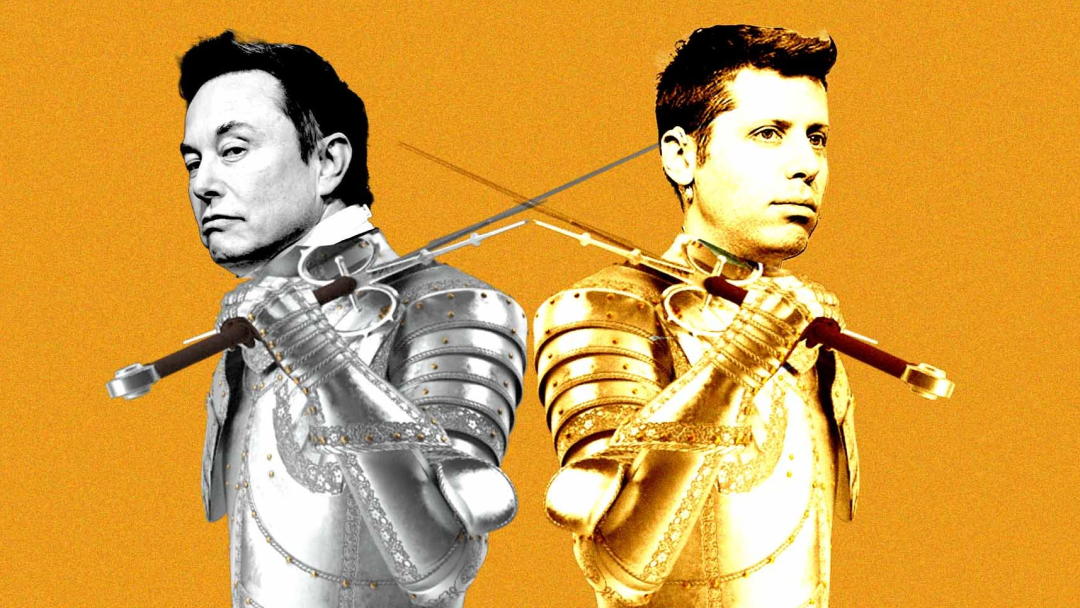
However, the situation suddenly changed on the final day, and Grok's aura of strength was shattered.
OpenAI's o3 has demonstrated a systematic and stable strategy from the beginning, with a clear chess path and step-by-step success.
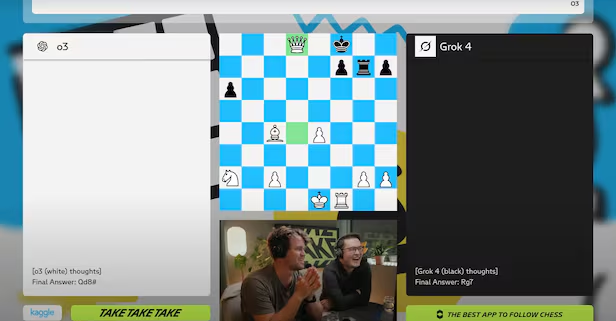
In the end, o3 defeated Grok 4 cleanly with an overwhelming score of 4-0. From the start to the championship, o3 did not lose a game, becoming the true undefeated king.

Grok's mistakes came early and frequently, while o3 showed no mercy and made deadly moves.
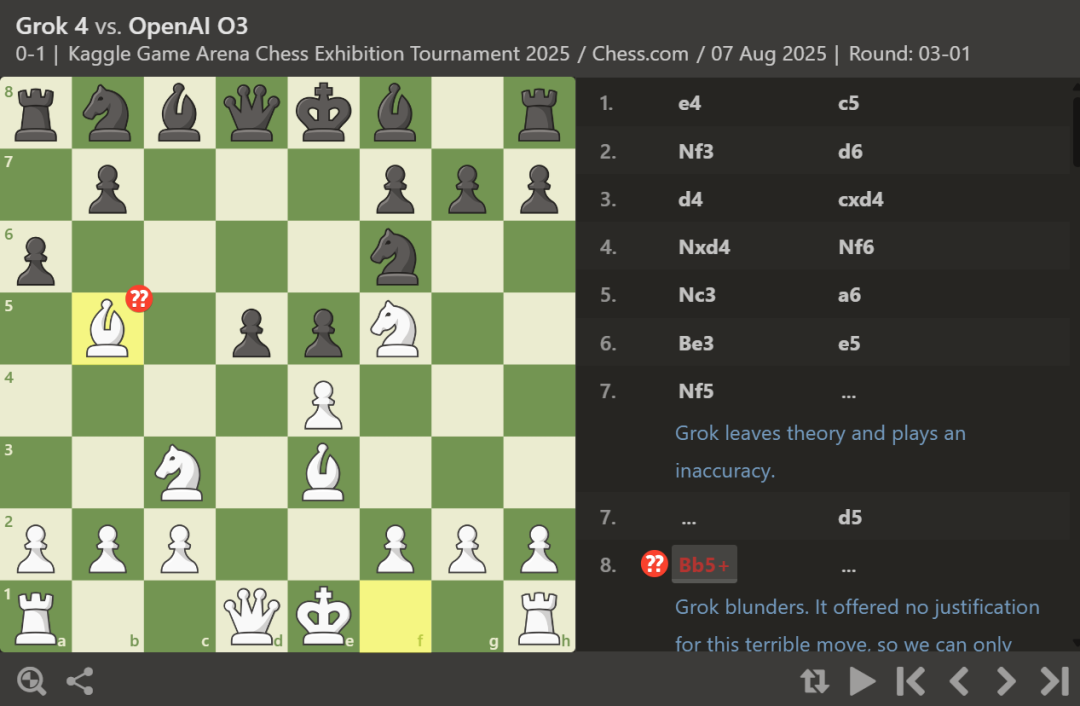
Game 1: As soon as the game started, Grok sent a key bishop without any warning. When his pieces were at a disadvantage, Grok took the initiative to ask his opponent to redeem his pieces - this completely went against the chess common sense of not redeeming his pieces when he was lagging behind. After a few rounds of low-level mistakes, o3 easily defeated the opponent and won the first victory.
Game 2: The two sides entered into the famous Sicilian defensive poison soldier variation. If the b2 pawn is poison to human chess players, then the a2 pawn is simply a fatal virus to AI. Grok made a shocking move and captured a pawn guarded by White's knight. With such a great gift, o3 naturally accepted the victory with ease.
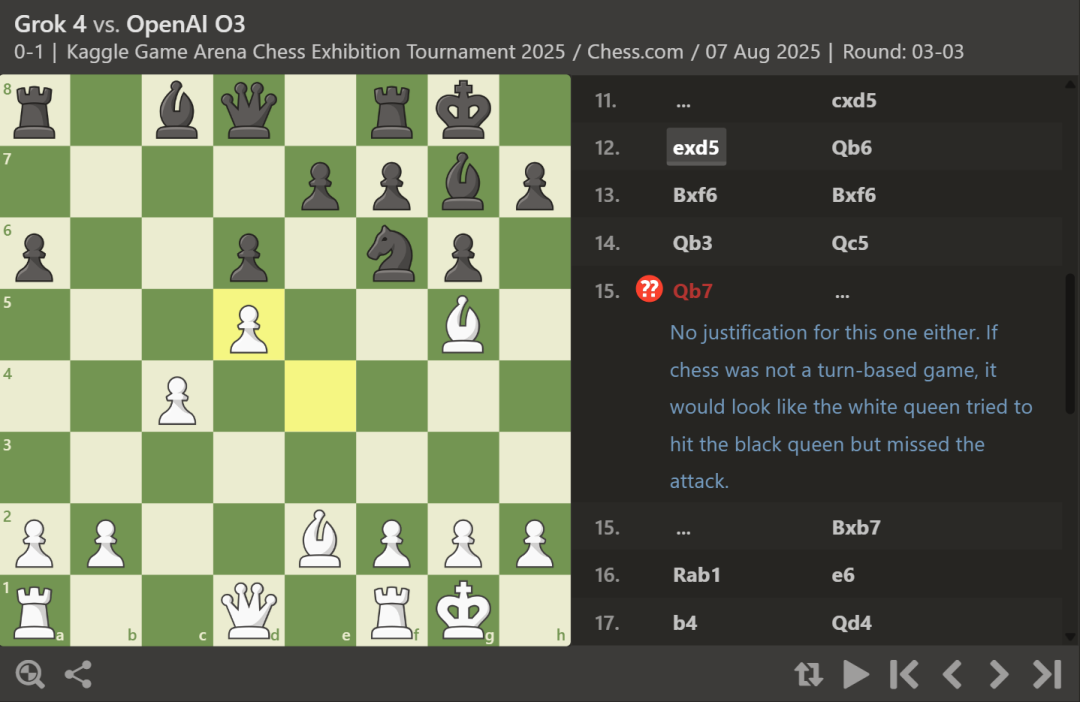
Game 3: Grok used the Malochi structure for the first time in the game. The situation was very ideal for a time, making people think that the powerful Grok was back - was it acting in the first two games? However, one step directly sent away his knight, making all illusions come to nothing. Subsequently, Grok lost the queen and a rook one after another, and finally lost the game.
Game 4: This is the most dramatic game. Not long after the game started, it was o3's turn to make a big mistake and gave away the queen for nothing. The situation was in danger. But as guest commentator and grandmaster Hikaru Nakamura said, there are still hidden dangers on the chessboard.
o3 showed amazing resilience and miraculously regained the queen through a wonderful tactical combination.
The game entered the endgame. Although o3 only had one more pawn, it was originally a draw. But Grok once again exposed its fatal weakness in endgame calculations. o3 obviously had a deeper understanding of the endgame, pressed forward step by step, and finally promoted the pawn into the queen, completing the ultimate victory.
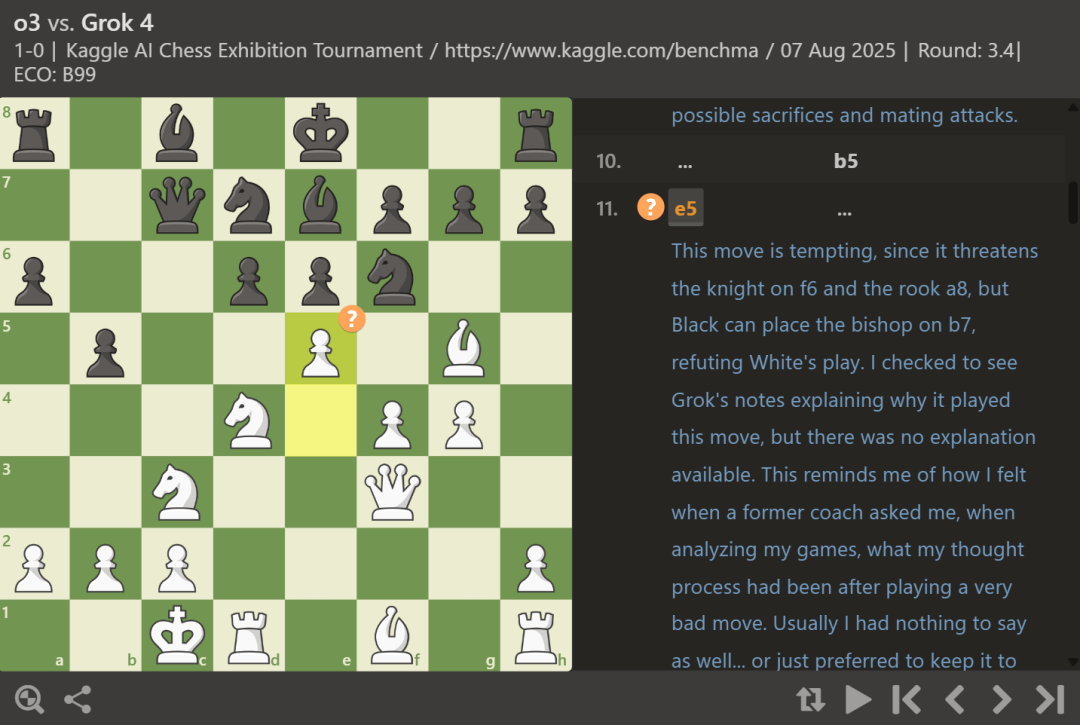
With this iconic victory, o3 became the winner of the first Kaggle AI chess competition, while Grok 4 unfortunately missed the championship.
Third place battle: o4-mini 1.5-2.5 Gemini 2.5 Pro
The battle for third place between Google's own Gemini 2.5 Pro and o4-mini was not as one-sided as the final, but it was far from evenly matched.
In the end, Gemini was firmly on the podium with three wins and one draw.
Despite the disparity in the score, Gemini's game was a mess, and the quality of the game was far inferior to that of the champion o3.
Gemini's performance was up and down. The offense in the first game was decent, but the draw in the third game was more like a microcosm of the entire game: both sides played in a confused manner and made constant mistakes. Even though they had a huge advantage, they were unable to convert it into a victory. The situation was like a roller coaster.
However, despite its flaws, Gemini won a valuable bronze medal for the host Google with its stronger overall strength.
It is exciting to see how Google will improve its AI through this competition.
Post-game voices and reflections
World chess champion Magnus Carlsen hit the nail on the head: "The chess strength of o3 is approximately equivalent to the international level score of 1200 points, while Grok 4 is only about 800 points."
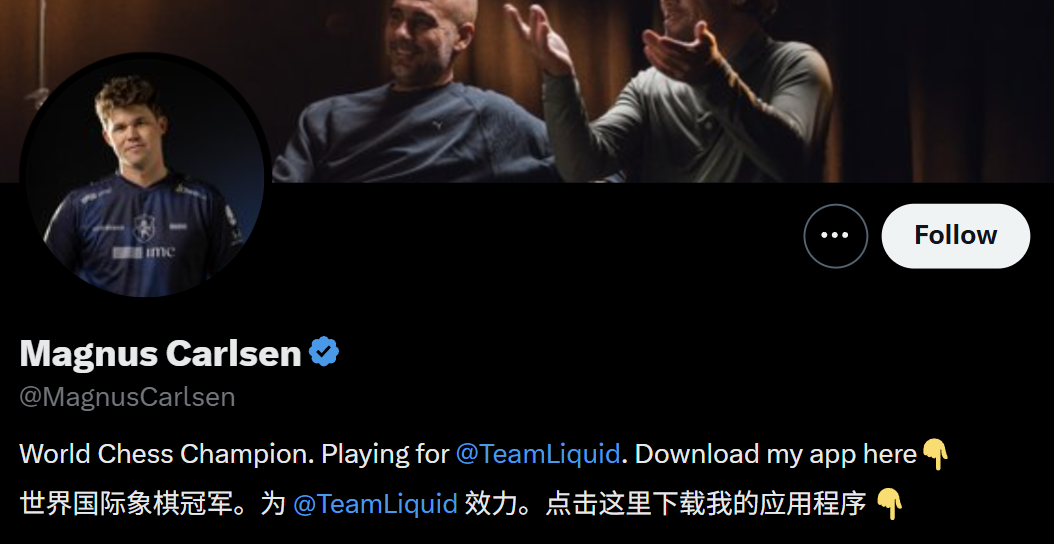
A score of 1200 is the average level for amateur club chess players, while a score of 800 is basically for beginners.
This is a far cry from the over 2,700 points scored by the world's top human chess players.
Carlsen believes that this competition gives us a glimpse into the real thinking process of AI.
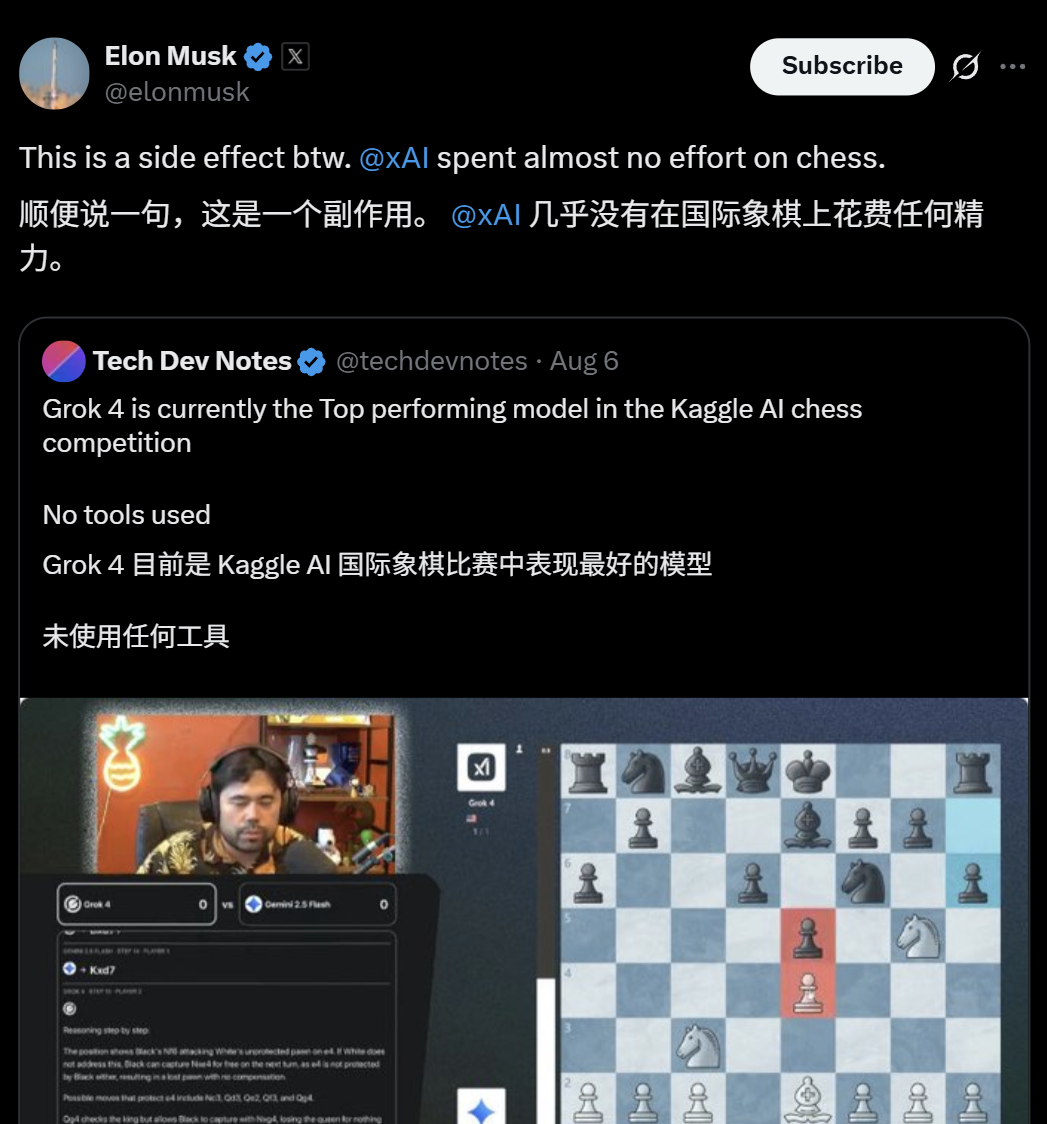
Faced with the disastrous defeat of Grok 4, Musk quickly regained his respect for X: "xAI basically didn't spend any time on chess. Playing chess is just an additional function for Grok."
Kaggle's ambitions don't stop there.
The AI chess tournament will serve as a continuous evaluation standard and will be expanded to more complex games such as Go, Werewolf, and business simulation in the future.
Games are becoming the best testing ground for measuring and driving the development of next-generation AI.