In a new study, NASA's James Webb Space Telescope (JWST) has discovered 300 unusually bright mysterious objects that may be located in the early universe, a discovery that poses a potential challenge to existing theories of galaxy formation.
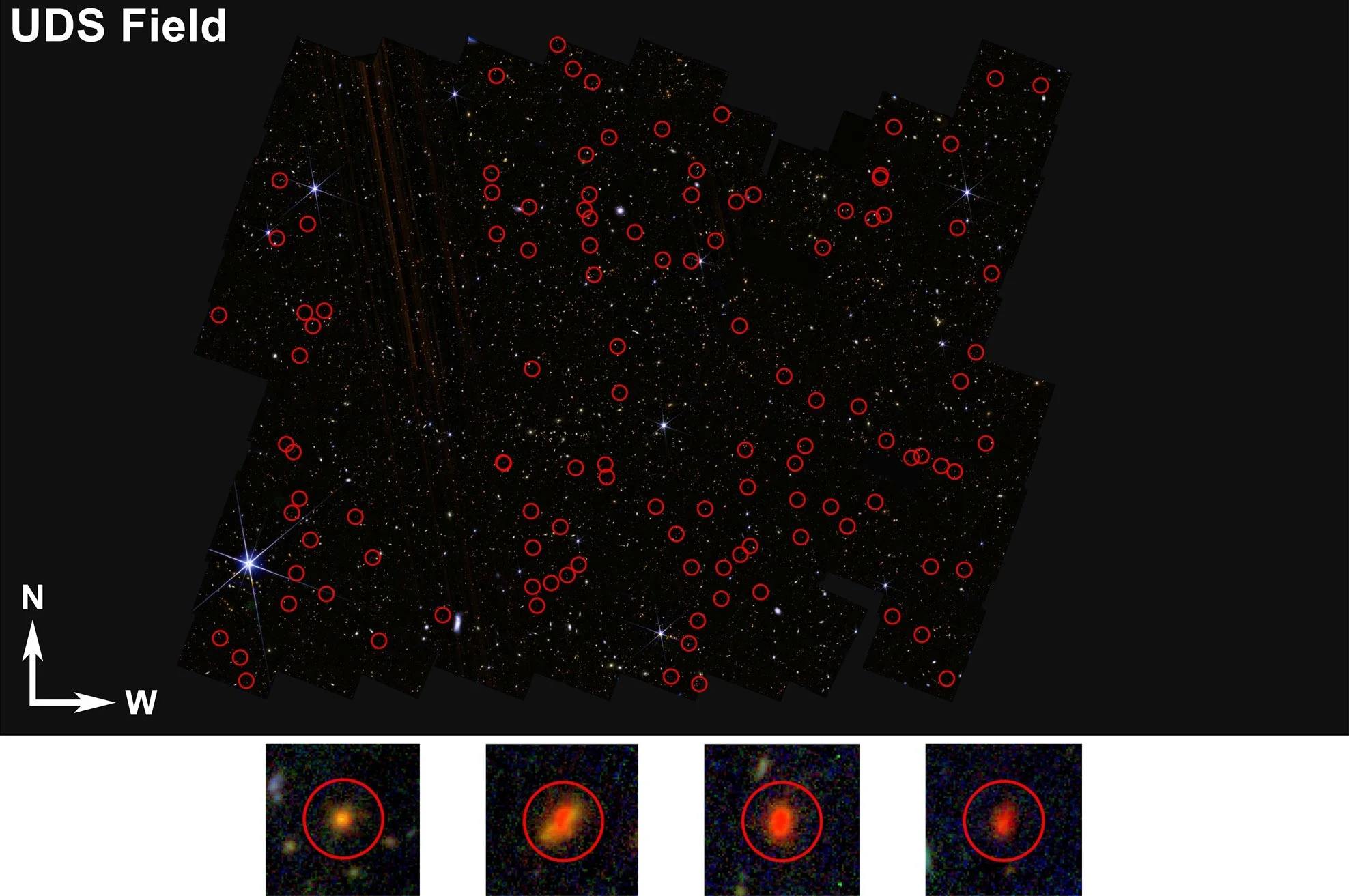
The researchers identified these candidate galaxies by analyzing infrared images taken by the Near Infrared Camera (NIRCam) and the Mid-Infrared Instrument (MIRI) on board the Webb telescope. Due to the expansion of the universe, the wavelength of light from distant celestial bodies is stretched during propagation, which is a "red shift" phenomenon, causing visible light to move to the infrared band. Therefore, detecting infrared light has become key to studying early galaxies.
The research team used the "dropout technique" to screen high-redshift candidates. This method identifies celestial bodies that are visible in longer wavelength bands but "disappear" in shorter wavelength bands to determine their degree of redshift and then infer their distance and age.
In the absence of complete spectral data, the team used spectral energy distribution fitting methods to estimate parameters such as redshift values, ages, and masses of these objects. Although such bright objects were often mistaken for nearby objects or other phenomena in the past, the results of this study indicate that they probably do come from the early universe.
If subsequent observations confirm that some of these objects belong to early galaxies, it will force scientists to revise their current theories about the origin and evolution of galaxies. Currently, the team has confirmed that one of the objects is an early galaxy through spectroscopic methods, but more observational data is still needed to draw a firm conclusion. Spectral analysis can decompose the light of celestial objects and accurately determine the red shift, composition and physical properties through its characteristic spectral lines. It is a recognized authoritative detection method in this field.