For the first time, scientists at the University of California, Davis, have identified a hidden mass that is about one million times the mass of the sun by observing the faint distortion of light caused by the gravity of distant objects. This discovery may be a dense clump of dark matter, or an extremely tiny, inactive galaxy. The research results not only support existing dark matter theories, but also prove that modern technology can detect extremely small and invisible structures in the universe.
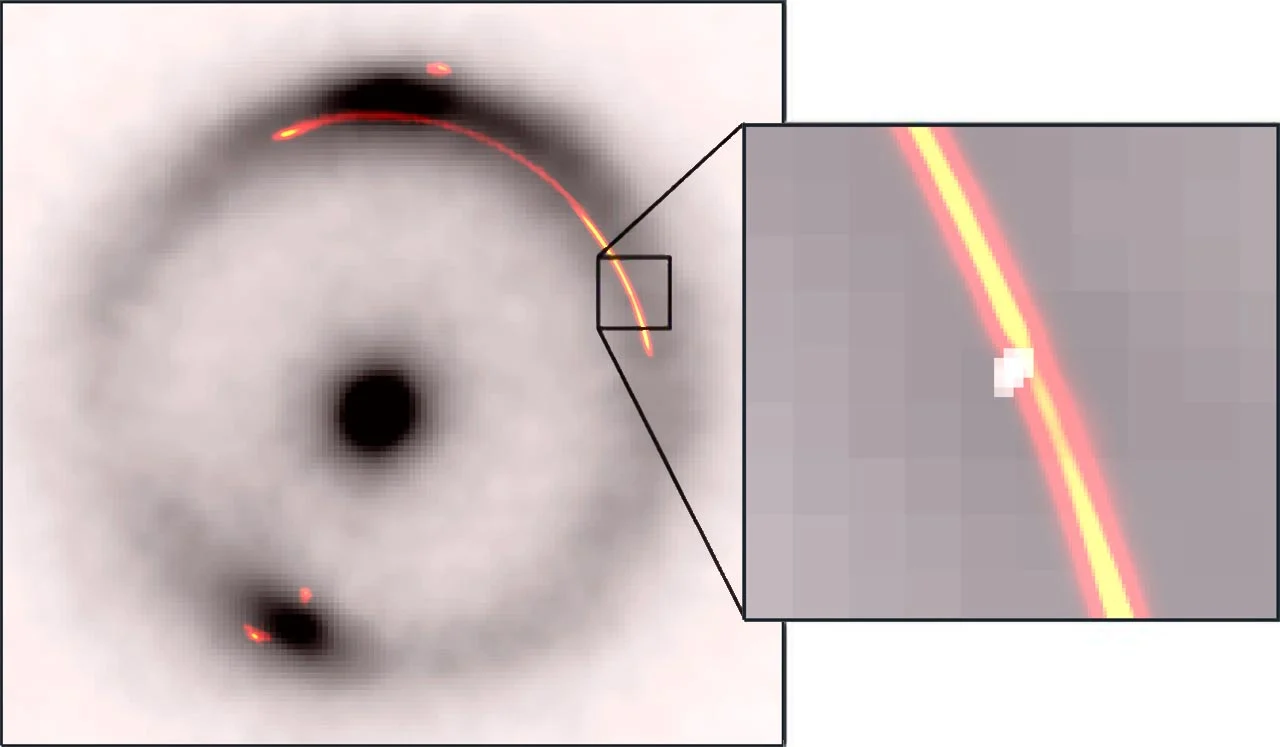
Using a global network of telescopes, astronomers have identified the smallest dark object known to date. Discovering more of these hidden masses and revealing their nature may help scientists further rule out some theories of dark matter, which is thought to make up about a quarter of the total matter in the universe. This result was published in "Nature Astronomy" and "Monthly Notices of the Royal Astronomical Society" on October 9.
The celestial body does not emit light and has no measurable radiation; scientists only relied on observing the "gravitational lensing" effect caused by its gravity on nearby light to analyze its material content. This miniature celestial body even appears as a weak "clip" in the light image of the celestial body distorted by a large gravitational lens, like a small flaw in a distorting mirror.
"It's remarkable to be able to observe such a low-mass object at such a distant location," said Chris Fassnacht, a professor in the Department of Physics and Astronomy at the University of California, Davis and a co-author of the study. "Discovering such low-mass objects is critical to studying the nature of dark matter."
The mass of this newly discovered object is about one million times that of the sun, and its true identity has not yet been determined: it may be the smallest known dark matter clump (about one-hundredth of the previous one), or it may be a compact but inactive dwarf galaxy. Although only perceived through gravitational manifestations, dark matter is thought to profoundly affect the structural distribution of visible matter in the universe such as galaxies and stars. One of the core scientific questions is whether dark matter can exist in a "star-free clump" manner; if it can be proven or denied, it will help revise the current theory about dark matter.
The scientific research team used multiple radio telescopes, including the Green Bank Telescope (GBT) in West Virginia, the Very Long Baseline Array (VLBA) in Hawaii, and the European Very Long Baseline Interference Network (EVN) covering Europe, Asia, South Africa, and Puerto Rico, to transform the earth into a super telescope to capture the subtle gravitational lensing signals caused by tiny dark celestial bodies.
The object's mass is hundreds of times lower than that of similar detection objects, demonstrating the technology's potential to discover more such objects in the future. "Based on the sensitivity of the data, we expected to find at least one dark object, so this discovery is consistent with the current 'cold dark matter theory', which underpins most of the galaxy formation mechanisms," said lead author Devon Powell of the Max Planck Institute for Astrophysics (MPA) in Germany. "Now we have to see whether more such dark objects can be found, and whether their numbers are still consistent with theoretical models."
The scientific research team is continuing to analyze the data to further determine the specific nature of the dark object and search for similar dark object samples in other sky areas.
Compiled from /ScitechDaily