New data from the European Space Agency's (ESA) Gaia space telescope reveal a huge wave of fluctuations spreading outward from the center of the Milky Way. This discovery shows that in addition to the known rotation and disk distortion of the Milky Way, there are large-scale ripples in the Milky Way that resemble the ripples of a pebble in water.
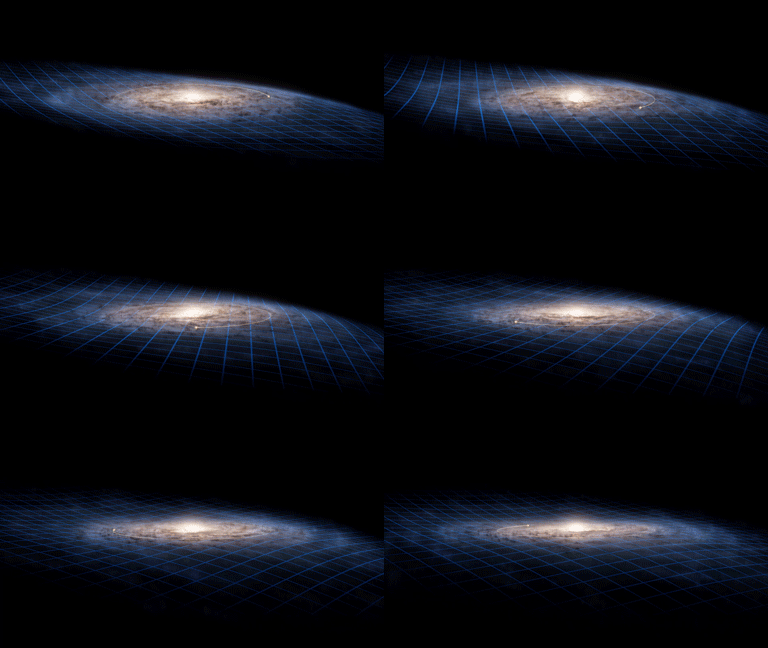
Over the past century or so, scientists have determined that the Milky Way's stars rotate around its center. The Gaia mission has previously measured the speed and motion of these stars. Since the 1950s, the Milky Way's disk has been shown to be distorted. In 2020, Gaia also discovered that the disk would swing over time like a top. Now, a new wave of data clearly shows that a wave is driving the motions of stars in the Milky Way within tens of thousands of light-years from the sun. Like ripples caused by a pebble, this galactic ripple spans a large area of the Milky Way's outer disk.
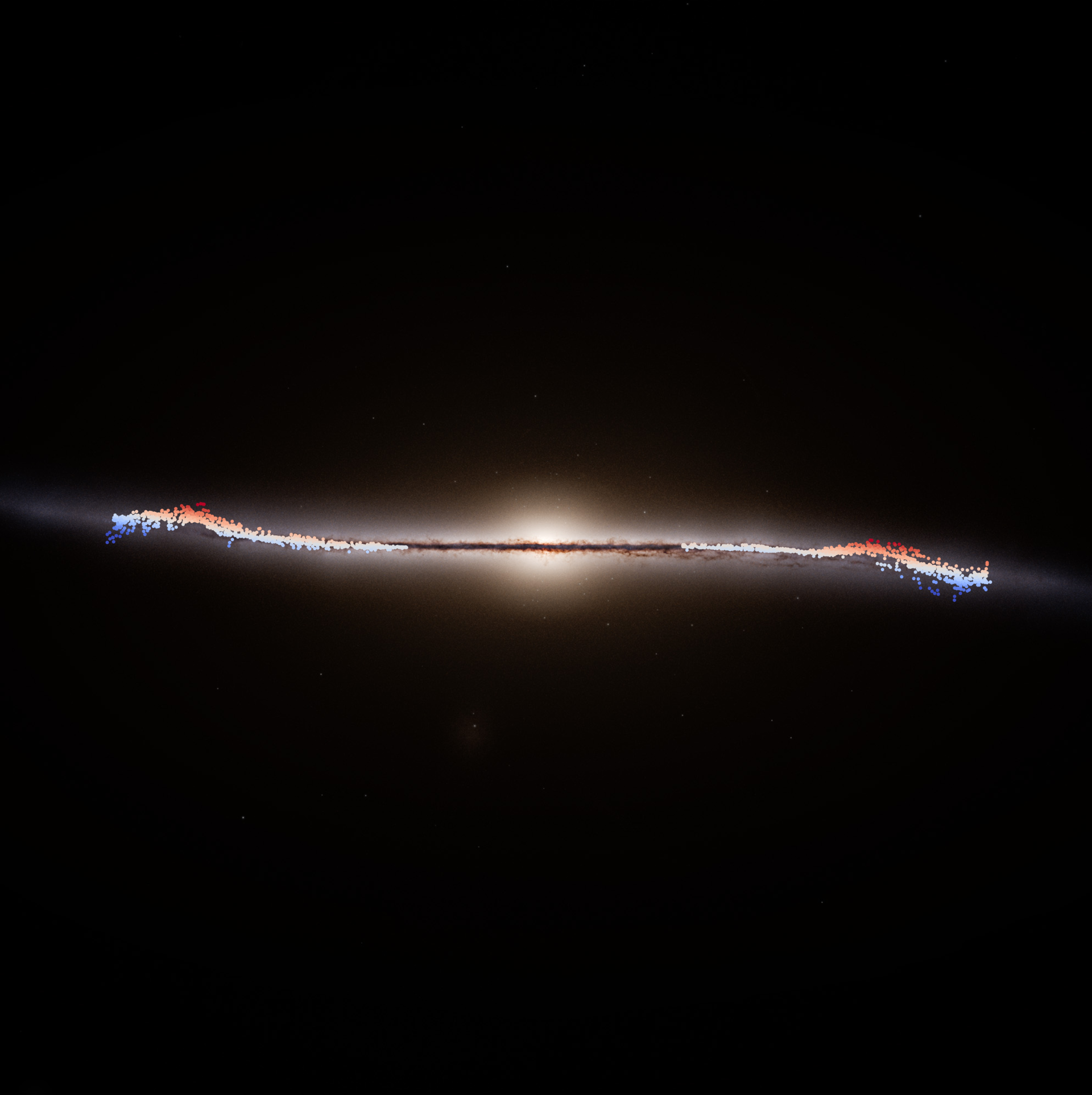
This fluctuation is shown in a visualization: the positions of thousands of stars, marked in red and blue, are overlaid on a map of the Gaia Milky Way. In the "top view," one side of the Milky Way's disk curves upward and the other side curves downward (a distortion of the disk), and the newly discovered fluctuations are highlighted by red areas (stars above the disk) and blue areas (stars below the disk). The Gaia space telescope can obtain the three-dimensional position and speed of stars with unparalleled accuracy, and draw such a "top-view" and "side-view" panoramic map for scientists. The data show that this fluctuation affects stars about 30,000 to 65,000 light-years away from the center of the Milky Way - while the Milky Way is about 100,000 light-years across.
This fluctuation was first discovered by a scientific research team led by astronomer Eloisa Poggio of the Italian National Institute of Astrophysics (INAF). Eloisa said that Gaia not only reveals the three-dimensional spatial distribution of fluctuations, but also captures the dynamic changes of stars in the fluctuation zone. "The most striking thing is that not only is this wave structure clearly visible in space, but the analysis of stellar motion also completely exhibits wave characteristics."
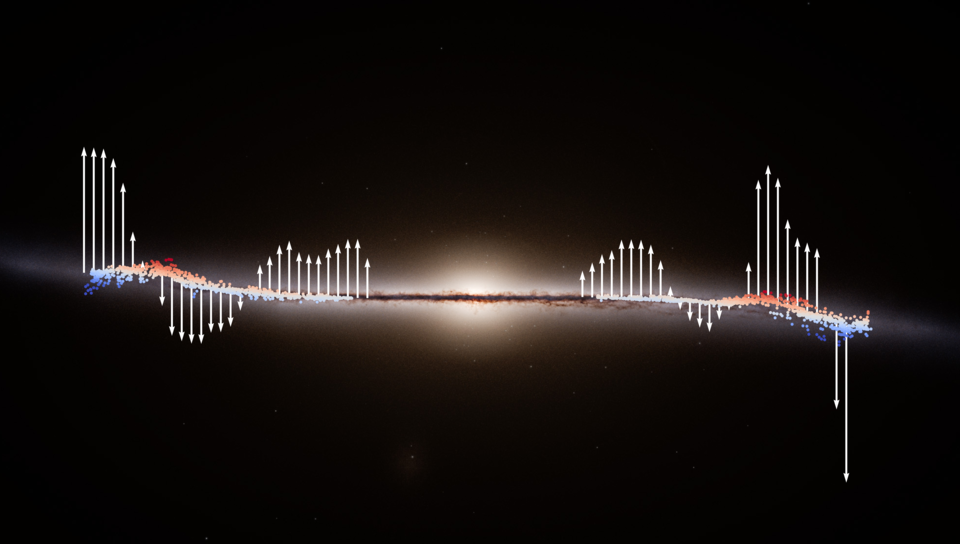
The scientific research team also analyzed the vertical motion of stars in the side view of the Milky Way and found that the fluctuations in vertical velocity are slightly shifted laterally, which is the characteristic of the fluctuations. Eloisa compared this phenomenon to the "human wave" performance in a stadium: the time scale of the Milky Way is extremely long, like a frozen human wave scene. Some areas of the star resemble a standing crowd (the red areas on the map), while areas showing the greatest upward motion resemble a crowd about to stand up to welcome the wave.
The researchers used Gaia's observations of young giant stars and Cepheids to reveal this movement. These stars periodically change in brightness and can be tracked by space telescopes over long distances. Because young stars and Cepheids move with the fluctuations, scientists believe that gas in the galactic disk may also participate in this large-scale fluctuation. Young stars may still retain a "memory" of fluctuations inherited from their birth gas.
As for the origin of this galactic fluctuation, scientists are not sure yet. Past collisions with dwarf galaxies may be one explanation, but further research is needed. It is worth noting that a smaller wave structure called "Radcliffe Wave" has been discovered near the Milky Way, which is about 500 light-years away from the sun and extends to 9,000 light-years. However, it is different from the location of the "big wave" discovered this time, and the connection has yet to be verified.
Gaia's fourth round of data release will bring more precise star position and motion information, especially variable stars such as Cepheid variables, provide scientists with a more complete map of the Milky Way, and promote our further exploration and understanding of the characteristics of our galactic home.