A latest smartphone market forecast shows that thanks to strong demand for the iPhone 17 series, Apple will almost dominate global shipment growth in 2025 and is heading towards the brightest year in the history of smartphones. However, concerns about tight supply of memory chips may quickly extinguish this craze in 2026.
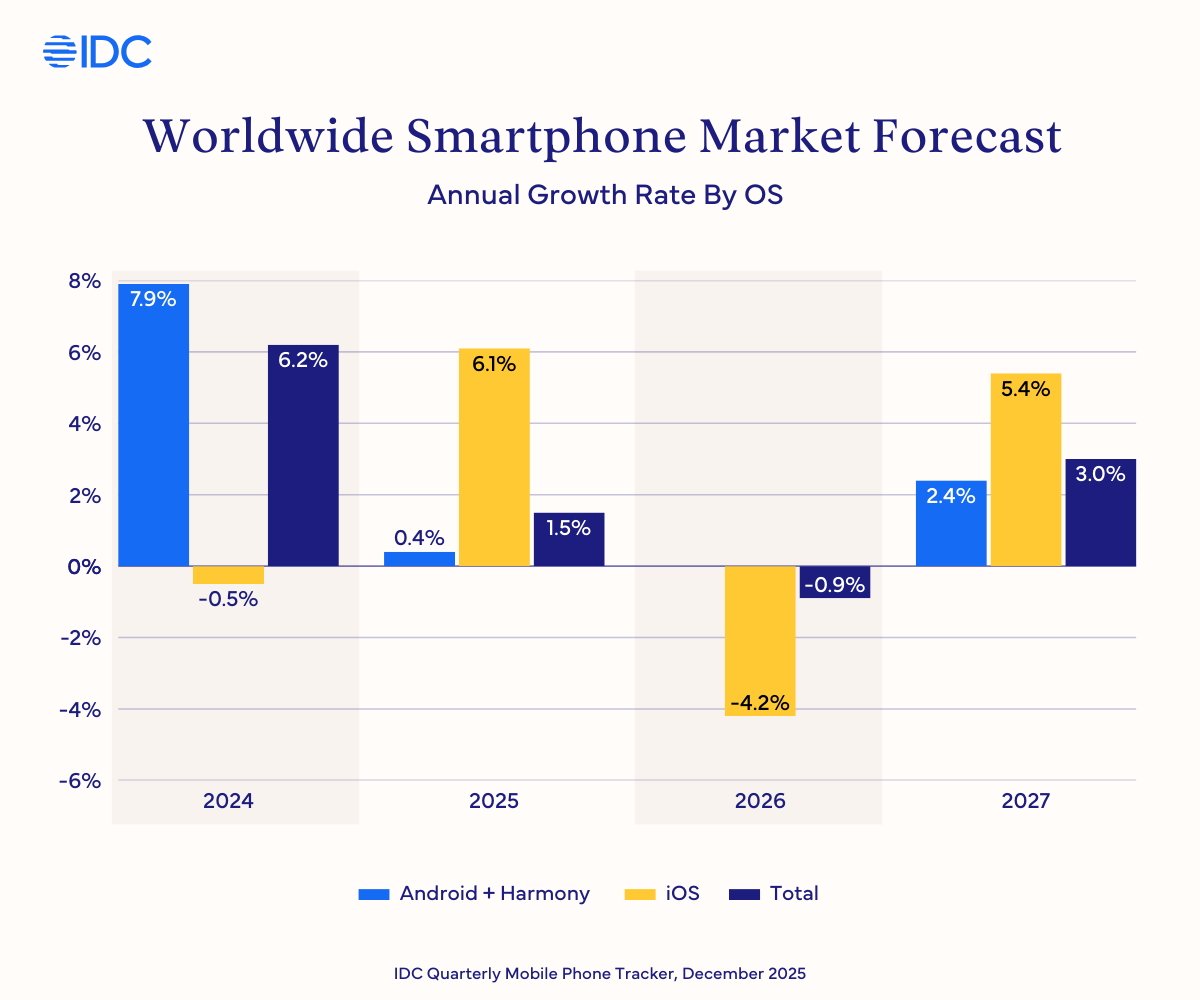
The report predicts that global smartphone shipments will reach 1.25 billion units in 2025, a year-on-year increase of 1.5%. Behind the optimistic expectations, it mainly comes from Apple’s strong performance during the holiday shopping season, the rebound of the Chinese market, and the rebound in demand in some emerging markets. According to IDC's calculations, Apple's shipments are expected to reach 247.4 million units in 2025, a year-on-year increase of 6.1%, the highest level in the company's smartphone business history.
The iPhone 17 series has become the core product of this growth cycle, leading sales in many regions, especially in the Chinese market. Apple's market share in October and November 2025 both exceeded 20%, which is far better than the previous pessimistic expectation of a "1% decline for the whole year" in the Chinese market. The updated data reflects that the Chinese market is expected to grow by about 3% this year, turning from "almost stagnant" to a key force enough to pull global shipments back to positive growth.
For operators, high-end flagship models are still the main products that attract users to sign multi-year contracts. The hot sales of iPhone 17 also make this model continue to work in North America and Western Europe. Against the background of stabilizing high-end demand, IDC predicts that Apple Intelligence mobile phone business revenue will exceed US$261 billion in 2025, a year-on-year increase of approximately 7.2%, showing the dual driving effect of "high price + high sales volume".
But optimism took a nosedive in 2026. IDC has lowered its global shipment forecast for 2026 from "modest growth" to a decline of 1%, meaning that terminal shipments will decrease again. The core reason for the turning point is the increasingly tight supply of storage and memory chips. Not only are these key components more difficult to purchase, but their prices are also rising, directly pushing up the cost of the entire machine.
In the Android camp, low-end and mid-range models will be the first to bear the pressure. These products are highly dependent on small profits but quick turnover, and fine-tuning costs may break the breakeven. The report predicts that the average selling price of smartphones will rise to around US$465 in 2026. Even if shipments decline, the overall market size may still increase to approximately US$579 billion, creating an abnormal situation of "selling less, but receiving more."
When the market evolves in this direction, consumers with limited budgets are often the first to be “lost”. In order to maintain the price band, some entry-level models may further reduce memory, storage or camera specifications, and component price increases will hardly improve this situation. Some manufacturers will directly raise their prices, while others will use marketing and product layout to guide consumers to higher prices and higher profit margins.
Apple’s strategic adjustments will also amplify the shock in 2026. IDC revealed that Apple plans to postpone the release of the next-generation basic iPhone from the fall of 2026 to early 2027. This change of pace is expected to cause iOS device shipments to fall by more than 4% in 2026. However, operators and channels may offset the impact to a certain extent through more active promotional activities, so the specific impact on each manufacturer is still different.
With high-end flagship models that already have higher profit margins, Apple is relatively easy to absorb the cost of more expensive memory. The gross profit buffer of high-priced iPhones makes it more capable of "absorbing" some supply chain price increases. In contrast, Android manufacturers that rely on "extreme cost-effectiveness" and radical hardware stacking to attract users will face a more difficult decision when deciding whether to cut configurations or increase prices.
The lengthening of consumer replacement cycles has released another layer of worries for manufacturers. Whether they are iPhone 16e users or those who have purchased mid-range Android models in the past two or three years, more and more people tend to wait three to four years to replace their phones. A longer holding period, on the one hand, weakens the "strong stimulation" of the new product cycle on the market, and on the other hand, it also gives users more time to wait and see and compare. Once the price rises too fast, giving up the replacement or delaying the purchase will become more common choices.
Still, IDC kept some positives in the report. The penetration rate of smartphones in emerging markets continues to increase, and the overall demand is still on the rise, providing a certain underpinning for global shipments. At the same time, some consumers who are more price-sensitive may choose to purchase an iPhone in advance at the end of 2025 to avoid potential price increases in 2026, thereby forwarding part of future demand into the iPhone 17 cycle.
Against this background, operators and channel vendors will have a relatively favorable bargaining and promotion environment in 2025. They can take advantage of the iPhone 17's hot-selling window period to lock in more long-term users, and then use contracts and packages to consolidate revenue. If IDC's predictions are fulfilled, the global smartphone market will "ride on Apple's coattails" to achieve moderate growth in 2025, while in 2026 it will usher in a new normal of high prices and low volumes, and the entire industry will have to find more profit margins in fewer shipments.